 MAKENEXA
Purchased scope
List every quoted part or assembly with part number, revision, quantity and whether finishing, hardware, assembly, testing, kitting or packaging is included.
Engineering design resource
A useful RFQ gives engineering enough information to compare a manufacturing route and return explicit assumptions. It does not need to answer every supplier question in advance, but it should define the purchased scope, controlled files, demand, material, critical requirements and required evidence.
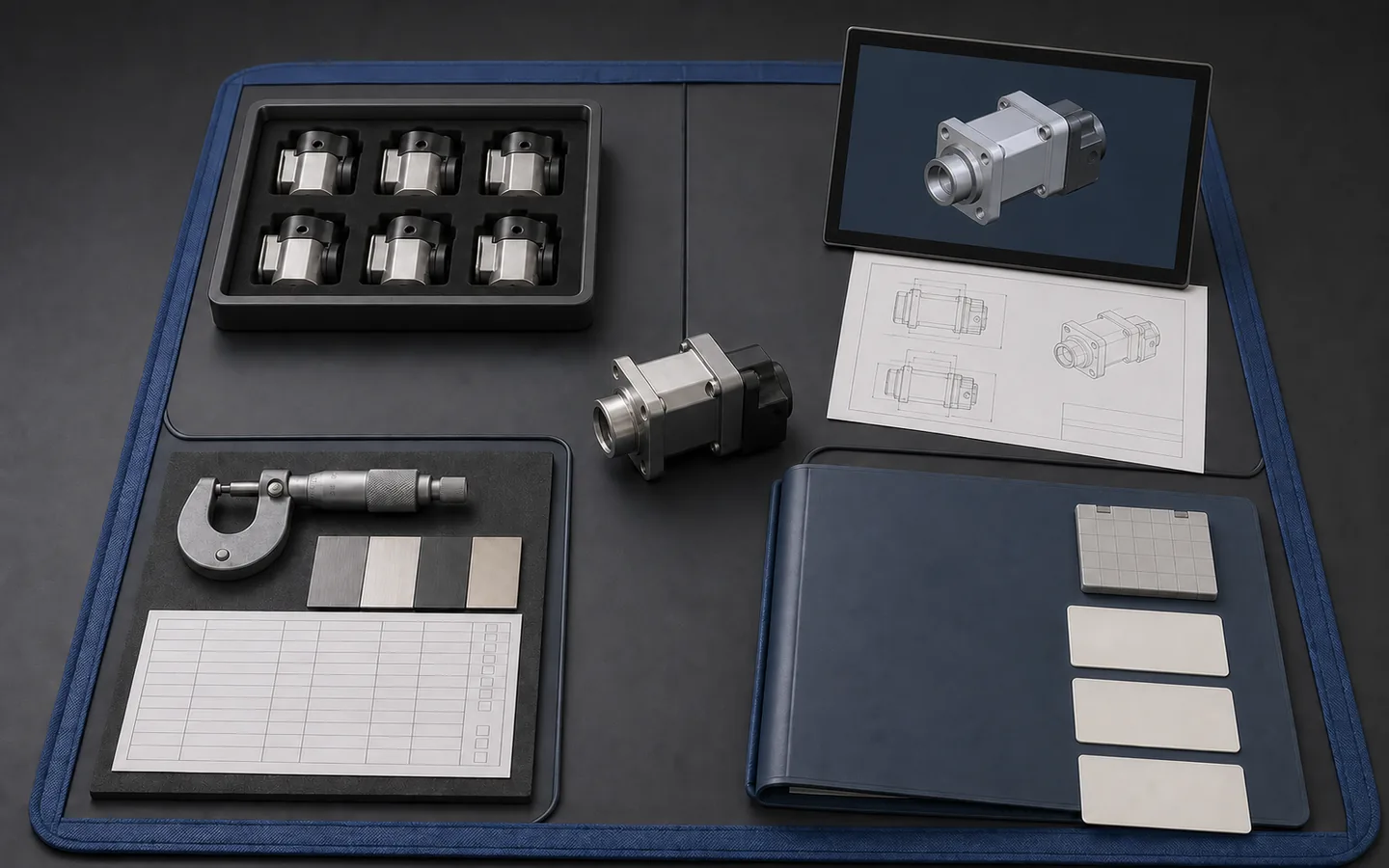
Use this guide
Two prices are not comparable if they assume different revisions, materials, quantities, finishing, inspection, packaging or delivery. Start the RFQ with one part list and one controlled file package. State what is fixed, where alternatives are permitted and which open questions need engineering input. A supplier can then separate included work, exclusions, assumptions and options rather than hiding them in a single number.
The checklist should also reflect the buyer's project stage. A concept prototype may prioritize learning and changed features, while a production-intent request needs demand cadence, approved revisions, material records, first-article or inspection scope, packaging and repeat-order control. MakeNexa uses these inputs for human review, supplier routing and quote preparation; the submitted form itself is not an instant price or manufacturing commitment.
Design priorities
Keep technical, quality, commercial and communication scope connected to the same part revision.
List every quoted part or assembly with part number, revision, quantity and whether finishing, hardware, assembly, testing, kitting or packaging is included.
Provide current models and drawings, material or performance requirements, critical features, finish, appearance zones and permitted alternatives.
Identify inspection, sampling, first-article, material documentation, traceability, test and record-delivery needs before supplier selection.
State quantity, credible repeats, target timing, delivery destination, packaging and the technical and commercial contacts who can answer clarification.
Common review gaps
A shorter request is not faster when each supplier must reconstruct a different scope.
One prototype, a first order of fifty and a recurring quantity of fifty can justify different setup, tooling, sourcing and inspection decisions.
A broad family name can hide condition, product form and evidence differences. Specify the grade when required or state the controlling needs and allowed substitutions.
Define finish location, masking, cosmetic priority and whether critical dimensions apply before or after coating, heat treatment or another secondary operation.
Terms such as inspection, certification or traceability are incomplete until the RFQ states characteristics, sample or lot scope, document type and acceptance responsibility.
Practical choices
A good RFQ can invite route options while preserving the function the buyer must approve.
Use this for a qualified material, controlled interface, mandated record or other condition that cannot change without buyer approval.
Allow an alternate process, material, stock form, finish or inspection method when the quote identifies the change and explains its effect.
Request distinct prototype, repeat-quantity, finish or quality options when combining them would make price, timing or assumptions difficult to compare.
Design decision table
Typical published practice for a complete manufacturing RFQ. Which inputs a specific project needs is a buyer decision, and the review outcome is confirmed on the quote rather than from this table.
| RFQ area | Minimum useful input | What the reviewed quote should clarify |
|---|---|---|
| Geometry | A solid model at a stated revision as controlling geometry | Whether the geometry is manufacturable as drawn |
| Acceptance | A drawing carrying tolerances, datums, material, finish and edge condition | Which requirements drive cost and which are free |
| Tolerances | A ±0.125 mm block value with ±0.025 mm on named features only | Whether the tight features are achievable and measurable |
| Material | Grade and condition in full — 6061-T651 rather than aluminium, 4140 with its heat-treated condition | Availability, product form and lead time for that grade |
| Material evidence | Which specification a certificate must reference, such as ASTM B221 or ASTM A276 | Availability, format and scope of the record |
| Quantity | The firm quantity and, separately, any forecast | How the price changes with quantity, since at 1 to 10 parts setup dominates |
| Surface finish | A value such as Ra 1.6 µm on the surfaces that need it | Whether a secondary operation is implied |
| Coating and plating | Specification, class and thickness — anodize at 5 to 25 µm, powder at 50 to 100 µm per surface | Which features are masked, and whether dimensions apply before or after |
| Edge condition | A stated break such as 0.1 to 0.3 mm on named edges, with the sharp edges excluded | Whether an unreachable burr needs a dedicated operation |
| Inspection | Which characteristics need reporting, on how many parts, by what method | Whether the tolerance is measurable with the intended equipment |
| Hardware and assembly | Part numbers, whether equivalents are acceptable, and the installation sequence | Whether the gauge or resin supports the hardware |
| Open items | What is still undecided, stated as open rather than omitted | Which assumptions the quote is based on |
Turn the guide into an RFQ
Attach the answers or place them in the RFQ fields that carry the same meaning.
Complete packages move faster: revision-matched CAD, critical dimensions, quantity and material notes are enough to open engineering review across the network.
Get a QuotePart numbers, revisions, quantities and a clear make, buy, assemble, finish and packaging boundary
Current CAD, drawings, BOM and reference files with model-versus-drawing authority stated
Material grade, condition, permitted alternatives, finish and final-dimensional condition
Critical interfaces, datums, tolerances, threads, appearance zones and functional tests
Inspection, sampling, first article, material documents, traceability and record-delivery requirements
Project stage, expected repeats, required destination/timing and technical/commercial clarification contacts
Questions before routing
These answers prepare the request; the reviewed quote controls project-specific commitments.
No — route selection is part of the review. What helps far more is stating what the part must do: the load case and direction, service temperature, chemical exposure, the few critical dimensions with tolerances, quantity and finish requirements. A part with 1.0 mm to 3.0 mm uniform walls implies moulding, one with varying section implies machining, one with constant thickness and folds implies sheet — but the requirements should lead, not the geometry alone.
It is useful context if it is genuine, because it signals which trade-offs are worth exploring — whether a substitute grade is acceptable, whether a ±0.025 mm callout can relax to ±0.125 mm, whether a finish is required. It does not change what the part costs to make. State it as context alongside the requirements rather than as a constraint on the review.
State them as open rather than omitting them. An RFQ with a stated open item — final finish undecided, quantity between two figures, material substitution possibly acceptable — gets reviewed against clear assumptions. An RFQ with the item silently missing gets quoted against the supplier's default, which may be far from your intent and only surfaces later. Open items are normal; unstated ones are the problem.
No. Submitting an RFQ starts a review: the inputs are checked, missing requirements are identified, a feasible route is confirmed and a prepared quote is returned with its assumptions stated. Supplier fit, material, dimensions, tolerance, quantity, price, lead time, inspection, documentation and compliance are all confirmed at that point rather than implied by the submission.
Material condition and the finishing sequence, roughly equally. A grade without a temper — 6061 rather than 6061-T651, or 4140 without its heat-treated condition — leaves a spread that on 4140 runs from about 415 MPa to 1520 MPa in yield. And a finish without a statement of whether dimensions apply before or after leaves every critical fit ambiguous, since anodize adds 5 to 25 µm and powder 50 to 100 µm per surface.
Next step
Apply the guide to a real drawing and RFQ package. MakeNexa routes capable suppliers from a global network covering competitor-class process categories, then returns a prepared quote or focused clarification for your revision.