 MAKENEXA
Powder-bed additive parts
SLS, MJF or another reviewed powder-bed route may support complex ducts, clips, housings and consolidated geometry. Define orientation, powder removal, surface, color, post-process and evidence for the exact supplier route.
Material selection decision
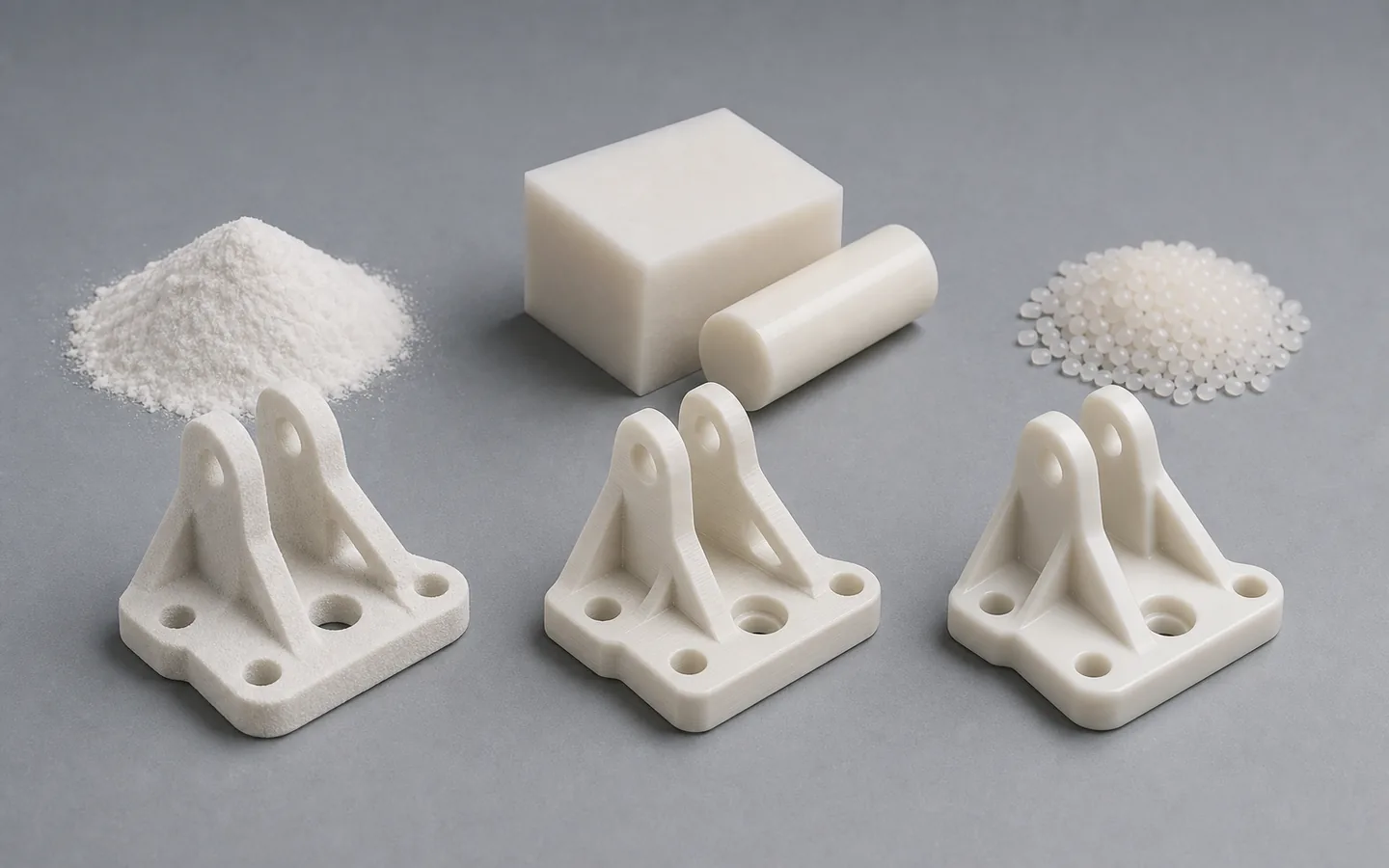
Nylon 12 can appear as additive powder, machined stock or molding resin, but those forms and processes do not create equivalent parts. Grade, additives, moisture conditioning, orientation, surface, color and quantity affect the result. MakeNexa reviews the exact requirement and supplier route; properties, dimensions, appearance and evidence remain project-specific.
Selection criteria
Define environment, load, impact, wear, temperature, moisture, chemicals, electrical needs, appearance, assembly and expected quantities. State the exact grade, color and additive package when fixed, or provide controlling restrictions for a reviewed selection. A printed prototype should not be treated as proof of molded properties, and stock-machined material should not be assumed to match additive orientation or porosity.
For additive routes, define orientation-sensitive features, wall and escape geometry, surface, color, post-processing and dimensional state. For machining, control stock grade, support, heat, burrs and moisture conditioning. For molding, control resin, tooling, draft, shrink, gates, appearance and sample acceptance. Document route-created differences across prototype and repeat releases.
Where the material fits
The material family becomes useful only after its process-created condition is included in the design decision.
SLS, MJF or another reviewed powder-bed route may support complex ducts, clips, housings and consolidated geometry. Define orientation, powder removal, surface, color, post-process and evidence for the exact supplier route.
Rod, plate or tube may support bushings, guides and low-quantity components when stock grade, moisture, workholding, thermal movement, burrs and final conditioning are controlled.
Molding may fit production-intent geometry and repeat quantities when exact resin, additives, draft, walls, ribs, shrink, gates, ejectors, texture and sample approval are planned together.
Clips, sliding surfaces, fastener bosses and mating fits require actual load, movement, temperature, humidity and assembly context. Validate the complete joint rather than the material name alone.
Material tradeoffs
Nylon parts can look similar while differing in conditioning, orientation, surface and dimensional behavior.
Unfilled, filled, flame-modified, colored and process-specific grades can behave differently. State exact material and records where function or compliance depends on them.
Conditioning and service humidity can influence dimensions and behavior. Define measurement condition, preconditioning, packaging and assembly state for sensitive features.
Build orientation, layer or voxel history, thermal profile and post-processing can affect behavior. State critical directions and validate the actual supplier route for functional parts.
Texture, porosity, dye, smoothing, machining and molding can create different surfaces. Define cosmetic and functional zones, cleaning, roughness or reference conditions as needed.
Grade and route choices
The selected route should answer current design decisions while preserving a clear transition to repeat supply.
Use for complex, low-tooling geometry where orientation, surface, powder removal and post-processing are acceptable. Confirm exact grade and evidence with the supplier route.
Use stock material for accessible geometry and small quantities when support, heat, moisture and burr control fit. Record differences from any later molded or printed part.
Use tooling when production-intent resin, appearance and repeat quantities justify it. Quote resin, tool, sampling, secondary operations and finished parts as one controlled program.
Material comparison
Typical published values for PA12 in the routes named. Printed and machined PA12 do not share a datasheet, and actual values vary with grade, powder refresh ratio and build orientation, so the project requirement is confirmed on the reviewed quote rather than from this table.
| Property or decision factor | Typical published value | Routing consequence |
|---|---|---|
| Water absorption | About 0.25% in 24 h and roughly 1.5% at saturation, against 1.5% in 24 h and 8% for PA66 | The reason to choose PA12 over PA66 when fits matter |
| Tensile strength, machined stock | About 50 MPa | Below PA66 at 82 MPa dry — stability is bought with strength |
| Tensile strength, SLS or MJF | About 48 MPa with roughly 15% elongation | Close to machined stock, but directional and slightly porous |
| Tensile modulus | About 1.4 GPa unfilled | Noticeably less stiff than PA66 at 2.8 to 3.3 GPa |
| Density | About 1.01 g/cm³, close to that of water | The lightest of the common engineering nylons |
| Melting point | About 178 °C, against 260 °C for PA66 | Lower service ceiling; state the actual service temperature |
| Printed accuracy | Commonly quoted as ±0.3 mm or ±0.3% of nominal, whichever is larger, for SLS and MJF | Machined stock holds tighter, at about ±0.1 mm |
| Printed surface | Ra 8 to 15 µm as built with a uniform matte grain | Media finishing, dyeing or vapour smoothing are separate operations |
| Porosity | Powder-bed parts are slightly porous, which raises effective moisture uptake and can leak under pressure | State any sealing or pressure requirement — it changes the route |
| Chemical resistance | Good against oils, fuels and many solvents, which is why PA12 is used for fluid lines | State the fluid, concentration, temperature and duration |
| Injection moulded PA12 | Denser and more consistent than powder-bed parts, with tooling cost and lead time attached | The production route once quantity justifies the tool |
| Machined tolerance | ±0.1 mm is realistic on extruded stock, and unlike PA66 it is not undermined by moisture movement | The practical advantage of PA12 over PA66 on a fitted part |
Material RFQ inputs
Define material and process state so similar-looking parts are not treated as equivalent.
Complete packages move faster: revision-matched CAD, critical dimensions, quantity and material notes are enough to open engineering review across the network.
Get a QuoteSubmit the controlled model, drawing, revision and service environment
State the Nylon 12 grade, additives, color, feedstock or stock form and alternatives
Define load, wear, impact, temperature, moisture, chemical and assembly needs
Mark orientation-sensitive, thin, snap, fit, thread, surface and powder-removal features
Specify conditioning, post-process, appearance, cleaning, inspection and packaging
List prototype and repeat quantities, tooling, tests, sampling and material records
Questions before routing
These answers prepare the request; the reviewed quote controls project-specific commitments.
No — same polymer, three different materials in practice. Powder-bed parts from SLS and MJF publish around 48 MPa tensile with roughly 15% elongation and are slightly porous with directional properties; machined extruded stock gives about 50 MPa with consistent properties in every direction; injection moulded PA12 is denser and more consistent again but carries tooling cost and lead time. State the process alongside the material — the datasheets do not transfer.
Far less than the other common nylons, which is its main advantage. PA12 takes up about 0.25% in 24 h and roughly 1.5% at saturation, against 1.5% and 8% for PA66. That means a machined PA12 part holds its size where a PA66 one grows 0.5 to 0.8% reaching equilibrium. Powder-bed printed PA12 is a partial exception: its porosity raises effective uptake, so a printed part behaves less well than machined stock.
Yes, from extruded rod and plate, holding about ±0.1 mm on typical features. It cuts easily but is gummy, so sharp tooling and good chip evacuation matter. The practical advantage over PA66 is that the tolerance actually holds — PA66's 0.5 to 0.8% moisture-driven growth defeats tight fits regardless of how well the part was machined. The trade is strength: about 50 MPa against 82 MPa dry for PA66.
Potentially, and it is used in production for fluid lines, housings and functional covers. What decides it is the route and the requirement: powder-bed parts are slightly porous and can leak under pressure, printed accuracy is commonly ±0.3 mm or ±0.3%, and lot consistency depends on powder refresh ratio and nesting position. State quantity, tolerance, sealing and documentation requirements so the route — printed, machined or moulded — can be reviewed against them.
Next step
Send the material requirement with geometry and use context. MakeNexa routes capable suppliers from a global network covering competitor-class process categories, then returns a prepared quote or focused clarification for your revision.