 MAKENEXA
Appearance and presentation models
Smooth surfaces, fine text and controlled cosmetic treatment can support design reviews and stakeholder presentations.
Manufacturing service decision
Source stereolithography for presentation models, fit-check prototypes, patterns, fixtures and detailed resin components. MakeNexa reviews resin behavior, geometry, support contact, post-cure, surface, color, dimensional priorities and service conditions before confirming an SLA supplier route.
Route decision
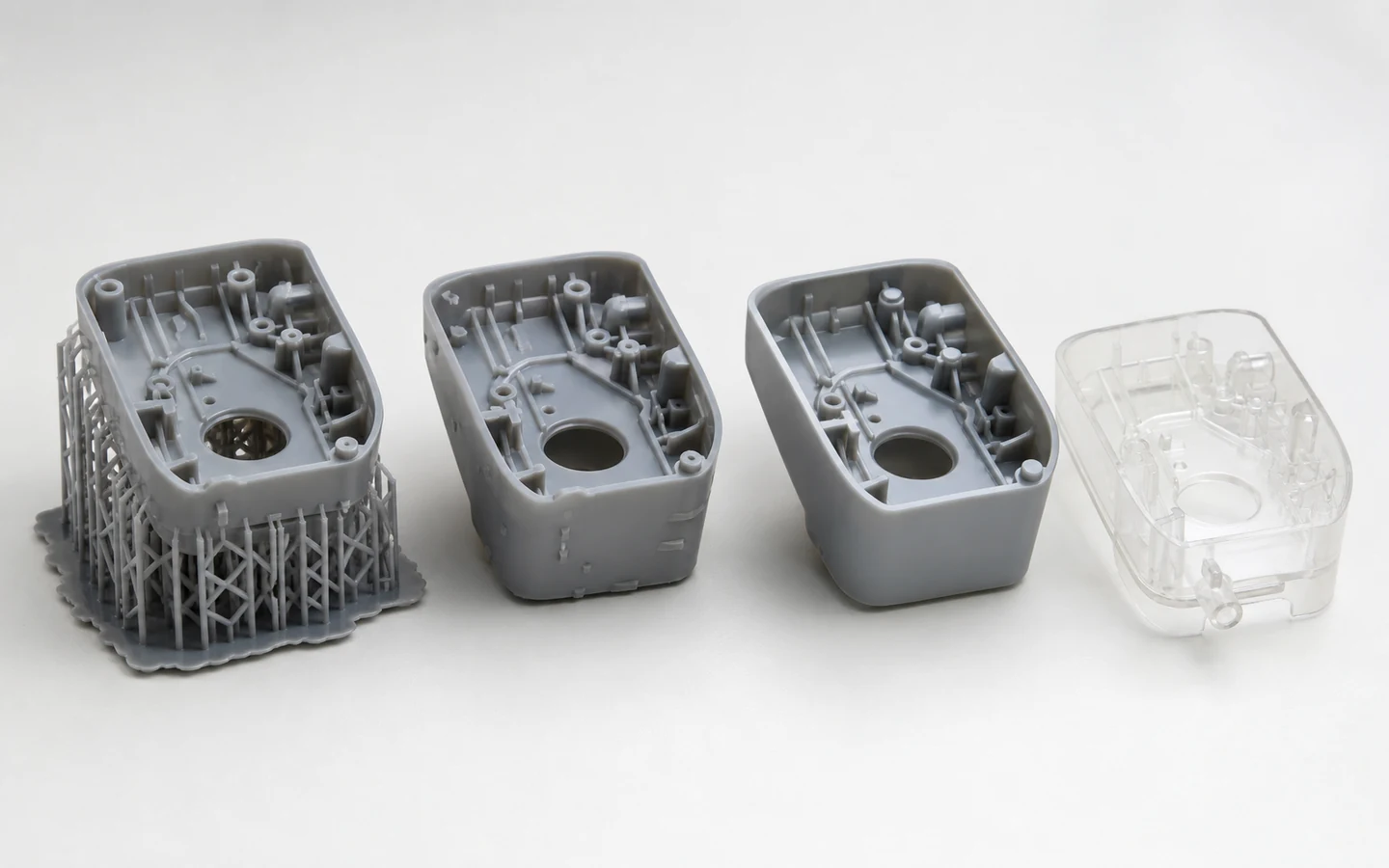
SLA can reproduce fine features and smooth surfaces that make it useful for appearance models, master patterns and detailed prototypes. The word resin, however, covers very different behaviors. A visually convincing SLA part may not match an injection-molded thermoplastic in impact, heat, UV aging, creep, moisture response or long-term dimensional stability, so the end use must be communicated before material selection.
Support location, build orientation, drainage, hollow geometry, wall transitions and post-cure can influence appearance and measurement. MakeNexa reviews whether SLA is appropriate or whether SLS, MJF, FDM, CNC machining, urethane casting or molding better serves the requirement. Exact resin, machine, orientation, finish, tolerance, supplier, price and lead time are established during RFQ review rather than promised by this page.
Best-fit parts and programs
The route is strongest when visible detail and model purpose are more important than generic process labels.
Smooth surfaces, fine text and controlled cosmetic treatment can support design reviews and stakeholder presentations.
Detailed housings, connectors and interfaces can reveal geometric conflicts before a production process is selected.
High-detail resin parts may support casting, molding or finishing workflows when shrink and downstream process needs are reviewed.
Clear, heat-oriented, flexible or other resin families may be considered when their documented behavior matches the application.
Feasibility checks
A fine surface does not establish mechanical durability or long-term material suitability.
Support marks and orientation can affect cosmetic zones, edges, holes and surfaces used for fit or measurement.
Enclosed liquid resin must be avoided; drain access, wall thickness and cleaning strategy need explicit review.
Cure state, light, heat and time can affect color, brittleness and dimensions depending on the selected resin.
Transparent or presentation-grade results may require sanding, coating or painting with separately defined acceptance criteria.
Route options
Select the route from the model's purpose, expected handling and required material evidence.
Compared for larger, faster or more mechanically representative thermoplastic prototypes when visible layers are acceptable.
Compared for support-free powder-bed geometry, functional polymer behavior and batch production needs.
Considered when stock material properties, a polished clear surface or repeated resin copies justify a different route.
Decision comparison
Typical published values for stereolithography. Achievable accuracy, detail and material behaviour depend on the resin, machine and post-cure, and the project requirement is confirmed on the reviewed quote rather than from this table.
| Decision area | Typical published value | Review focus |
|---|---|---|
| Layer thickness | 0.05 mm is the usual production setting; 0.025 mm for fine detail and 0.1 mm for draft geometry | Which surfaces need the finer layer |
| Dimensional accuracy | Commonly quoted as ±0.1 mm or ±0.1% of the nominal length, whichever is larger — the tightest of the common polymer additive routes | Critical fits, stated so they can be oriented deliberately |
| Minimum feature size | About 0.3 mm for a positive feature; text and embossed detail below that fills in | Whether fine detail survives the resin and the post-cure |
| Minimum wall | About 0.5 mm self-supporting; 1.0 mm and above where the wall carries any load | Thin SLA walls are brittle rather than flexible |
| As-built surface | Ra 1 to 5 µm on upward faces — smoother than any powder-bed route | The reason SLA is chosen for appearance models and masters |
| Support marks | Every downward-facing surface carries support witness that has to be sanded or accepted | Which faces are cosmetic, so orientation can protect them |
| Heat resistance | Standard resins publish heat-deflection figures near 50 °C, with high-temperature grades reaching 80 °C and above | Well below moulded thermoplastics — ABS is about 98 °C at 0.45 MPa |
| Mechanical behaviour | Standard resins are strong but brittle; tough and durable grades trade stiffness for elongation without matching a moulded thermoplastic | Whether the part is a form model or a functional test piece |
| Creep under load | SLA resins creep under sustained stress at room temperature; a clipped or clamped feature relaxes | Not a material for a loaded snap fit or a long-term assembly |
| UV stability | Resins continue to cure and yellow in daylight; clear parts discolour measurably over months | Whether the part is stored, displayed or used outdoors |
| Clear parts | Printed clear resin is translucent, not optical; a sanded and clear-coated finish is a separate operation | The clarity requirement and its acceptance basis |
| Post-cure | A specified UV and thermal post-cure is what develops final properties; an uncured part is softer and dimensionally unstable | Whether post-cure is part of the quoted scope |
Quote inputs
Define the prototype's job before choosing a resin by marketing name.
Complete packages move faster: revision-matched CAD, critical dimensions, quantity and material notes are enough to open engineering review across the network.
Get a QuoteWatertight 3D model and drawing for critical or cosmetic requirements
Prototype purpose and expected handling or service environment
Resin behavior, color, transparency and permitted alternatives
Critical interfaces, drain needs, threads and protected surfaces
Support-mark, sanding, coating, paint and appearance criteria
Quantity, inspection, packaging, labeling and delivery expectations
Questions before routing
These answers prepare the request; the reviewed quote controls project-specific commitments.
For fit, form and appearance, yes and better than any other additive route — accuracy is commonly ±0.1 mm or ±0.1% with Ra 1 to 5 µm surfaces. For load-bearing function, usually not. Standard resins are brittle, publish heat-deflection figures near 50 °C against about 98 °C for ABS, creep under sustained load at room temperature, and continue curing in daylight. If the test is structural or thermal, SLS, MJF or a machined part represents production far better.
It produces translucent parts, not optical ones. Clear resin comes off the machine hazy from layer lines and surface texture, and reaching genuine transparency requires sanding through progressive grits and a clear coat or lacquer — a separate, manual, cost-bearing operation. Clear resins also yellow measurably in daylight over months. State the clarity requirement, the acceptance basis and whether the part will be stored in light.
Yes, on every downward-facing surface — supports touch the part and leave witness that has to be sanded or accepted. Upward faces come off at Ra 1 to 5 µm and look excellent; downward faces do not. Orientation is the main lever, so mark which faces are cosmetic and which can carry support marks, and state whether sanding to a stated finish is in scope.
Commonly quoted at ±0.1 mm or ±0.1% of the nominal length, whichever is larger, on well-supported features — the tightest of the polymer additive routes, with 0.05 mm layers as standard and 0.025 mm available for fine detail. What moves it on a specific part: tall thin geometry, large flat spans and heavily supported down-faces all drift further, and the post-cure itself shifts the part slightly. Name the few dimensions that are critical so orientation and inspection can be planned around them, and the achievable result for your geometry is confirmed on the reviewed quote.
Less well than most people assume. The resins continue to cure in daylight, becoming more brittle and yellowing over months, and they creep under sustained load at room temperature — a clamped or clipped feature relaxes over weeks. Heat-deflection figures near 50 °C for standard resins mean a car interior or a sunlit window ledge is enough to soften a part. SLA suits models, masters and short-term functional checks rather than long-lived parts.
Next step
Send geometry and process requirements for review. MakeNexa routes capable suppliers from a global network covering competitor-class process categories, then returns a prepared quote or focused clarification for your revision.