 MAKENEXA
Prototype tooling
Early molded-material learning and lower initial quantities.
Review what must represent production intent and which shortcuts are acceptable.Injection molding
Send the part model, resin target, volume forecast and cosmetic zones. MakeNexa reviews DFM and tooling assumptions, then matches prototype, bridge or production routes across the supplier network. Tool price and lead time stay on the reviewed quote.
Start this RFQ Review the route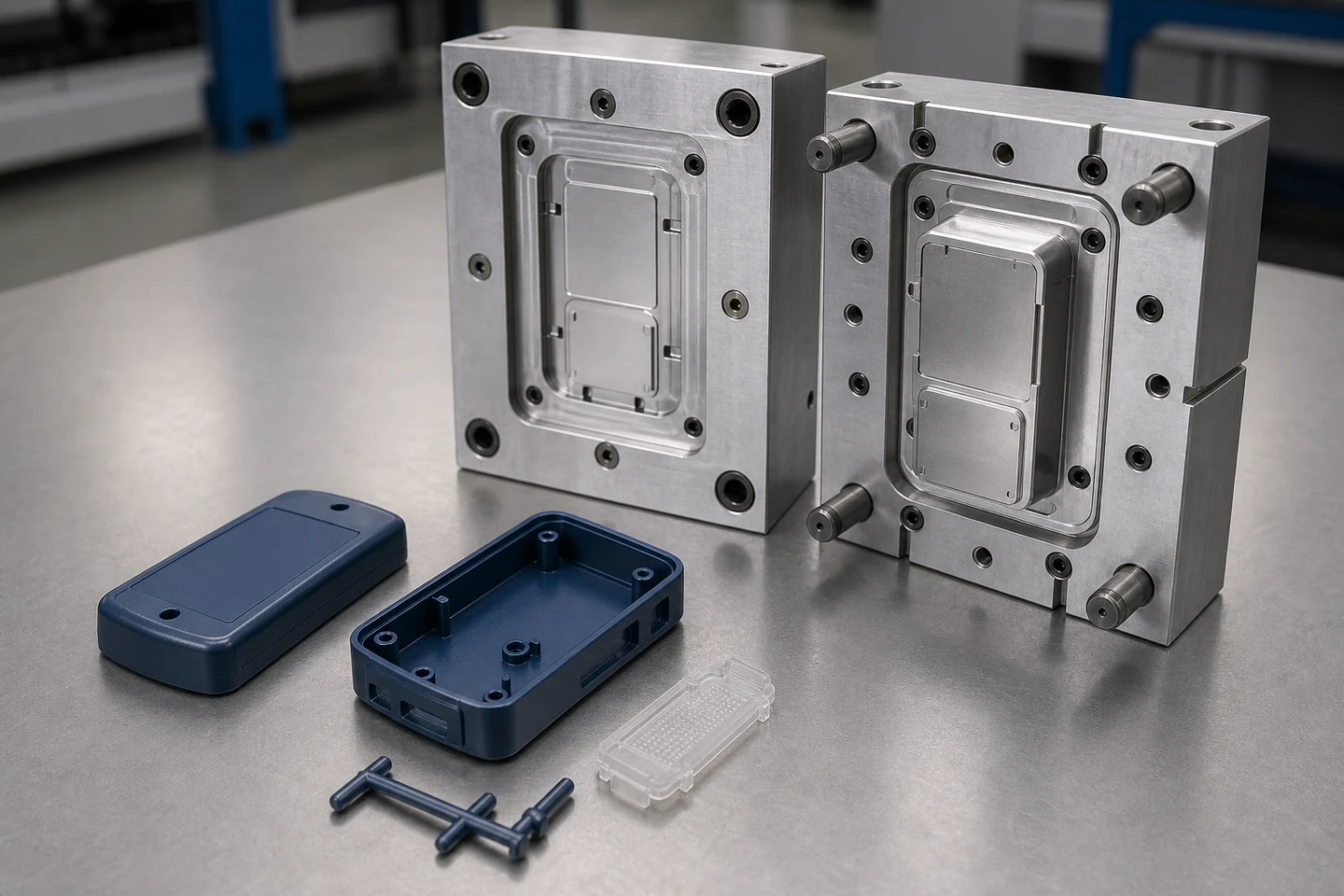
Decision guide
A molding RFQ should distinguish part requirements from tooling preferences. Wall thickness, draft, undercuts, ribs, bosses, knit-line risk, gate and ejector constraints affect the tool concept, while resin grade, color, texture and cosmetic zones affect processing and acceptance.
Volume and program stage guide tool material, cavity strategy, sampling and maintenance expectations. MakeNexa does not promise a tool price or lead time before review; the submitted package is used to confirm a practical supplier, tooling and qualification route.
Route options
The appropriate route is based on required part behavior and program economics rather than one fixed tool category.
Early molded-material learning and lower initial quantities.
Review what must represent production intent and which shortcuts are acceptable.Parts needed while a longer-life tool or supply route is being prepared.
Review expected quantity, change risk, tool life and transfer expectations.Repeat demand with controlled resin, process and quality requirements.
Review cavity strategy, validation, maintenance, spare components and documentation.Parts combining molded material with inserts or another substrate.
Review insert control, placement, bonding, heat exposure, pull-out and inspection.Decision table
Use the RFQ to identify constraints and acceptable choices.
| Topic | What to provide | Why it matters |
|---|---|---|
| Wall thickness | 1.0 to 3.0 mm nominal held within about 25% variation; 2.0 mm is the usual housing starting point | Cooling scales with the square of the thickest section, so wall drives cycle cost for the tool's life |
| Draft and ribs | 1° to 2° minimum draft on unfilled resins, 3° to 5° on textured faces; ribs at 50 to 60% of the adjoining wall | Zero draft drags on ejection; thick ribs sink on the opposite face |
| Material and shrink | Resin grade, filler, colour and compliance needs. Shrink runs about 0.5% for ABS, 0.6% for polycarbonate, 1.5% for nylon and 2.5% for acetal | The tool is cut for one resin — a resin change is a tool change |
| Achievable tolerance | Commonly ±0.1 mm on small features in a stable resin, with ±0.05 mm reachable under added process control | Widens with wall thickness, shrink and part size |
| Appearance | Texture reference, gloss, colour tolerance and permitted gate and ejector positions. A polished cavity gives part surfaces near Ra 0.4 µm | Every part carries a gate vestige and ejector witness somewhere |
| Demand and tooling | Aluminium tooling at 1,000 to 10,000 shots and 2 to 4 weeks lead; P20 at about 30 HRC for several hundred thousand; H13 at 48 to 52 HRC beyond a million | Guides tool construction, cavity count and maintenance plan |
| Qualification | Samples, dimensional report on named characteristics, capability commonly targeted at a Cpk of 1.33, material records and test needs | Defines what must be completed before production release |
| Processing controls | Melt commonly 250 °C for ABS and up to 320 °C for polycarbonate; polycarbonate, nylon and PEEK must be dried before moulding | A wet resin loses strength permanently and shows splay |
Preparation
These items commonly create quote loops when they are missing.
Frequently asked questions
Use the submitted quote and written clarification as the project-specific record.
Yes. State the part requirements, quantities, program stage and desired tool-life assumptions. The supplier route and tooling approach are reviewed together.
Provide the first order, likely annual demand and any lifetime estimate you actually have. Label uncertain forecasts as estimates so they are not treated as firm demand.
Name the exact grade when it is functionally or commercially controlled. Otherwise describe performance and environmental needs and list whether alternatives may be considered.
State the samples, dimensional records, material documents and functional checks you require. The quote should then identify the agreed qualification and release path.
Ready for review
You will receive a stable RFQ reference. MakeNexa will assess the package, request clarification when needed and return a reviewed quote or clear next action.