 MAKENEXA
Known stainless grade and condition
Provide exact alloy, product form, heat-treatment or cold-work condition and any material record requirement. A family label alone is insufficient when method compatibility, environment or regulated use matters.
Manufacturing service decision
Passivation is one step in a stainless-part route that begins with known material and controlled processing. Machining, heat treatment, welding, blasting, handling and cleaning can change contamination risk and the required preparation. MakeNexa reviews the alloy, final condition, governing requirement and evidence before coordinating a supplier route; corrosion outcome and compliance are not inferred from the word passivate.
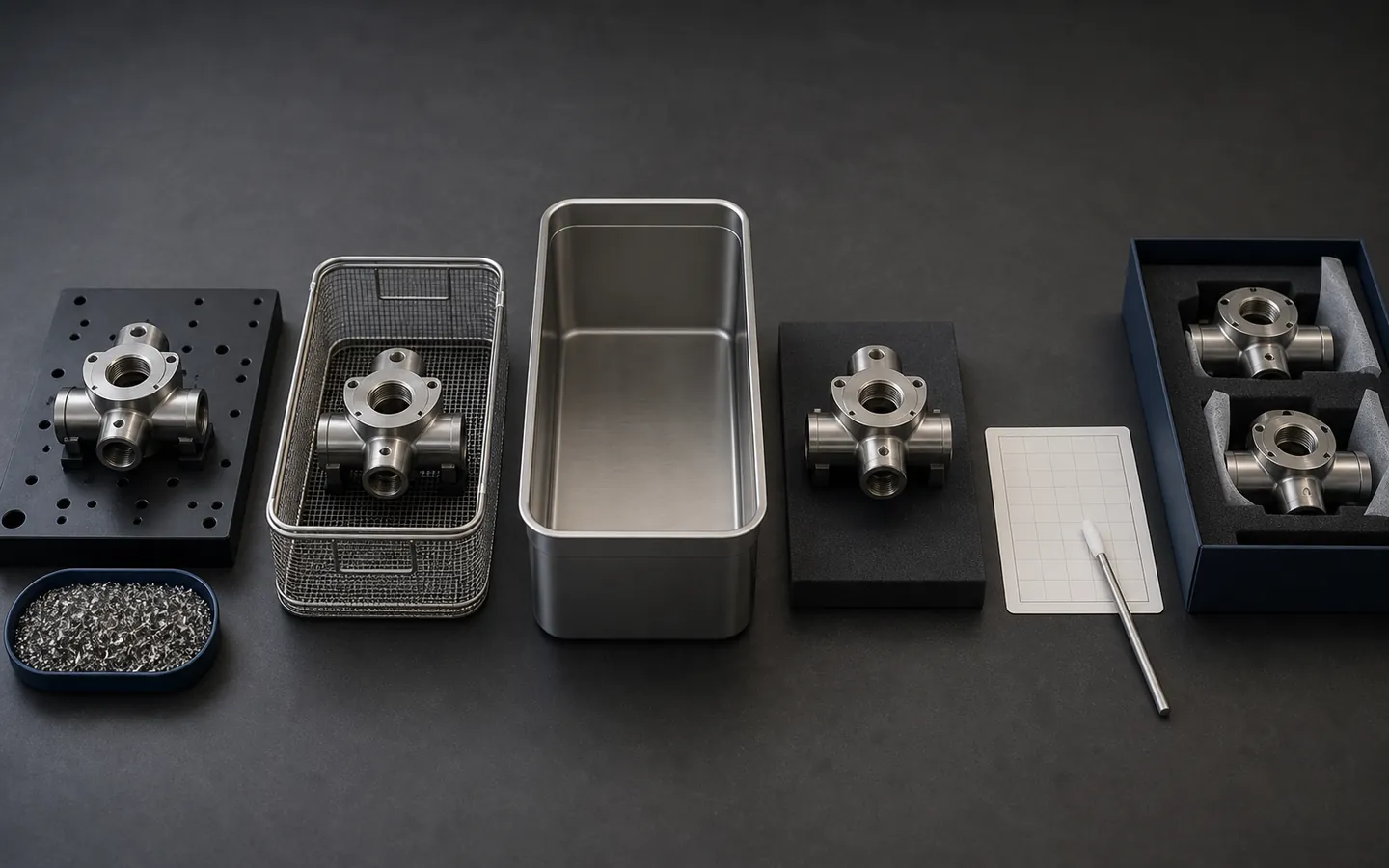
Route decision
Start with the exact stainless grade, condition and manufacturing history. Identify free-iron or cross-contamination risks from cutting tools, fixtures, blasting media, shop handling and prior processes. Remove scale, oil, debris and incompatible residue using an appropriate controlled preparation; passivation should not be treated as a substitute for correcting embedded contamination, heat tint, severe scale, wrong material or a damaged surface condition.
State the governing customer, drawing or industry requirement and identify any allowed method selection, pretreatment, test, report or lot linkage. Citric and nitric routes are not interchangeable labels detached from grade, specification and supplier controls. Define masking, appearance limits, cleanliness, drying, handling and packaging after processing. MakeNexa coordinates a quote-specific route and evidence scope but does not promise a universal method, corrosion result or certification.
Best-fit parts and programs
The service fits when alloy, prior process, cleaning, requirement and final evidence can be traced through the RFQ.
Provide exact alloy, product form, heat-treatment or cold-work condition and any material record requirement. A family label alone is insufficient when method compatibility, environment or regulated use matters.
Describe welding, cutting, grinding, blasting, heat tint, embedded material and shared-tool risks. Identify carbon-steel contact or unusual shop exposure that may need correction before chemical processing.
Define oil, chips, compound, scale, discoloration and cleanliness concerns. The proposed route should distinguish cleaning, descaling or pickling needs from the passivation step and protect sensitive geometry.
State the required test, sampling, report and lot linkage, then define drying, gloves, separation, packaging and storage needed to avoid recontamination after the process.
Feasibility checks
Chemical treatment cannot compensate for every upstream material, surface or cleanliness problem.
Passivation does not establish material identity. Maintain grade control and request material evidence or positive identification only when the project requires it.
Weld discoloration, heavy oxide and transferred metal may require separate preparation. Identify these conditions rather than assuming the passivation bath will automatically remove them.
A preferred chemistry may conflict with grade, customer specification or approved supplier controls. Cite the applicable requirement and state which choices are fixed versus open to supplier review.
Uncontrolled racks, tools, gloves, bins or packaging can reintroduce residue and contact contamination. Include post-process handling and packaging in the final accepted route.
Route options
Different starting conditions require different route steps even when the final drawing contains one passivation note.
Use when the manufactured stainless surface is compatible and routine contamination can be removed by the defined preparation. Confirm chemistry, controls, test and post-process handling from the governing requirement.
Review a stronger preparation when welding, heat treatment or other processing leaves oxide or heat tint that the final requirement does not allow. Protect dimensions, appearance and joined materials.
Electropolishing, mechanical finishing or another controlled process may address roughness, appearance or contamination differently. It is not an automatic substitute; review geometry, function, material removal and evidence.
Decision comparison
Typical published practice for stainless passivation. Method selection and acceptance testing depend on grade, part condition and the applicable specification, and the project requirement is confirmed on the reviewed quote rather than from this table.
| Route layer | Typical published practice | Release question |
|---|---|---|
| What it does | Dissolves free iron embedded in the surface by tooling and fixturing so the chromium oxide film reforms evenly | Whether the part actually has an embedded-iron problem or a different one |
| Dimensional effect | No measurable thickness change — it removes contamination rather than adding a layer | Unlike plating or anodizing, fits are unaffected |
| Governing specification | ASTM A967 is the usual reference, with AMS 2700 where a programme requires it | Which specification, type and acceptance test the drawing calls |
| Nitric acid methods | The traditional route, effective on the 300-series austenitic grades | Whether the grade tolerates it |
| Citric acid methods | Increasingly specified, and preferred for free-machining and martensitic grades that nitric can attack | Grade compatibility, which is a grade question before it is a preference |
| Weld scale and heat tint | Not removed by passivation — pickling or mechanical cleaning has to come first, and passivating over scale leaves the corrosion problem in place | Whether descaling is a separate specified operation in the sequence |
| Rust | Not removed by passivation; existing corrosion has to be mechanically removed before treatment | Whether the part condition on arrival is defined |
| Common acceptance tests | Water immersion, high humidity, copper sulphate, or salt spray to ASTM B117 for a stated duration | Which test is required and who witnesses it |
| Free-machining grades | 303 and 416 expose sulphide inclusions that passivation cannot remove, so results are inherently worse than on 304 | Whether the grade choice, not the finish, is the corrosion problem |
| Sequence | Passivation comes after all machining, welding, descaling and mechanical finishing — anything cut afterward re-contaminates the surface | Whether any operation follows passivation |
| Electropolishing | An alternative route that removes 10 to 40 µm of material and passivates in the process, improving surface finish at the same time | Where a cleanable surface finish is also required |
| What it does not prove | Passivation restores a grade to its own best behaviour; it does not lift 304 at a pitting resistance number of 18 to 20 toward 316 at 24 to 26 | Whether the grade suits the environment at all |
| Descaling reference | ASTM A380 covers cleaning, descaling and passivation practice and is the usual companion reference | Whether descaling is specified separately from passivation |
| Citric bath conditions | Citric processes commonly run warm, up to about 82 °C, with immersion times measured in tens of minutes | The specification and type, not a bath recipe, on the drawing |
| Sanitary surface | Hygienic wetted surfaces are commonly specified at Ra 0.8 µm or better before passivation | Whether roughness is a stated requirement with a measurement method |
| Electropolish comparison | Electropolishing removes 10 µm and more of surface and passivates in the same operation | Whether one operation can replace two |
| Grade specification | The stock specification, commonly ASTM A240 for sheet and plate, still governs what the material is | Which specification the certificate references |
Quote inputs
Provide material, prior processing and acceptance context with the controlled part definition.
Complete packages move faster: revision-matched CAD, critical dimensions, quantity and material notes are enough to open engineering review across the network.
Get a QuoteSubmit the model and drawing with exact stainless grade, condition and material evidence needs
Describe machining, welding, heat treatment, blasting and known cross-contamination risks
Identify oil, scale, heat tint, debris, cleanliness and any required pretreatment constraints
Cite the governing passivation requirement and state fixed or supplier-selectable method details
Define masks, appearance, sensitive interfaces, verification test, sampling and documentation
Specify post-process drying, handling, separation, cleanliness, packaging and storage needs
Questions before routing
These answers prepare the request; the reviewed quote controls project-specific commitments.
No to both, and this is the most common misunderstanding. Passivation dissolves free iron embedded in the surface by tooling and fixturing; it does not remove existing corrosion products, weld scale or heat tint. Those need pickling or mechanical cleaning first, and passivating over them simply seals the problem in. State the descaling operation separately in the sequence, with its own acceptance criteria.
It is a grade question before it is a preference. Nitric methods are the traditional route and work well on the 300-series austenitic grades. Citric methods are increasingly specified and are preferred for free-machining and martensitic grades such as 303, 416, 410 and the precipitation-hardening steels, where some nitric treatments can attack the surface. ASTM A967 covers both. State the grade and let the method follow from it.
By a specified acceptance test, not by appearance. ASTM A967 lists several — water immersion, high humidity, copper sulphate and salt spray to ASTM B117 for a stated duration — and they differ in sensitivity and in how destructive they are. Name the test, the duration, the sample scope and who witnesses it. Without a stated test, passivation is an operation that happened rather than a result that was confirmed.
No. It restores a grade to its own best behaviour by removing surface contamination — it does not change the alloy. Passivated 304 still sits at a pitting resistance number of roughly 18 to 20 against 24 to 26 for 316, and passivated 303 still carries sulphide inclusions that initiate pitting. If the part is corroding in service, the first question is whether the grade suits the environment, not whether it was passivated.
After everything that touches the surface. Machining, welding, descaling, grinding and mechanical finishing all embed iron or leave scale, so passivation comes last — and any operation performed afterward re-contaminates the part. Where a cleanable surface finish is also required, electropolishing is often specified instead: it removes 10 to 40 µm of material, improves the surface and passivates in one operation.
Next step
Send geometry and process requirements for review. MakeNexa routes capable suppliers from a global network covering competitor-class process categories, then returns a prepared quote or focused clarification for your revision.