 MAKENEXA
Electrical interfaces
Define current, contact, temperature rise, mating material, plating, fastener pressure and acceptance. Material conductivity alone does not establish the resistance or heating of the finished joint.
Material selection decision
Copper is often selected for electrical or thermal function, yet grade, temper, purity, product form, surface and joining determine whether a custom component can deliver the intended interface. MakeNexa reviews machining, sheet and secondary routes across its network; achieved conductivity, thermal performance, compliance, price and timing require project-specific evidence.
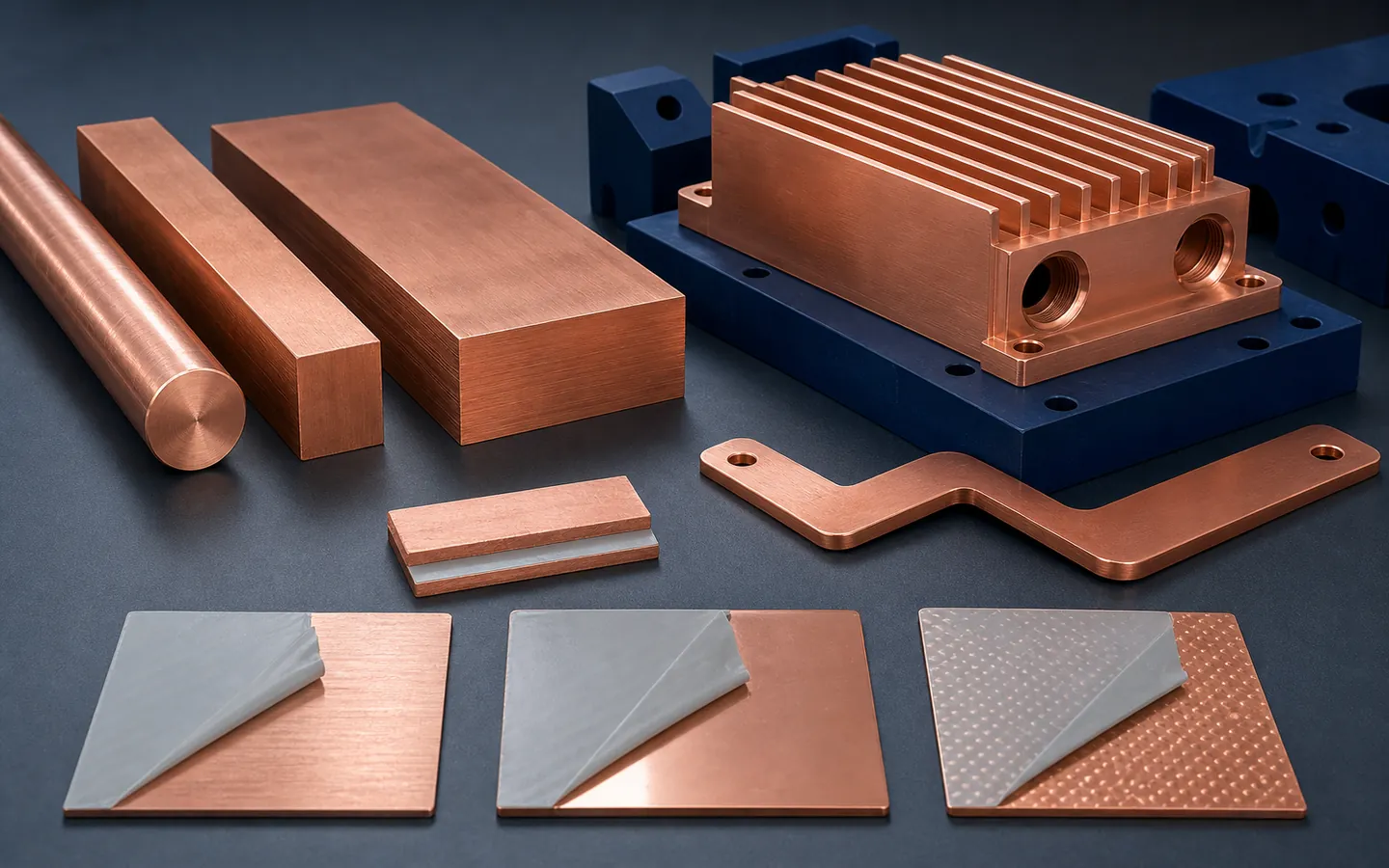
Selection criteria
State whether the part carries current, spreads heat, forms a contact, shields, joins to another material or simply uses copper for a different mechanical reason. Define the operating temperature, current or heat path, contact pressure, cooling, surface, joint and allowable loss. Then specify exact copper grade, temper and product form or the material properties that control selection. Commercially pure, oxygen-free and alloyed copper families do not share one machining, forming, strength or conductivity profile.
Geometry can dominate the route. Thin fins, deep narrow slots, small holes, soft surfaces, heavy sections and flat sheet features create different machining, burr, distortion and handling risks. Identify final plating, cleaning, joining, protected cosmetic areas and the test or material document needed. MakeNexa can coordinate the route, but a representative copper part is not proof of a thermal or electrical result in the buyer's assembly.
Where the material fits
Grade, geometry, surface and joining must preserve the interface that motivated the material.
Define current, contact, temperature rise, mating material, plating, fastener pressure and acceptance. Material conductivity alone does not establish the resistance or heating of the finished joint.
State heat source, sink, interface flatness, coolant or airflow, joining and cleanliness. Fin geometry and surface contact may influence performance as much as the nominal material family.
Soft or tough behavior, heat, burr formation, thin fins, small tools and surface sensitivity can affect setups and cutting. Mark functional surfaces, burr-sensitive passages and protected cosmetic areas.
Sheet grade, temper, thickness, bend, stamping, brazing, soldering or welding route must match the final electrical, thermal and cleanliness state. Define filler and interface materials where they matter.
Material tradeoffs
High-conductivity intent still needs exact material, geometry, surface and measurement context.
Do not assign a value from the word copper. Provide exact grade, temper and governing material requirement, plus a supplier record or test when the program needs evidence.
Soft material and small features can leave burrs that affect contacts, passages and assembly. Define edge condition, internal intersections, cleaning and inspection access for the actual geometry.
Copper can show scratches, fingerprints, oxidation and staining. Mark functional and cosmetic zones, protective films, allowed surface state and packaging needed before plating or assembly.
Brazed, soldered, plated or mechanically joined interfaces can introduce heat, filler, galvanic and cleanliness questions. Review the full joint and acceptance rather than only the copper body.
Grade and route choices
The proposal should return the exact grade and process consequences for the functional path.
Use machining for controlled bores, ports, threads, bases and complex interfaces when stock, workholding, heat, burr and finish can be managed. Include post-machining cleaning and surface protection.
Use sheet or plate for bus, shield, fin, spreader or formed geometry when thickness, temper, flatness, bend and joining fit. Control edges, warpage and surface condition through packaging.
A copper alloy, bonded insert, plated substrate or separate interface may balance conductivity with strength, wear or manufacturability. State what may change and require engineering validation of the complete assembly.
Material comparison
Typical published values for the grades named. Actual values vary with temper, product form and the supplier's material certification, and the project requirement is confirmed on the reviewed quote rather than from this table.
| Grade and typical use | Typical published properties | What it is chosen for |
|---|---|---|
| C110, electrolytic tough pitch | 101% IACS minimum, about 388 W per metre-kelvin thermal conductivity, machinability rating about 20% | The default conductor grade: bus bars, terminals, sheet and strip |
| C101 and C102, oxygen-free | Comparable conductivity with the oxygen removed | Brazed, furnace-joined and vacuum applications where C110 would embrittle above roughly 400 °C |
| C145, tellurium copper | About 93% IACS with a machinability rating near 85% | Machined electrical parts — it cuts more than four times faster than C110 |
| C182, chromium copper | About 80% IACS with far higher strength after age hardening | Resistance welding electrodes and loaded electrical contacts |
| Conductivity in context | 101% IACS for C110 against about 43% for 6061 aluminium and 26% for C360 brass | The reason to accept copper's mass and machining cost |
| Thermal conductivity in context | About 388 W per metre-kelvin against 167 for aluminium and 16 for 304 stainless | Heat spreaders, cold plates and thermal interfaces |
| Tensile yield strength | About 69 MPa / 10 ksi annealed, rising to roughly 310 MPa / 45 ksi hard drawn | Temper changes strength by more than a factor of four — state it |
| Modulus of elasticity | About 117 GPa / 17 Msi | Between aluminium at 68.9 GPa and steel at 200 GPa |
| Density | 8.94 g/cm³ | The heaviest common non-ferrous structural metal, over three times aluminium |
| Machining behaviour | Gummy and ductile; sharp tooling, high rake and generous coolant are needed to avoid built-up edge | Cycle times and finishes are worse than brass despite the softer material |
| Surface behaviour | Oxidises visibly in air within days and forms a patina over months | Plating, lacquer or a specified protective finish is normally required |
| Common specifications | ASTM B152 for sheet, strip and plate, ASTM B187 for bar and rod | Which specification the mill certificate must reference |
Material RFQ inputs
Provide the functional path and evidence need so grade and process can be reviewed together.
Complete packages move faster: revision-matched CAD, critical dimensions, quantity and material notes are enough to open engineering review across the network.
Get a QuoteSubmit the controlled model, drawing, revision and electrical or thermal application context
State exact copper grade, temper, product form, purity and material-record requirements
Define current, heat, contact, temperature, cooling, mating and acceptance conditions
Mark fins, flatness, small holes, internal passages, burr-sensitive and cosmetic surfaces
Specify plating, cleaning, brazing, soldering, oxidation limits and protective packaging
List quantities, dimensions, test method, sampling, documents and permitted alternatives
Questions before routing
These answers prepare the request; the reviewed quote controls project-specific commitments.
C110 is the default at 101% IACS minimum, and it covers bus bars, terminals and sheet work. The catch is machinability at about 20%, so where the part is heavily machined, tellurium copper C145 is often the better purchase: roughly 93% IACS with a machinability rating near 85%, more than four times faster to cut. For brazed or vacuum work use oxygen-free C101 or C102, and for loaded contacts consider chromium copper C182 at about 80% IACS with far higher strength.
Yes, but slowly and with a poorer finish than the softness suggests. C110's machinability rating is about 20% against 100% for C360 brass, because copper is gummy: it smears, builds up on the cutting edge and tears rather than breaking chips. Very sharp tooling, high rake angles and generous coolant are standard practice. If the design allows, C145 tellurium copper at about 85% machinability keeps most of the conductivity at a fraction of the cycle time.
The material publishes about 388 W per metre-kelvin — more than twice 6061 aluminium at 167 — but a thermal path is a system, not a material. Interface flatness, contact pressure, surface oxide, thermal interface material and joint quality often dominate over the bulk conductivity. State the thermal requirement as a measured performance on the assembly with a test method, and state the flatness and surface condition of the interface separately.
Some protection is normally required — bare copper oxidises visibly in air within days and forms a patina over months, and that oxide raises contact resistance at an electrical interface. Common routes are tin, nickel or silver plating on contact surfaces, lacquer for appearance, or controlled packaging for parts that will be joined soon after manufacture. Plating thickness affects fits, so mask what must hold size and say whether dimensions apply before or after.
Next step
Send the material requirement with geometry and use context. MakeNexa routes capable suppliers from a global network covering competitor-class process categories, then returns a prepared quote or focused clarification for your revision.