 MAKENEXA
Strength with mass constraints
Titanium alloys can be relevant when component loads and weight targets justify their material and processing cost.
Material selection decision
Source machined, formed, additively manufactured and project-specific titanium components through MakeNexa's global supplier network. Engineering reviews grade, supplied condition, stock form, geometry, finishing, environment, documentation, quantity and inspection before confirming the manufacturing route.
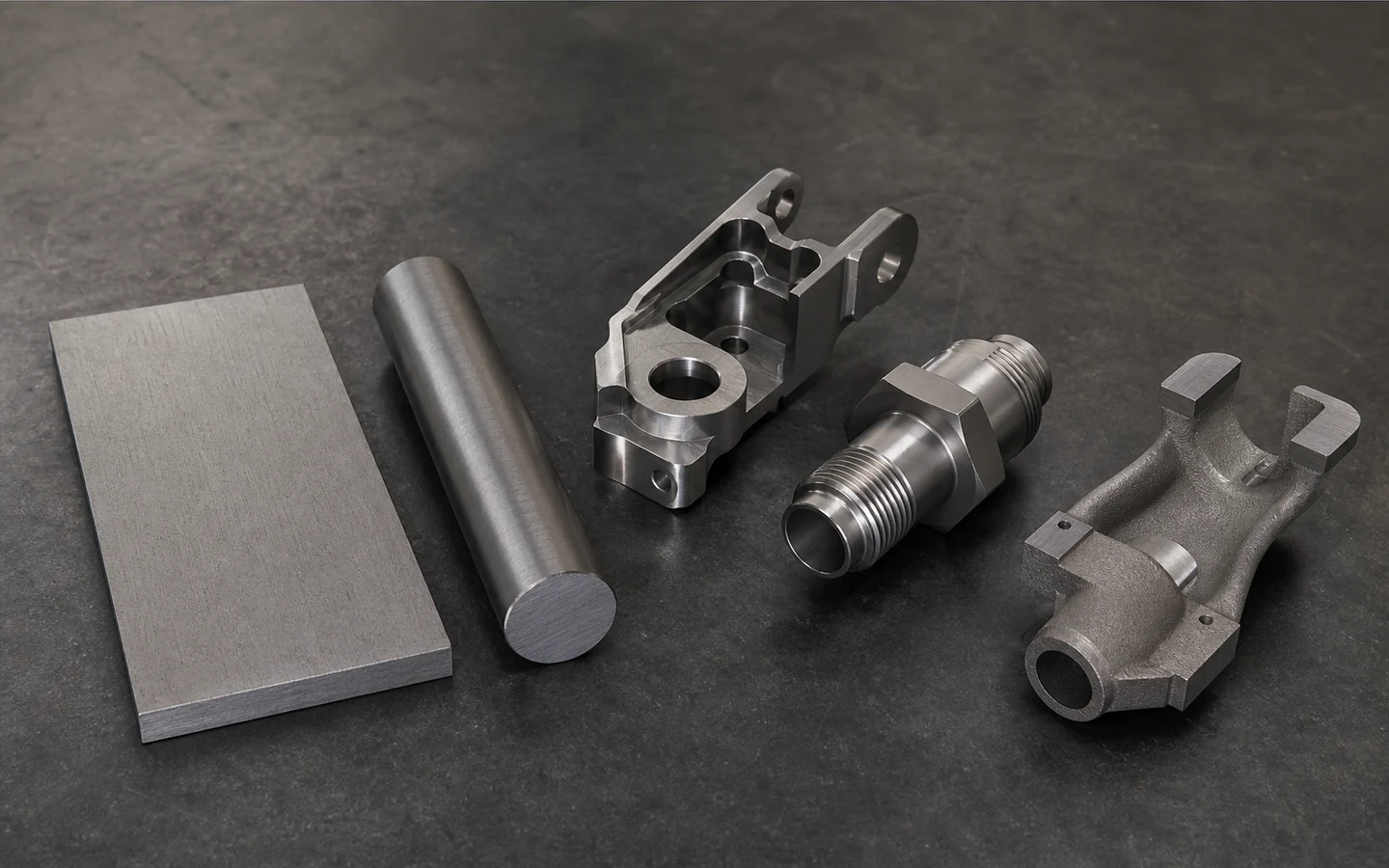
Selection criteria
Titanium is often selected for a combination of strength-to-weight performance, corrosion behavior, temperature capability or application-specific compatibility. Those benefits do not make every titanium grade interchangeable. Commercially pure grades and alloyed grades differ in strength, forming, machining, welding, availability and documentation, while stock form and material condition can influence both price and the feasible route.
MakeNexa does not treat a generic titanium callout as a complete purchasing definition. The RFQ should identify the exact grade or required properties, permitted alternatives, service environment, critical surfaces, heat-treatment state and records. Engineering compares machining, forming, additive, casting or combined operations across capable suppliers. Exact stock, dimensions, tolerance, equipment, price, lead time and compliance evidence are confirmed per project.
Where the material fits
Tie the material to a measurable design or operating requirement rather than prestige or category alone.
Titanium alloys can be relevant when component loads and weight targets justify their material and processing cost.
Selected grades can perform in demanding environments when the actual chemicals, temperature, crevices and galvanic interfaces are reviewed.
Cyclic loads and elevated temperature may support titanium selection, subject to grade, surface, defects and life requirements.
Some programs select titanium for nonmagnetic, biocompatibility or process reasons that require exact standards and evidence.
Material tradeoffs
Material cost is only one part of the manufacturing and release route.
State grade, annealed or heat-treated condition, stock specification and any substitution limits explicitly.
Heat, tool access, workholding, thin walls and surface damage can influence operation sequence and supplier selection.
Embedded iron, alpha case, scale, tool marks or handling residues may matter for corrosion, fatigue or regulated cleaning.
Mill records, lot traceability, chemistry, mechanical properties and downstream process records should match the actual risk.
Grade and route choices
Geometry, quantity, material condition and evidence determine whether one or several operations are appropriate.
Used for controlled prismatic and rotational parts from plate, bar, billet or project-specific stock.
Considered for sheet structures when bend, joining, shielding, distortion and final surface requirements are defined.
Compared for complex geometry when heat treatment, machining, internal quality and documentation support the application.
Material comparison
Typical published values for the grades named in the annealed condition. Actual values vary with product form, section size and the supplier's material certification, and the project requirement is confirmed on the reviewed quote rather than from this table.
| Grade or property | Typical published value | What the grade is chosen for |
|---|---|---|
| Grade 1, commercially pure | About 170 MPa / 25 ksi yield, the most formable of the family | Deep drawing and severe forming where strength is not the requirement |
| Grade 2, commercially pure | 275 MPa / 40 ksi minimum yield, 345 MPa / 50 ksi ultimate, 4.51 g/cm³ | The workhorse: chemical process, marine and fabricated sheet and tube; readily welded |
| Grade 5, Ti-6Al-4V | About 880 MPa / 128 ksi yield, 950 MPa / 138 ksi ultimate, 4.43 g/cm³ | Strength-led machined parts; harder to machine and weld |
| Grade 23, Ti-6Al-4V ELI | Comparable strength to Grade 5 with tighter interstitial limits for fracture toughness | Where the specification calls for extra-low interstitial material |
| Modulus across the family | 105 to 114 GPa | Roughly half of steel at 200 GPa — titanium parts deflect about twice as much at the same section |
| Density across the family | 4.43 to 4.51 g/cm³ | Around 44% lighter than steel, about 64% heavier than aluminium |
| Thermal conductivity | About 6.7 W per metre-kelvin for Grade 5 and 16 for Grade 2, against 167 for 6061 aluminium | Heat stays at the cutting edge — the reason titanium machines slowly |
| Typical cutting speed | Commonly 30 to 60 m/min for Grade 5, against 300 m/min and above for aluminium | Cycle time and price follow from this |
| Corrosion resistance | A self-repairing oxide film that outperforms 316 stainless in seawater and chlorides | The reason to choose titanium where mass is not the driver |
| Welding and hot work | Titanium absorbs oxygen and nitrogen above roughly 400 °C and embrittles; inert shielding of the weld and hot zone is required | A process requirement with its own acceptance criteria |
| Chip handling | Fine chips and dust are reactive and can ignite; flood coolant and controlled chip handling are standard practice | A supplier-capability question, not a design one |
| Common specifications | ASTM B265 for sheet and plate, ASTM B348 for bar and billet, AMS 4928 for Grade 5 where a programme requires it | Which specification the mill certificate must reference |
Material RFQ inputs
Make the grade, final condition and service requirements unambiguous.
Complete packages move faster: revision-matched CAD, critical dimensions, quantity and material notes are enough to open engineering review across the network.
Get a Quote3D model and revision-matched drawing
Titanium grade, governing specification, condition and stock restrictions
Loads, temperature, corrosion, fatigue and assembly context
Heat treatment, weld, finish, cleaning and protected-surface requirements
Critical dimensions, roughness, inspection and test methods
Quantity, material records, traceability, packaging and delivery needs
Questions before routing
These answers prepare the request; the reviewed quote controls project-specific commitments.
Start from strength against formability. Grade 2 publishes 275 MPa / 40 ksi minimum yield with about 20% elongation and welds readily, which suits chemical, marine and fabricated sheet work. Grade 5 gives roughly 880 MPa / 128 ksi at the cost of formability, weldability and machining speed, which suits strength-led machined parts. Grade 23 is Grade 5 with tighter interstitial limits where a specification requires it. Name the grade and the specification, not just the metal.
Routinely, but slowly, and the reason is thermal. Titanium conducts heat at about 6.7 W per metre-kelvin for Grade 5 against 167 for aluminium, so the heat generated stays in the cutting zone and destroys tools. Cutting speeds are commonly 30 to 60 m/min against 300 and above for aluminium, and the 105 to 114 GPa modulus lets thin sections deflect under cutting load, so rigid workholding matters. Fine chips are also reactive and need controlled handling. Cycle time and price reflect all of this.
It resists seawater, chlorides and most oxidising acids better than 316 stainless, through an oxide film that repairs itself in the presence of oxygen. But it is not universal: reducing acids such as hydrofluoric attack it, and above roughly 400 °C in air it absorbs oxygen and nitrogen and embrittles, which is why welding needs inert shielding of both the pool and the hot zone. State the fluid, concentration, temperature and duration rather than relying on the metal's reputation.
Lighter, not stiffer. Titanium runs 4.43 to 4.51 g/cm³ against 7.85 for steel — about 44% lighter — but its modulus is 105 to 114 GPa against 200 GPa, so the same section deflects roughly twice as much. On a strength-limited part that trade is excellent; on a deflection-limited one it is not, and the section has to grow to compensate. Check which constraint actually governs before substituting.
A mill certificate referencing the applicable specification — commonly ASTM B265 for sheet and plate or ASTM B348 for bar, with AMS 4928 where a programme requires it — recording chemistry, mechanical properties and heat or lot identity. Traceability from lot to finished part, weld records and inspection reports are separate requests. State what evidence you need in the RFQ; availability, format and scope are confirmed on the reviewed quote.
Next step
Send the material requirement with geometry and use context. MakeNexa routes capable suppliers from a global network covering competitor-class process categories, then returns a prepared quote or focused clarification for your revision.