 MAKENEXA
Elevated-temperature service
PEEK may be evaluated where common engineering plastics lose stiffness or stability, subject to load, duration and grade.
Material selection decision
Source machined, molded and project-specific PEEK components through MakeNexa. Engineering reviews exact polymer grade, filler, supplied condition, geometry, operating environment, dimensional stability, finish, quantity, inspection and material evidence before confirming the route.
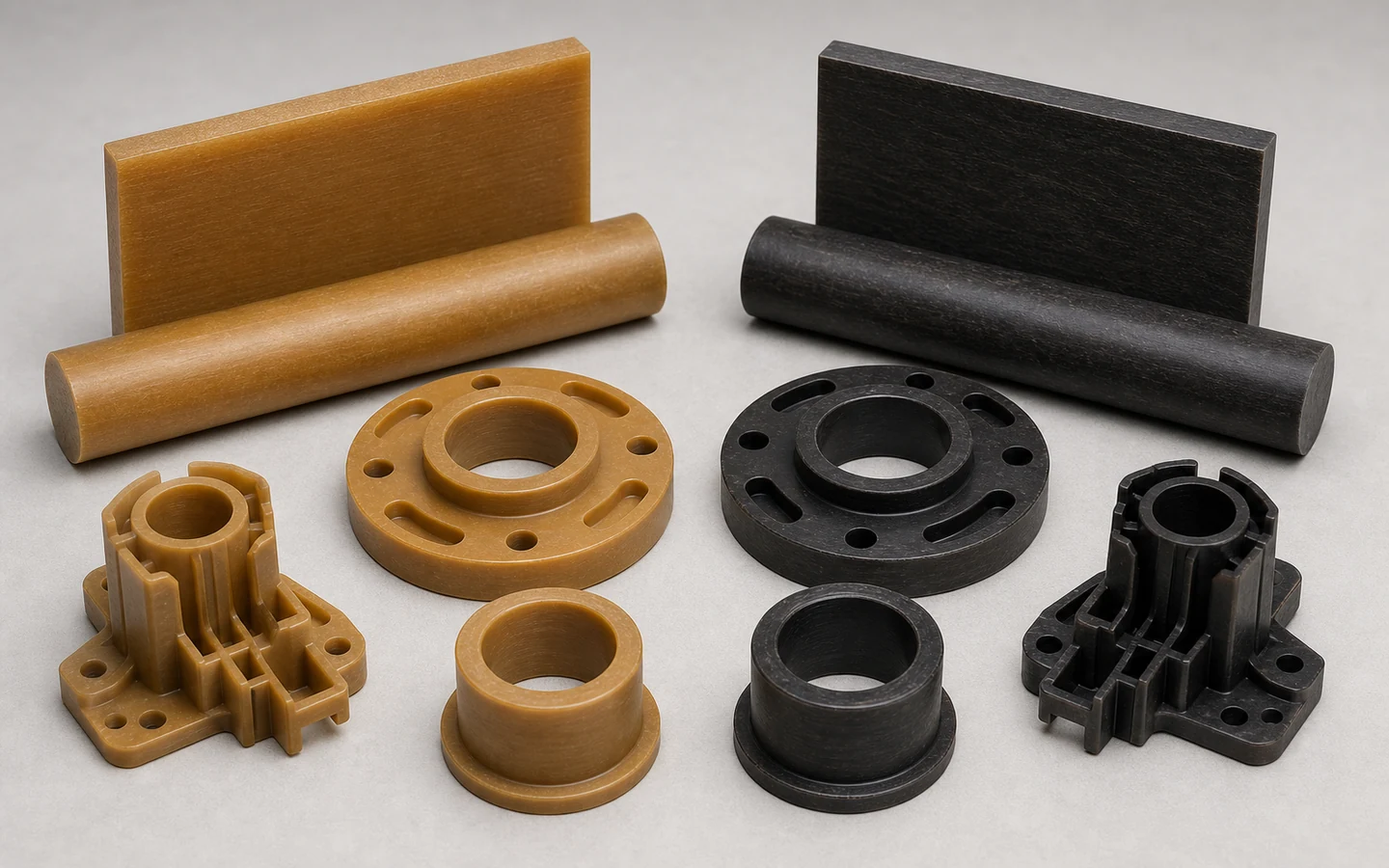
Selection criteria
PEEK is considered for demanding thermal, chemical, wear, electrical and mechanical applications, but unfilled, glass-filled, carbon-filled and bearing-oriented grades behave differently. Filler changes stiffness, wear, machining, surface, electrical behavior and dimensional response. Brand or regulatory restrictions can narrow stock and supplier options and should be stated before the quote is treated as comparable.
Machined PEEK begins with plate, rod, tube or another stock form whose extrusion, molding, annealing and residual stress can affect final geometry. Molded PEEK introduces tooling, high processing temperatures and demand considerations. MakeNexa reviews the material and manufacturing route together, including measurement condition, cleaning and documentation. Exact grade, stock, tolerance, price and lead time remain RFQ-specific.
Where the material fits
Use the actual environment and wear system to justify the material.
PEEK may be evaluated where common engineering plastics lose stiffness or stability, subject to load, duration and grade.
Selected grades can resist many chemicals, but concentration, temperature, stress and cleaning cycles must be specified.
Bushings, seals and guides may use filled grades when counterface, lubrication, load, speed and debris are understood.
Insulation, outgassing, cleanliness or application-specific evidence can influence exact grade and process route.
Material tradeoffs
High material performance does not eliminate stock, stress, tolerance or evidence decisions.
Unfilled and reinforced materials are not interchangeable; state composition, color, brand and substitution limits.
Large stock removal, thin walls and asymmetric geometry can release stress and require staged machining or annealing.
Filled grades can machine differently and may affect roughness, burrs, sealing surfaces and cosmetic appearance.
Application-specific cleanliness, lot control, certificates and packaging should be defined without assuming regulated compliance.
Grade and route choices
Demand, geometry and material evidence guide machining, molding or an alternative polymer.
Useful for prototypes and controlled quantities when stock grade and final geometry are compatible.
Considered for stable demand and moldable geometry when tooling, shrink, process and resin supply are justified.
Compared when temperature, wear, chemicals, electrical behavior, cost or availability can be met by another defined material.
Material comparison
Typical published values for unfilled and 30% glass-filled PEEK. Actual values vary with grade, supplier, stock form and processing history, and the project requirement is confirmed on the reviewed quote rather than from this table.
| Property or decision factor | Typical published value | Review focus |
|---|---|---|
| Tensile strength, unfilled | About 100 MPa, the highest of the common machinable thermoplastics | Well above acetal at 70 MPa and nylon 6/6 at 82 MPa dry |
| Tensile modulus, unfilled | About 3.6 GPa; 30% glass filling raises it to roughly 9.7 GPa | Filling nearly triples stiffness and cuts elongation to a few percent |
| Heat deflection temperature | About 152 °C at 1.8 MPa unfilled; roughly 315 °C for 30% glass-filled | The single biggest difference between the grades |
| Glass transition | About 143 °C — unfilled PEEK loses stiffness sharply above it even though it does not melt until 343 °C | Continuous service temperature is not the melting point |
| Continuous service temperature | Commonly quoted around 250 °C | State the actual service temperature, including cleaning and sterilisation cycles |
| Density | About 1.30 g/cm³ unfilled, 1.51 g/cm³ at 30% glass fill | Roughly half of aluminium at 2.70 and a sixth of steel |
| Water absorption | About 0.1 to 0.5%, far below nylon 6/6 at 1.5% in 24 h | Dimensional stability in humid or wet service |
| Chemical resistance | Resists most solvents, acids and bases; attacked by concentrated sulphuric acid | State the fluid, concentration and temperature |
| Machined tolerance | ±0.05 mm is realistic on small features; ±0.025 mm needs a stress-relieved blank and temperature control | Which fits justify the extra process control |
| Annealing | Stress relief before final passes is normal on precision parts; machining releases residual stress from the extruded or moulded stock | A specified operation with its own sequence position |
| Material cost | Among the most expensive machinable thermoplastics — commonly an order of magnitude above acetal per kilogram | Near-net stock form and nesting matter more than on cheaper polymers |
| Glass-filled machining | The glass is abrasive and wears tooling far faster than unfilled stock | Cycle time and tooling cost rise with the fill, not just the material price |
Material RFQ inputs
State grade and service conditions before assigning tight controls by default.
Complete packages move faster: revision-matched CAD, critical dimensions, quantity and material notes are enough to open engineering review across the network.
Get a Quote3D model and drawing with critical interfaces
Exact PEEK grade, filler, color, brand restrictions and alternatives
Temperature, load, chemicals, wear, electrical and cleaning context
Stock condition, annealing or molded-state requirements when applicable
Surface, burr, cleanliness, inspection and conditioning requirements
Quantity, material records, traceability, packaging and delivery
Questions before routing
These answers prepare the request; the reviewed quote controls project-specific commitments.
No, and the gap is large. Unfilled PEEK publishes about 100 MPa tensile strength, 3.6 GPa modulus and a heat-deflection temperature near 152 °C at 1.8 MPa. Adding 30% glass takes the modulus to roughly 9.7 GPa and the heat-deflection figure to around 315 °C, but cuts elongation to a few percent and makes the material abrasive to tooling. Carbon-filled and bearing grades differ again. Name the exact grade, not the polymer.
Yes, within limits that come from the polymer rather than the machine. ±0.05 mm is realistic on small features; ±0.025 mm needs a stress-relieved blank, controlled shop temperature and often a final pass after the part has settled. Extruded and moulded stock carries residual stress that releases as material is removed, so an annealing step before finishing is normal on precision parts. State the measurement temperature with any tight dimension.
On precision parts, usually yes. Machining releases residual stress locked into the stock during extrusion or moulding, and a thin-walled or asymmetric part will move after roughing. Annealing between roughing and finishing lets that movement happen before the final dimensions are cut. It is a specified operation with its own position in the sequence — state whether it is required and which dimensions are final after it.
Because nothing cheaper does the same job at temperature. At about 100 MPa tensile strength with a heat-deflection figure near 152 °C at 1.8 MPa unfilled — and around 315 °C at 30% glass fill — it outperforms acetal at 70 MPa and roughly 90 °C continuous, and it holds up in chemicals and steam that degrade most engineering plastics. At about 1.30 g/cm³ it is also half the density of aluminium. Where the service temperature is below 100 °C and the chemistry is mild, acetal or nylon is usually the better purchase.
Yes — PEEK is supplied by its manufacturers in grades carrying food-contact and implantable designations alongside the standard industrial grades, and the supplier network includes manufacturers holding ISO 9001 and ISO 13485 certification for that work. Available with the parts: the resin manufacturer's grade documentation, material traceability from lot to part, dimensional reports and cleaning records. Because the designation belongs to a specific grade rather than to PEEK as a polymer, name the exact grade and the evidence required in the RFQ, and availability, traceability and lead time come back confirmed on the quote.
Next step
Send the material requirement with geometry and use context. MakeNexa routes capable suppliers from a global network covering competitor-class process categories, then returns a prepared quote or focused clarification for your revision.