 MAKENEXA
Wear and motion components
Gears, guides, rollers and bushings may use nylon when counterface, lubrication, load, speed and moisture are defined.
Material selection decision
Source machined, molded and 3D-printed nylon parts through MakeNexa. Engineering reviews the exact nylon family, filler, moisture condition, operating environment, wear system, geometry, surface, quantity, inspection and records before the reviewed quote is prepared.
Selection criteria
Nylon can provide toughness, wear performance and useful mechanical behavior across many manufacturing routes, but PA6, PA66, PA11, PA12 and filled or modified grades are not interchangeable. Moisture uptake can change dimensions and properties, and printed nylon may not behave like machined stock or injection-molded resin even when the family name appears similar.
The RFQ should identify whether grade, brand, certification, color or a performance range controls selection. Measurement and assembly condition matter when moisture-sensitive dimensions or fits are critical. MakeNexa reviews machining, injection molding, SLS, MJF and other routes with the application, quantity and evidence requirements in view. Exact material, supplier, tolerance, price and lead time are confirmed per project.
Where the material fits
Match the grade and route to impact, wear, moisture and production conditions.
Gears, guides, rollers and bushings may use nylon when counterface, lubrication, load, speed and moisture are defined.
Impact-tolerant mechanical parts can be machined, molded or printed when stiffness and environment fit the grade.
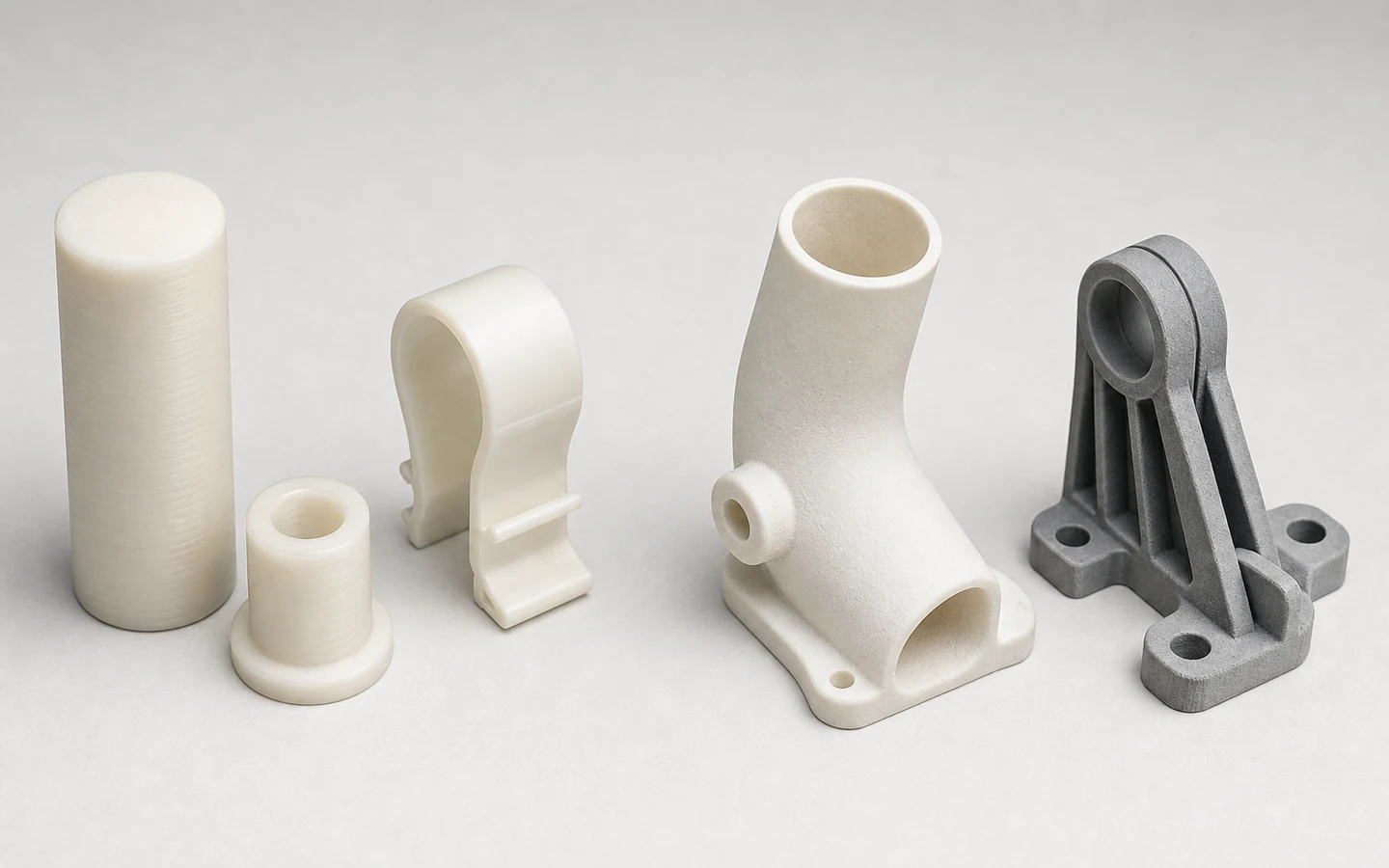
PA11 or PA12 powder-bed routes may support ducts, clips and lattices where depowdering and surface are acceptable.
Stable quantities can justify tooling for ribs, bosses, clips and other nylon features with moisture and shrink considered.
Material tradeoffs
Control the material condition and process, not only the word nylon.
As-molded, dry-as-machined and conditioned parts can measure and behave differently; state the acceptance condition.
Glass, carbon, impact modification and lubricants change stiffness, wear, surface, shrink and sometimes electrical behavior.
Printed, molded and extruded-stock nylon have different histories, anisotropy, porosity, surface and evidence.
Temperature, water, fuels, cleaners and stress can alter suitability and should be stated with duration.
Grade and route choices
Select the process with the grade, geometry and demand pattern in view.
Useful for low and repeat quantities from controlled plate, rod or block stock with defined conditioning.
Considered for stable volume, moldable geometry and production resin when tooling and shrink are justified.
Compared for complex support-free polymer geometry and batch production with route-specific surface and properties.
Material comparison
Typical published values for the grades named, quoted dry-as-moulded unless stated. Nylon data is published either dry or conditioned to equilibrium and the two differ substantially, so the project requirement is confirmed on the reviewed quote rather than from this table.
| Grade | Typical published properties | What it is chosen for |
|---|---|---|
| Nylon 6/6, unfilled | About 82 MPa tensile dry and 60 MPa conditioned, 1.14 g/cm³, melting near 260 °C, 1.5% water absorption in 24 h | The toughest and most heat-resistant of the common nylons, at the cost of moisture movement |
| Nylon 6, unfilled | Comparable strength to PA66 with slightly lower melting point and higher moisture uptake | Better surface finish and impact than PA66 in moulded parts |
| Nylon 12, unfilled | About 50 MPa tensile, 1.01 g/cm³, melting near 178 °C, 0.25% water absorption in 24 h | Dimensional stability and the standard SLS and MJF powder material |
| Nylon 6/6, 30% glass filled | About 180 MPa tensile and 9 GPa modulus, with much reduced moisture-driven movement | Stiffness and stability where unfilled nylon drifts |
| Moisture movement | Unfilled PA66 grows commonly 0.5 to 0.8% from dry to equilibrium — on a 100 mm feature that is 0.5 to 0.8 mm | Larger than any machining tolerance; it is a design constraint, not a process one |
| Water absorption in context | PA66 at 1.5% in 24 h against nylon 12 at 0.25% and acetal at 0.2% | The single most useful number when comparing nylons |
| Density across the family | 1.01 to 1.14 g/cm³ unfilled | Lighter than acetal at 1.41 and PEEK at 1.30 |
| Heat deflection temperature | About 90 °C at 1.8 MPa for dry PA66; lower for nylon 12 | Continuous service is normally held well below it |
| Wear and abrasion | Better than acetal, which is why nylon is used for gears, wear strips and bushings despite the moisture behaviour | State the counterface, load, speed and lubrication |
| Machined tolerance | ±0.1 mm is realistic on unfilled stock; tighter fits are defeated by moisture movement rather than by the machine | State the humidity and temperature at which dimensions apply |
| Common alternative | Acetal at about 70 MPa with 0.2% water absorption and far better dimensional stability | Where fits matter more than toughness |
Material RFQ inputs
Prevent route and condition ambiguity before comparing quotes.
Complete packages move faster: revision-matched CAD, critical dimensions, quantity and material notes are enough to open engineering review across the network.
Get a Quote3D model and drawing with functional interfaces
Exact nylon family, grade, filler, color and permitted alternatives
Preferred or permitted machining, molding or printing route
Moisture, temperature, chemicals, impact and wear environment
Critical dimensions, surface and measurement conditioning
Quantity, material records, tests, packaging and delivery expectations
Questions before routing
These answers prepare the request; the reviewed quote controls project-specific commitments.
Decide on moisture first. PA66 is the toughest and most heat resistant at about 82 MPa tensile dry and melting near 260 °C, but it absorbs roughly 1.5% water in 24 h and grows 0.5 to 0.8% reaching equilibrium. Nylon 12 gives up strength at about 50 MPa but absorbs only around 0.25% and holds its size, which is why it is the standard SLS and MJF powder. Glass-filled PA66 at roughly 180 MPa keeps the strength and reduces the movement. If fits matter more than toughness, compare acetal instead.
Because it changes both the size and the strength of the finished part. Unfilled PA66 grows commonly 0.5 to 0.8% from dry-as-moulded to equilibrium — on a 100 mm feature that is 0.5 to 0.8 mm, larger than any tolerance likely to be on the drawing — while tensile strength falls from about 82 MPa dry to roughly 60 MPa conditioned. Datasheets quote one condition or the other, so always check which. State the humidity and temperature at which dimensions apply.
No. Machined parts come from extruded or cast stock; SLS and MJF parts are built from nylon 12 powder and are typically slightly porous, which raises effective moisture uptake and gives different surface and directional properties. Printed PA12 publishes around 48 MPa tensile with roughly 15% elongation, against about 50 MPa for machined PA12 stock and 82 MPa dry for PA66. State the process alongside the material, because the datasheet does not transfer between them.
Commonly, and heat-set brass inserts are the usual route. Plan at least 1.5 mm of material around the insert, and account for moisture: a nylon boss that grows 0.5% will relax its grip on the insert as it conditions, which matters for a torque-critical joint. Provide insert type, installation method, load, torque, access and inspection needs so the boss design can be reviewed with the supplier route.
Next step
Send the material requirement with geometry and use context. MakeNexa routes capable suppliers from a global network covering competitor-class process categories, then returns a prepared quote or focused clarification for your revision.