 MAKENEXA
Anodizing and conversion coatings
Aluminum protection, appearance, wear or pretreatment needs.
Review alloy, finish type, color, thickness, masking and electrical contact.Surface finishing
Name the base material, finish spec, mask zones and cosmetic faces. MakeNexa reviews pretreatment, buildup, appearance and records before confirming a finish route—so threads, grounding pads and mating surfaces are not guessed later.
Start this RFQ Review the route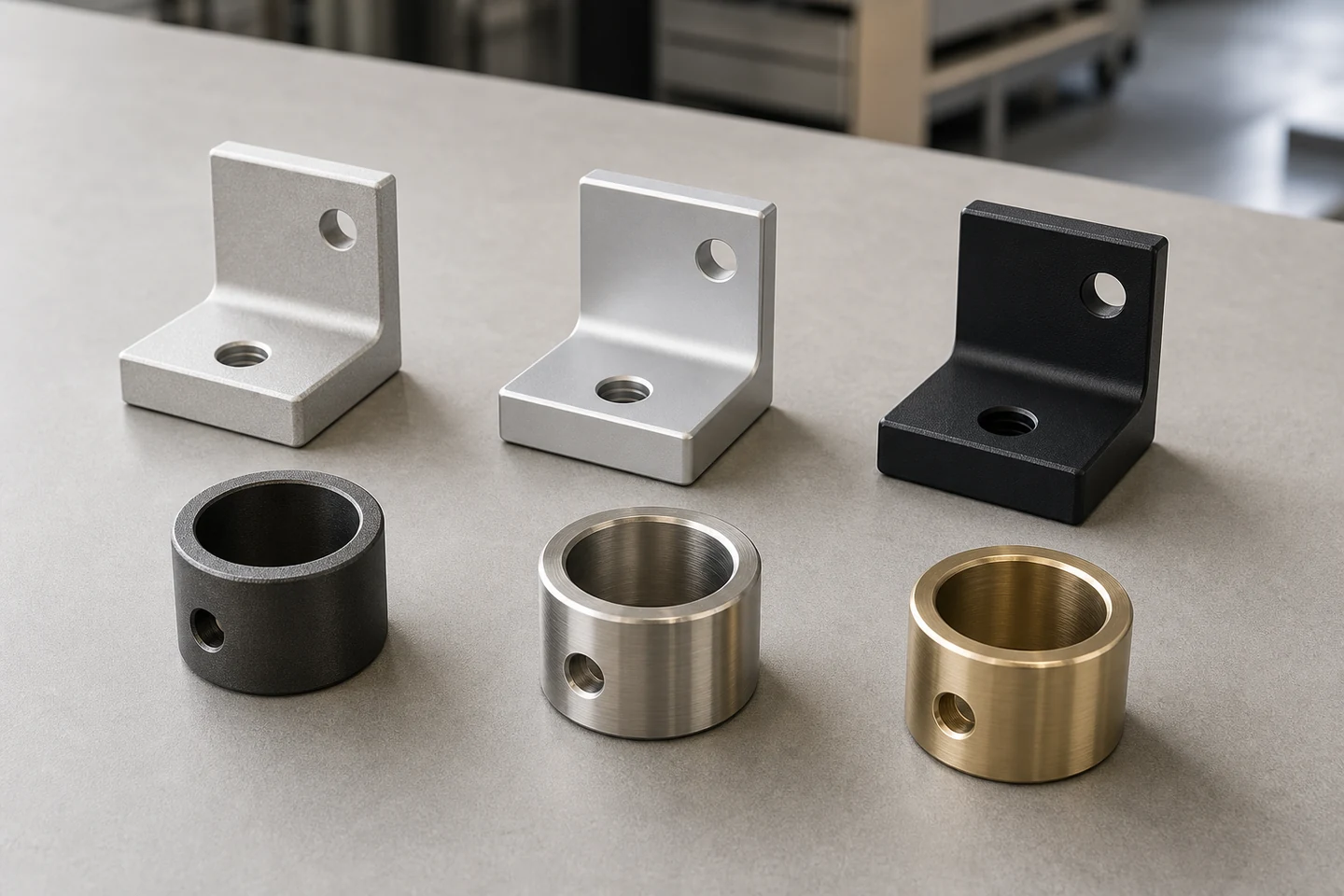
Decision guide
The same finish name can describe different specifications, colors, thicknesses and acceptance methods. Begin with the base material and the reason for the finish: corrosion protection, wear, conductivity, appearance, cleaning, paint adhesion or a combination of these.
Mark surfaces that must be masked, grounded, fitted, sealed or kept cosmetic. If color or texture matters, provide a recognized specification or physical reference and define the acceptable variation. The reviewed quote confirms compatibility, supplier route and documentation for the actual part.
Route options
Availability depends on substrate, geometry, required performance, color and supplier route.
Aluminum protection, appearance, wear or pretreatment needs.
Review alloy, finish type, color, thickness, masking and electrical contact.Corrosion, wear, conductivity, solderability or surface preparation.
Review substrate, specification, thickness, rack/contact marks and hydrogen concerns.Durable color or protective coating on metal components.
Review color system, gloss, texture, coverage, masking, cure exposure and packaging.Bead blasting, brushing, tumbling, polishing and controlled surface preparation.
Review initial surface, directional appearance, edge condition and protected features.Decision table
A controlled finish note reduces subjective interpretation.
| Requirement | Useful definition | Review impact |
|---|---|---|
| Specification | Finish name plus type, class and thickness: MIL-A-8625 for anodize, ASTM B633 for zinc, ASTM B733 for electroless nickel, ASTM A967 for passivation, ASTM B912 for electropolishing | Identifies process controls and the records that can ship with the parts |
| Thickness added | Powder 50 to 100 µm per surface, Type II anodize 5 to 25 µm growing about half outward, Type III 25 to 50 µm, zinc 5 to 25 µm, electroless nickel 5 to 50 µm | The thickest common finish is the one most likely to bind a thread or a fit |
| Material removed | Electropolishing takes 10 to 40 µm off the surface; passivation and chem film take effectively nothing | Removal has to be allowed for on threads and precision bores |
| Coverage and masking | All-over, selected surfaces, masked areas, threads and contact points. Powder misses deep recesses through the Faraday cage effect | Changes fixturing, masking and inspection |
| Electrical behaviour | Anodize and powder both insulate; chem film under 1 µm stays conductive | Every grounding and bonding path must be identified |
| Appearance | Cosmetic zones, colour reference, gloss and defect criteria. Bead blasting gives Ra 1.6 to 3.2 µm; a colour code fixes hue but not gloss or texture | Supply a controlled reference where appearance is contractual |
| Corrosion testing | Salt spray to ASTM B117: yellow-chromated zinc commonly 96 hours and beyond, pretreated powder on steel 500 to 1000 hours | Test hours are a comparative benchmark, not a service-life prediction |
| Process temperature | Powder cures at 180 to 200 °C for 10 to 20 minutes, which exceeds bearings, seals, elastomers and electronics | Decides which components are installed before finishing |
Preparation
Include these when the surface affects function or appearance.
Frequently asked questions
Use the submitted quote and written clarification as the project-specific record.
A color name may help early review, but controlled appearance normally needs a recognized color system, range or physical reference plus gloss and cosmetic criteria.
State the intended condition for each critical feature. Coating buildup or material removal can change dimensions, so the measurement stage must match function.
Potentially. Describe the incoming part condition, quantity, material, packaging and any existing records. The route is confirmed after the finish supplier reviews the parts and requirements.
No. Specify which certificate, test or process record you need. Availability and format are confirmed with the selected supplier before commitment.
Ready for review
You will receive a stable RFQ reference. MakeNexa will assess the package, request clarification when needed and return a reviewed quote or clear next action.