 MAKENEXA
Machined guides and wear parts
Blocks, rails, pads and low-friction guides may be reviewed when load, motion, mating surface, temperature, wear and replacement expectations are known. Validate the full interface for life-critical use.
Material selection decision
HDPE can support machined and fabricated parts where chemical context, low moisture uptake, toughness or low-friction behavior is useful, but exact grade and application still govern suitability. Creep, thermal movement, soft workholding, welding or joining, surface and measurement state require deliberate control. MakeNexa reviews stock and supplier routes per RFQ.
Selection criteria
Define service media, concentration, temperature, duration, load, impact, motion, UV exposure, cleanliness, color and any regulated context. Specify the exact HDPE grade and product form when fixed, including additives or material records, or provide the restrictions that control a reviewed alternative. Broad HDPE terminology does not prove chemical, food-contact, outdoor or other application suitability.
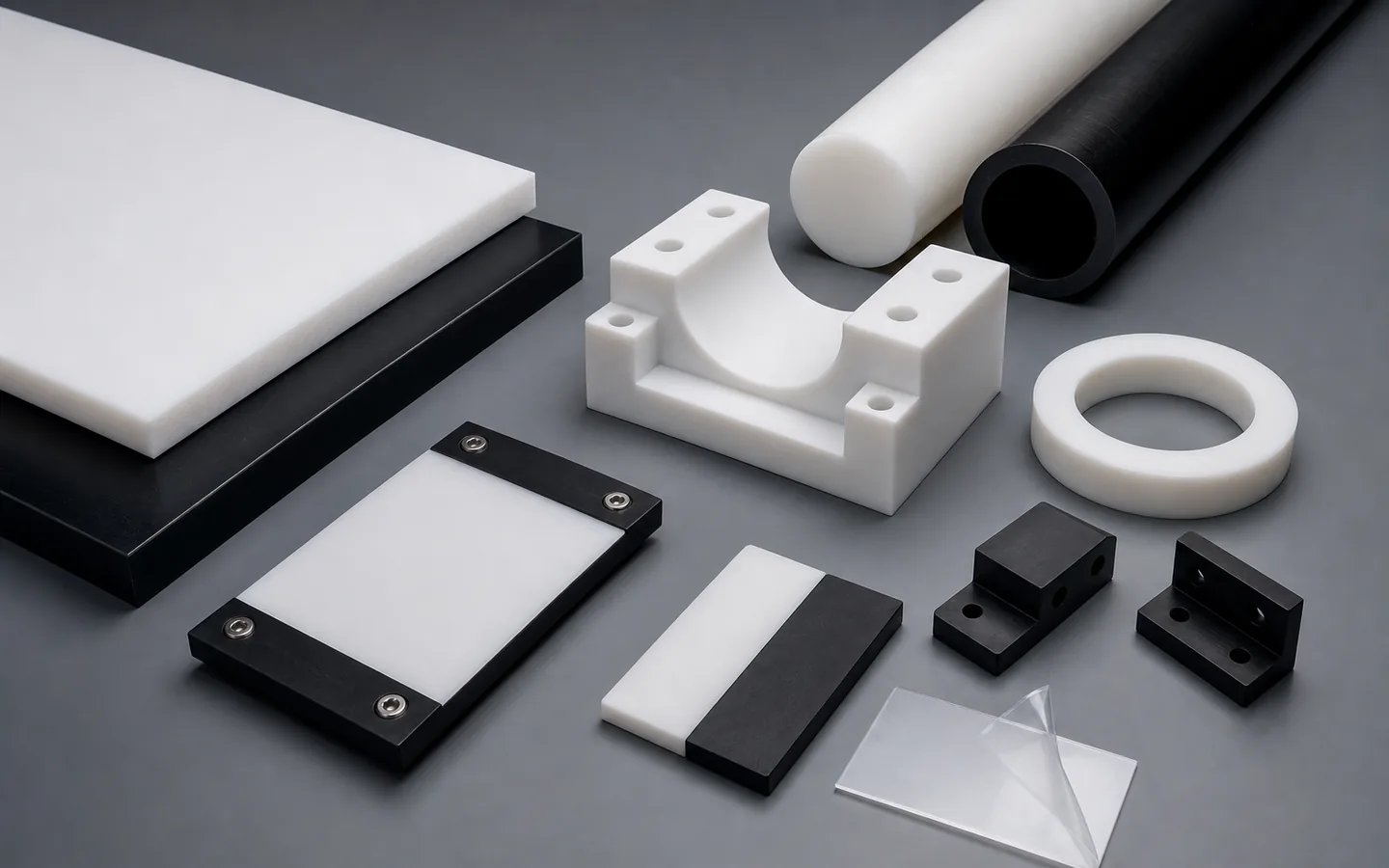
Machined plates, guides, wear strips, blocks and rings can relax or deform under clamp load, heat and time. Fabricated sheet assemblies may add welded seams, fasteners or inserts that change behavior. Define critical dimensions, support, conditioning, free or restrained inspection, joint acceptance, edge state, cleaning and packaging so the component is judged in a reproducible state.
Where the material fits
Material advantages only become useful when load, temperature, time, fit and environment are explicit.
Blocks, rails, pads and low-friction guides may be reviewed when load, motion, mating surface, temperature, wear and replacement expectations are known. Validate the full interface for life-critical use.
Sheet stock can support panels, guards, liners and separators when flatness, support spacing, fasteners, thermal movement, edge treatment and cleaning are controlled.
Compatible welding, fastening or insert routes may build larger or enclosed forms. Define joint geometry, access, leak or strength test, support and final dimensional state.
HDPE may be considered for some media, but exact grade, concentration, temperature, stress, duration and cleaning govern compatibility. Use approved data and project validation.
Material tradeoffs
A dimension measured immediately after machining may not represent the supported assembly or long-term service state.
Creep can alter fit and support under time and temperature. Provide load duration, contact area, assembly restraint and service conditions, then validate the complete design.
Long plates and panels can move with temperature. Include slots, clearances, support spacing or joint design appropriate to the assembly rather than overconstraining every edge.
Soft walls, rings and panels can change under jaws, bolts or gauges. Define low-force measurement and free, supported, restrained or installed acceptance for critical dimensions.
Color and surface do not prove composition, cleanliness, food contact, chemical compatibility or regulated suitability. Specify exact grade, cleaning, handling, packaging and evidence.
Grade and route choices
Select the route from geometry, support, environment, quantity and final-state requirements.
Use exact sheet, plate, rod or tube stock for accessible geometry and smaller quantities when support, heat, burr, surface and relaxation can be controlled.
Use compatible welded or mechanically assembled sheet when size and geometry support it. Define joint preparation, restraint, test, cleanup and final inspection.
UHMW, acetal, nylon, PTFE, PEEK or another polymer may better balance stiffness, wear, temperature, friction or dimensional stability. Compare exact grade and service before changing.
Material comparison
Typical published values for unfilled HDPE. Actual values vary with grade, molecular weight, stock form and supplier, and the project requirement is confirmed on the reviewed quote rather than from this table.
| Property or decision factor | Typical published value | Routing consequence |
|---|---|---|
| Density | About 0.95 g/cm³ — below water, so HDPE parts float | The lightest of the common machinable plastics |
| Tensile strength | About 22 to 31 MPa, against 70 MPa for acetal | Structurally weak: this is a chemical and wear material, not a load-bearing one |
| Tensile modulus | About 0.8 to 1.5 GPa, roughly a third of acetal at 3.1 GPa | Parts flex noticeably; thin sections will not hold shape |
| Water absorption | Below 0.01% | Completely unaffected by humidity, unlike nylon at 1.5% in 24 h |
| Thermal expansion | About 120 to 200 µm per metre per °C, roughly twelve times steel | A 500 mm panel moves 0.6 to 1.0 mm across a 10 °C swing — expansion joints are a design requirement |
| Melting point | About 130 °C, with continuous service commonly held near 80 °C | The lowest service ceiling of the common engineering plastics |
| Chemical resistance | Excellent against acids, bases and salts across a wide range | The usual reason HDPE was specified in the first place |
| Machined tolerance | ±0.25 mm is realistic on typical features; the material relaxes after cutting and moves with shop temperature | Do not put a machining tolerance on HDPE that the material cannot hold |
| Machining behaviour | Soft and gummy; needs sharp tooling, high rake and good chip clearance, and it melts at the cut if feeds are wrong | Cycle is set by heat management, not by hardness |
| Welding | Readily hot-gas and extrusion welded, and butt-fusion welded in sheet and pipe — the standard joining route for tanks and ducting | Weld method and acceptance criteria stated in the RFQ |
| Bonding | Very low surface energy: adhesives do not stick without flame, corona or chemical treatment | Weld or fasten mechanically rather than gluing |
| Moulding shrinkage | Commonly 1.5 to 3%, among the highest of the common thermoplastics | Tooling must be cut for the specific grade and wall |
Material RFQ inputs
Define environment and accepted state so material and dimensions are not guessed from a generic polymer name.
Complete packages move faster: revision-matched CAD, critical dimensions, quantity and material notes are enough to open engineering review across the network.
Get a QuoteSubmit the controlled model, drawing, revision and complete service environment
State the HDPE grade, additives, color, stock form, records and permitted alternatives
Define media, temperature, duration, load, impact, movement, UV and cleanliness
Mark thin walls, panels, fits, threads, supports, burr-sensitive and wear surfaces
Specify joints, fasteners, expansion clearances, conditioning, cleaning and packaging
List quantities, measurement state, sampling, tests, material and process documents
Questions before routing
These answers prepare the request; the reviewed quote controls project-specific commitments.
Yes, and it cuts fast, but it is soft and gummy — sharp tooling, high rake angles and good chip clearance are needed or it melts at the cut and welds to the tool. The bigger constraint is tolerance: ±0.25 mm is realistic on typical features, because the material relaxes after cutting and moves with shop temperature. Putting ±0.05 mm on an HDPE drawing specifies something the material will not hold regardless of the machine.
Against humidity, completely — water absorption is below 0.01%. Against temperature, no: HDPE expands about 120 to 200 µm per metre per °C, roughly twelve times steel, so a 500 mm panel moves 0.6 to 1.0 mm across a 10 °C change. That is why HDPE tank and duct fabrications are designed with expansion allowance and slotted fixings rather than rigid bolted joints. State the temperature range and the measurement temperature for any controlled dimension.
Yes — hot-gas, extrusion and butt-fusion welding are the standard joining routes for HDPE tanks, ducting and pipework, and they produce joints approaching parent-material strength. Adhesive bonding is the route that does not work: HDPE's surface energy is so low that nothing sticks without flame, corona or chemical treatment first. Specify the weld method, the joint design and the acceptance criteria in the RFQ.
Chemical resistance is genuinely broad — HDPE handles most acids, bases and salts — but it is not universal, and hydrocarbons and strong oxidisers are the usual exceptions. Food contact is a separate question entirely: it depends on the specific grade, its additives and the applicable regulatory route, not on the polymer family. State the fluid, concentration, temperature and duration, and state any regulatory requirement so grade and evidence can be reviewed.
Next step
Send the material requirement with geometry and use context. MakeNexa routes capable suppliers from a global network covering competitor-class process categories, then returns a prepared quote or focused clarification for your revision.