 MAKENEXA
Machined transparent or opaque stock
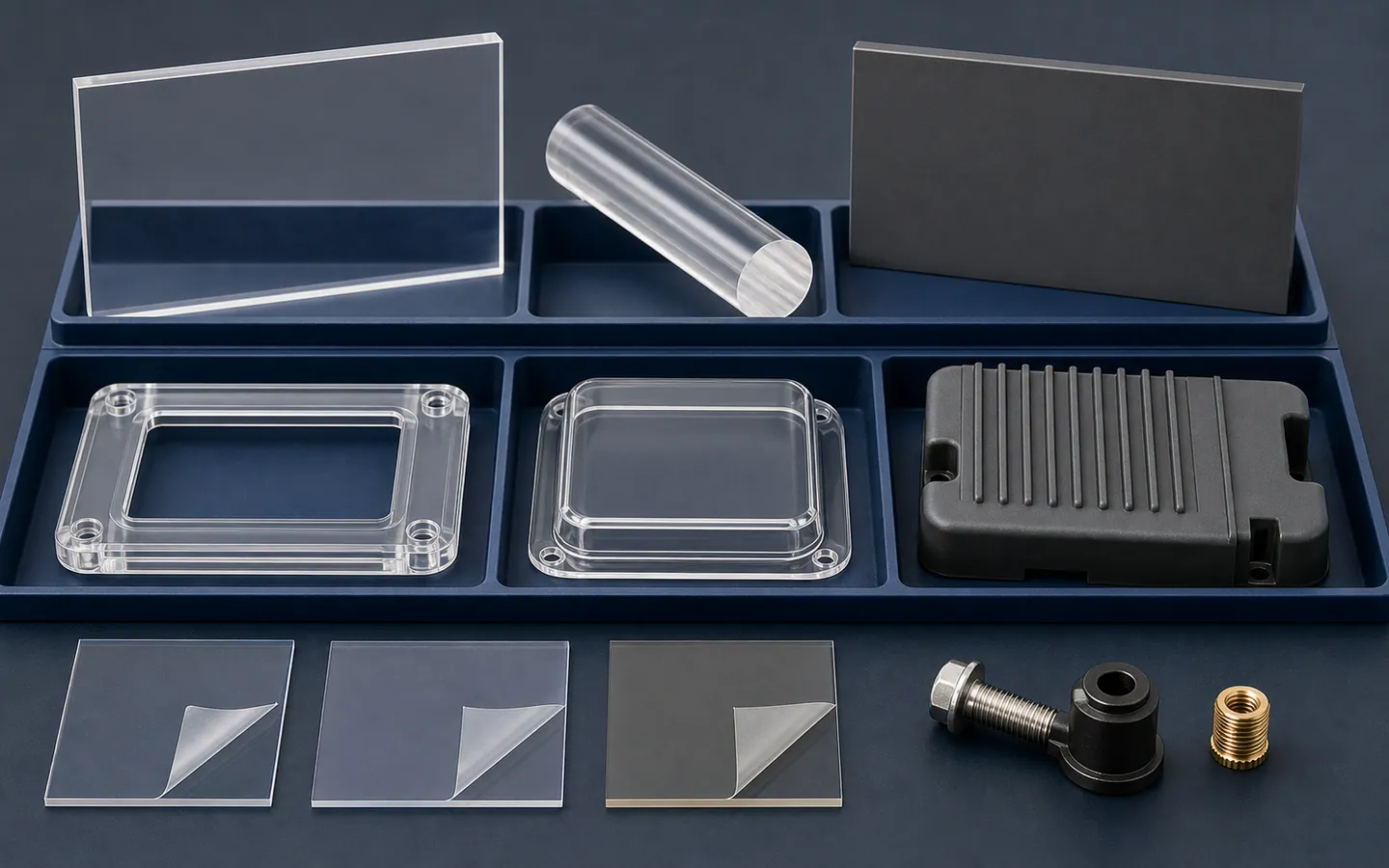
Plate, sheet, rod or billet can support windows, covers, fixtures and complex parts in selected quantities. Tooling, heat, burrs, edge polish, stress relief and protective film affect the final surface.
Material selection decision
Polycarbonate is available in clear, colored, filled and specialty grades and can be machined, formed, printed or molded through different routes. Optical appearance, impact intent, stress, chemical exposure, joining and quantity determine the suitable choice. MakeNexa reviews the exact grade and supplier route; performance and compliance require project evidence.
Selection criteria
State whether the part must be transparent, merely translucent or opaque, and identify viewing zones, distortion, haze, color, surface and light-path requirements. Add impact, load, temperature, flame, UV, chemical, cleaning and outdoor context. Not every polycarbonate grade or process provides the same optical or mechanical behavior. Exact resin, sheet, billet, colorant, coating and additives matter where performance or compliance is controlled.
Then compare geometry and quantity. Machining can support controlled small quantities and thick stock; thermoforming can shape compatible sheet; molding can create production-intent ribs, bosses and surfaces after tooling; additive routes may support earlier learning with different material and appearance. Define stress-sensitive features, screw bosses, sharp corners, solvents, adhesives, cleaning and protective packaging. A clear-looking sample is not evidence of optical, impact or flame performance.
Where the material fits
Optical surfaces, impact intent and process-created stress must be reviewed as connected requirements.
Plate, sheet, rod or billet can support windows, covers, fixtures and complex parts in selected quantities. Tooling, heat, burrs, edge polish, stress relief and protective film affect the final surface.
Thermoformed parts require exact sheet grade, thickness, draw, corner, trim, optical zone and heating plan. Thickness distribution and surface contact differ from flat incoming sheet.
Molding can produce ribs, bosses, lenses or housings when resin, wall, draft, flow, gate, ejector, tool finish, stress and sample acceptance are defined. Optical molding requires project-specific expertise and evidence.
Fasteners, adhesives, solvent processes, coatings, printing and cleaning can introduce stress, cracking or visual change. Define exact materials, sequence, cure, protected zones and final inspection.
Material tradeoffs
A visually acceptable part can still carry processing or assembly risks that appear later.
Transparency alone does not establish haze, distortion, birefringence, surface quality or light transmission. Specify exact optical criteria, viewing method and grade when the light path matters.
Cleaners, adhesives, oils and other chemicals can interact with stress and cause cracking. Provide exact media, concentration, temperature, duration and stressed assembly state for review.
Sharp corners, interference, over-tightening, molded-in stress and unsupported walls can create cracks. Define mating hardware, torque context, inserts, radii and assembly method without relying on material toughness alone.
Clear cosmetic surfaces can scratch during machining, forming, inspection, packing and assembly. Define film, separators, cleaning and final removal responsibility for visible zones.
Grade and route choices
Each route needs an exact grade and a process-specific acceptance plan.
Use compatible stock for small quantities, thick sections and controlled features when stress, heat, edge finish, optical zones and protective handling can be managed.
Use compatible sheet and tooling for covers and formed panels when draw, thickness distribution, trim, surface contact and optical distortion fit the requirement.
Use prototype or production tooling for molded ribs, bosses and repeat geometry when resin, stress, appearance, sample validation, secondary work and quality controls are mature.
Material comparison
Typical published values for unfilled polycarbonate. Actual values vary with grade, supplier, stock form and processing history, and the project requirement is confirmed on the reviewed quote rather than from this table.
| Property or decision factor | Typical published value | Routing consequence |
|---|---|---|
| Impact resistance | Notched Izod commonly 600 to 850 J/m, against roughly 20 J/m for acrylic | Around thirty times acrylic's impact strength — the reason to choose it |
| Tensile strength | About 60 to 70 MPa | Comparable to acrylic at about 70 MPa; strength is not what separates them |
| Tensile modulus | About 2.3 to 2.4 GPa, against roughly 3.2 GPa for acrylic | Polycarbonate is the more flexible of the two |
| Light transmission | About 88 to 90%, against roughly 92% for acrylic | Acrylic is the clearer material; polycarbonate is the tougher one |
| Heat deflection temperature | About 130 to 140 °C at 1.8 MPa, against 95 to 105 °C for acrylic | The wider service range of the two |
| Glass transition | About 147 °C | Above it the material softens over a narrow range |
| Density | About 1.20 g/cm³ | Marginally above acrylic at 1.19 |
| Scratch resistance | Noticeably worse than acrylic; hard-coated grades exist as separate materials | Specify a hard coat where the surface is handled or cleaned often |
| UV behaviour | Yellows outdoors unless a UV-stabilised or co-extruded grade is specified | State outdoor exposure explicitly |
| Stress cracking | Crazes and cracks under sustained stress with many solvents, cleaners and some adhesives — the most common field failure | Specify permitted cleaning agents and avoid designs that hold sustained tensile stress |
| Moulding shrinkage | About 0.5 to 0.7% | Tooling cut for the specific resin and wall |
| Drying before moulding | Must be dried below roughly 0.02% moisture before processing; a wet resin loses strength permanently and shows splay | A process control, not an optional step |
| Machined tolerance | ±0.1 mm is realistic; machined edges craze easily and internal corners are crack initiation sites | Specify radii, and state whether edges must be polished |
Material RFQ inputs
Provide exact visual, environment and assembly context so clear appearance is not mistaken for proven performance.
Complete packages move faster: revision-matched CAD, critical dimensions, quantity and material notes are enough to open engineering review across the network.
Get a QuoteSubmit the controlled model, drawing, revision and part application
State exact polycarbonate grade, color, additives, stock form and evidence needs
Define optical zones, haze, distortion, appearance, impact, temperature, UV, flame and chemical context
Identify machining, forming, molding, stress-sensitive corners, bosses and final dimensional state
Specify fasteners, inserts, adhesives, coatings, cleaning, surface finish and protective film
List quantities, inspection, tests, documents, packaging and permitted process alternatives
Questions before routing
These answers prepare the request; the reviewed quote controls project-specific commitments.
No. Light transmission runs around 88 to 90% for standard grades, but optical quality depends on the stock form and the surface: extruded sheet, cast sheet and moulded parts differ, and machined or sawn edges scatter light until they are polished. Hard-coated, UV-stabilised and abrasion-resistant grades are separate materials. Where acrylic's roughly 92% transmission and better scratch resistance matter more than impact, acrylic may be the correct choice instead.
Machining from sheet or rod suits prototypes and low quantities and holds about ±0.1 mm, but every machined edge is a potential craze initiation site and usually needs polishing on an optical part. Moulding gives the surface, consistency and cycle economics, at tooling cost and lead time, with about 0.5 to 0.7% shrinkage to design around and a mandatory resin drying step below roughly 0.02% moisture. State quantity, optical requirement and cosmetic zones so the routes can be compared.
Yes, and this is the single most common polycarbonate failure in the field. It is environmental stress cracking: a part under sustained tensile stress — from a press fit, an over-torqued fastener, or moulded-in stress — crazes and then cracks in contact with many solvents, cleaners and adhesives. The part is fine unstressed and fails within hours once assembled and wiped down. Specify permitted cleaning agents on the drawing, radius internal corners, avoid press fits, and anneal moulded parts where stress is a concern.
On tensile strength they are close — about 60 to 70 MPa for polycarbonate against roughly 70 MPa for acrylic — and acrylic is actually the stiffer at about 3.2 GPa against 2.3 to 2.4 GPa. The difference is toughness: polycarbonate's notched Izod impact commonly runs 600 to 850 J/m against about 20 J/m for acrylic, roughly thirty times higher. Acrylic shatters, polycarbonate deforms. Choose polycarbonate for impact and heat, acrylic for clarity and scratch resistance.
As optical parts, not as machined parts. Polycarbonate scratches more easily than acrylic, so protective film should stay on through machining and shipping wherever possible, and interleaving should be non-abrasive and free of plasticisers that could initiate crazing. State the cosmetic zones, the acceptance criteria for surface defects, whether protective film is to remain on delivery, and the permitted cleaning agents for the receiving inspection.
Next step
Send the material requirement with geometry and use context. MakeNexa routes capable suppliers from a global network covering competitor-class process categories, then returns a prepared quote or focused clarification for your revision.