 MAKENEXA
Sliding and rotating interfaces
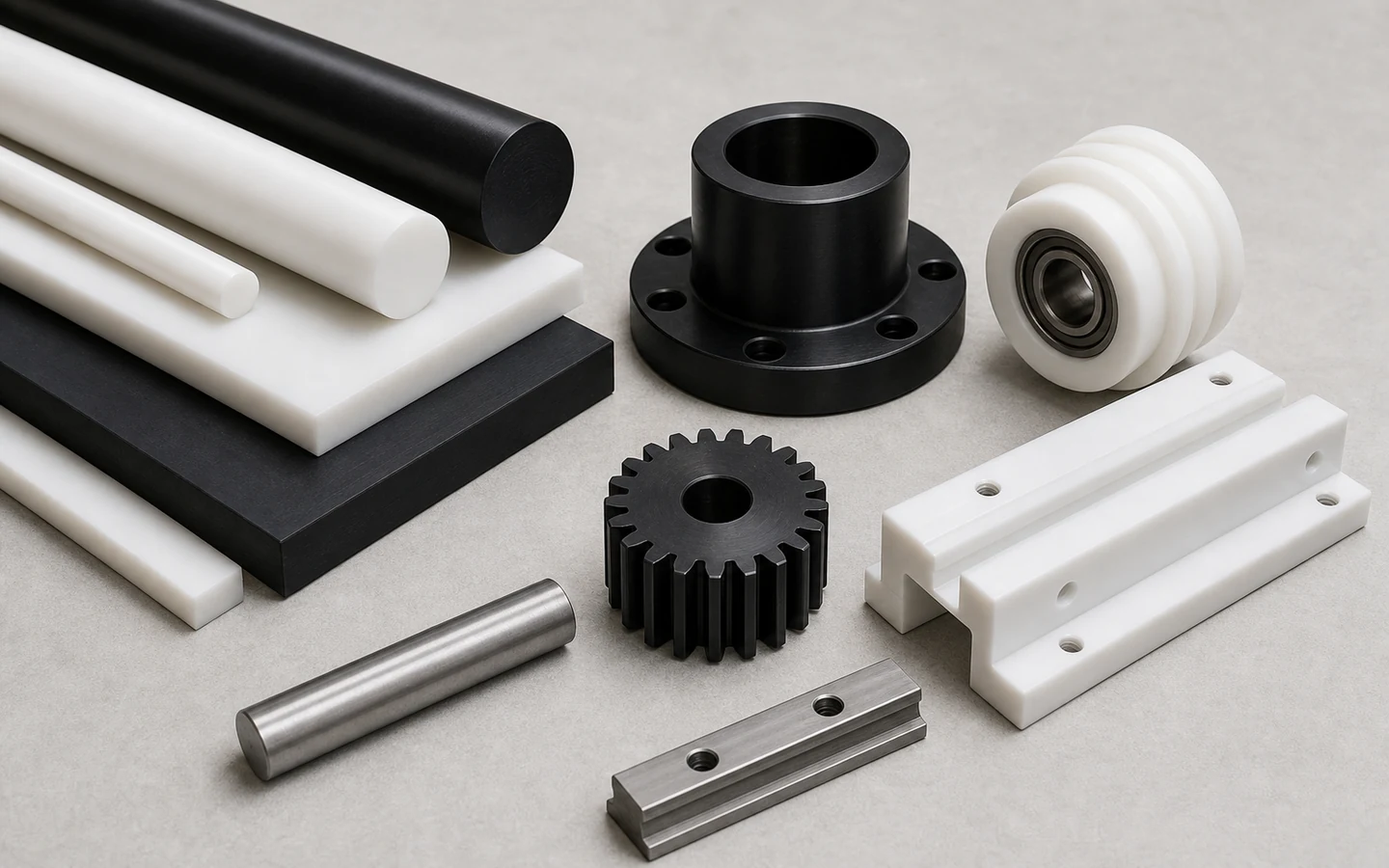
Bushings, guides, rollers and gears may use acetal when load, speed, lubrication and counterface are defined.
Material selection decision
Source machined and molded acetal components including guides, gears, bushings, rollers, fixtures and housings. MakeNexa reviews homopolymer or copolymer grade, stock condition, wear system, moisture, geometry, surface, quantity and inspection before confirming the route.
Selection criteria
POM and acetal are often chosen for low friction, stiffness, machinability and dimensional performance, but homopolymer and copolymer grades are not identical. Centerline porosity in some extruded stock, chemical exposure, hot water, UV, wear counterface and impact can change which grade and stock form make sense. Delrin is a trade name and should not be used as a universal synonym when brand matters.
Machined acetal parts can achieve clean features, but broad thin geometry, heavy stock removal, temperature and workholding still affect final measurements. Molded acetal introduces shrink, draft and tooling decisions. MakeNexa reviews exact grade, brand restriction, color, filler, stock or molding route, critical fits and inspection condition. Supplier, material availability, tolerance, price and timing are confirmed per RFQ.
Where the material fits
Relate the material to friction, moisture, stiffness and production needs.
Bushings, guides, rollers and gears may use acetal when load, speed, lubrication and counterface are defined.
Fixtures, spacers and mechanisms can benefit from machinability and stiffness within the application's temperature range.
Acetal may be compared with nylon where water-related dimensional change matters, subject to chemicals and grade.
Stable geometry and demand may support molding when draft, shrink, gating and material controls are addressed.
Material tradeoffs
A generic material callout can hide grade, stock and service differences.
Specify grade or required behavior; chemical, thermal, wear and stock considerations can differ.
Large rod or thick sections may need review where internal bores, sealing or appearance expose the stock center.
Fits and broad dimensions should account for temperature during use and inspection.
Load, speed, counterface, lubricant, debris and duty cycle matter more than a generic low-friction claim.
Grade and route choices
Part geometry, quantity and grade supply guide machining, molding or material alternatives.
Supports prototypes and repeat batches with controlled bores, profiles and interfaces from defined stock.
Considered for stable volumes and moldable parts when tooling, shrink and gate-related behavior are planned.
Compared when impact, temperature, wear, moisture, chemical exposure or cost shifts the material decision.
Material comparison
Typical published values for unfilled acetal. Homopolymer and copolymer differ in ways that matter for machining and for hot water service. Actual grade behaviour depends on the supplier's resin, stock form and part geometry, and the project requirement is confirmed on the reviewed quote rather than read off this table.
| Property | Typical published value | Why it matters for the part |
|---|---|---|
| Density | 1.41 g/cm³ for both homopolymer and copolymer | Sets part weight and stock cost directly; acetal is denser than nylon at 1.14 g/cm³ |
| Tensile strength | About 70 MPa for homopolymer and 62 MPa for copolymer, classified under ASTM D6778 | Homopolymer is the stiffer, stronger choice where the part is loaded rather than worn |
| Tensile modulus | 2.8 to 3.1 GPa, high enough that acetal holds a snap-fit and a thread without creeping quickly | Deflection under a sustained load, and whether a snap feature stays engaged |
| Melting point | 175 °C for homopolymer and 165 °C for copolymer, with continuous service usually held near 90 °C | Machining heat, welding, and whether the part survives a wash cycle |
| Thermal expansion | About 110 µm per metre per °C — roughly five times steel | A 100 mm bore moves about 0.11 mm across a 10 °C swing, which can close a running fit |
| Water absorption | 0.2 to 0.25% at 24 h, against 1.5% or more for nylon 6/6 | Acetal holds dimensions in humid service where nylon grows |
| Friction against steel | Dynamic coefficient around 0.2 to 0.35 dry, which is why acetal is the default unlubricated bearing plastic | Whether the wear pair needs lubrication or a filled grade |
| Machined tolerance | ±0.05 mm is realistic on small machined features; ±0.025 mm needs temperature control and a stress-relieved blank | Which fits justify the extra process control |
| Hot water limit | Copolymer resists hot water and alkaline cleaning better than homopolymer, which can degrade above about 60 °C in continuous wet service | Whether the grade choice is driven by strength or by the cleaning regime |
Material RFQ inputs
State whether the grade or the required performance controls the purchase.
Complete packages move faster: revision-matched CAD, critical dimensions, quantity and material notes are enough to open engineering review across the network.
Get a Quote3D model and drawing with datums and functional fits
Exact acetal grade, brand restriction, filler, color and alternatives
Temperature, moisture, chemicals, wear and cleaning environment
Stock form or molding preference and quantity context
Surface, burr, porosity-sensitive and cosmetic requirements
Inspection condition, material records, packaging and delivery needs
Questions before routing
These answers prepare the request; the reviewed quote controls project-specific commitments.
POM is the polymer family and acetal is the common name; Delrin is a brand associated with specific homopolymer grades. The distinction is not cosmetic: homopolymer publishes around 70 MPa tensile strength against roughly 62 MPa for copolymer, while copolymer holds up better in hot water and alkaline cleaning. Homopolymer stock can also carry centreline porosity in larger diameters. State the exact grade or the required behaviour when interchangeability is limited.
Neither is universally better, and moisture usually decides it. Acetal absorbs 0.2 to 0.25% water at 24 h and holds its dimensions; nylon 6/6 takes up 1.5% or more and grows measurably, which can close a machined fit in humid service. Nylon returns better impact resistance and abrasion life. Temperature, chemicals, stiffness, noise, cost and grade availability fill in the rest of the comparison.
About 110 µm per metre per °C, roughly five times the movement of steel. On a 100 mm bore that is around 0.11 mm across a 10 °C change — enough to close a running clearance or to put a press fit into interference. Machined acetal parts also relax after cutting, so a stress-relieve step is normal before final passes when a fit must hold to ±0.05 mm. State the measurement temperature with any tight dimension.
Some stock forms and sizes may show centreline porosity, and homopolymer extruded rod above roughly 50 mm diameter is the common case. It surfaces as a visible line or a leak path when the part is bored through the centre. Identify sealing, appearance and bore locations so stock form and geometry can be reviewed before quoting.
Yes through suitable suppliers. Acetal shrinks strongly for a thermoplastic — commonly 1.8 to 2.5%, against about 0.5% for ABS — so tooling must be cut for the specific resin and wall. Exact resin, geometry, shrink, venting, tooling, quantity and acceptance requirements need to be defined, and the reviewed quote confirms the project route.
Next step
Send the material requirement with geometry and use context. MakeNexa routes capable suppliers from a global network covering competitor-class process categories, then returns a prepared quote or focused clarification for your revision.