 MAKENEXA
Machined ABS prototypes
Billet or plate machining can support controlled interfaces and small quantities when stock grade, wall support, burrs, heat and surface finish are acceptable. Identify where stock material differs from future molding resin.
Material selection decision
ABS can appear as billet, filament and molding resin, but those routes do not create interchangeable parts. Grade, additives, process, orientation, tooling, surface and quantity influence the result. MakeNexa reviews the design stage and final requirement across its network; properties, appearance, price, timing and suitability remain specific to the exact material and RFQ.
Selection criteria
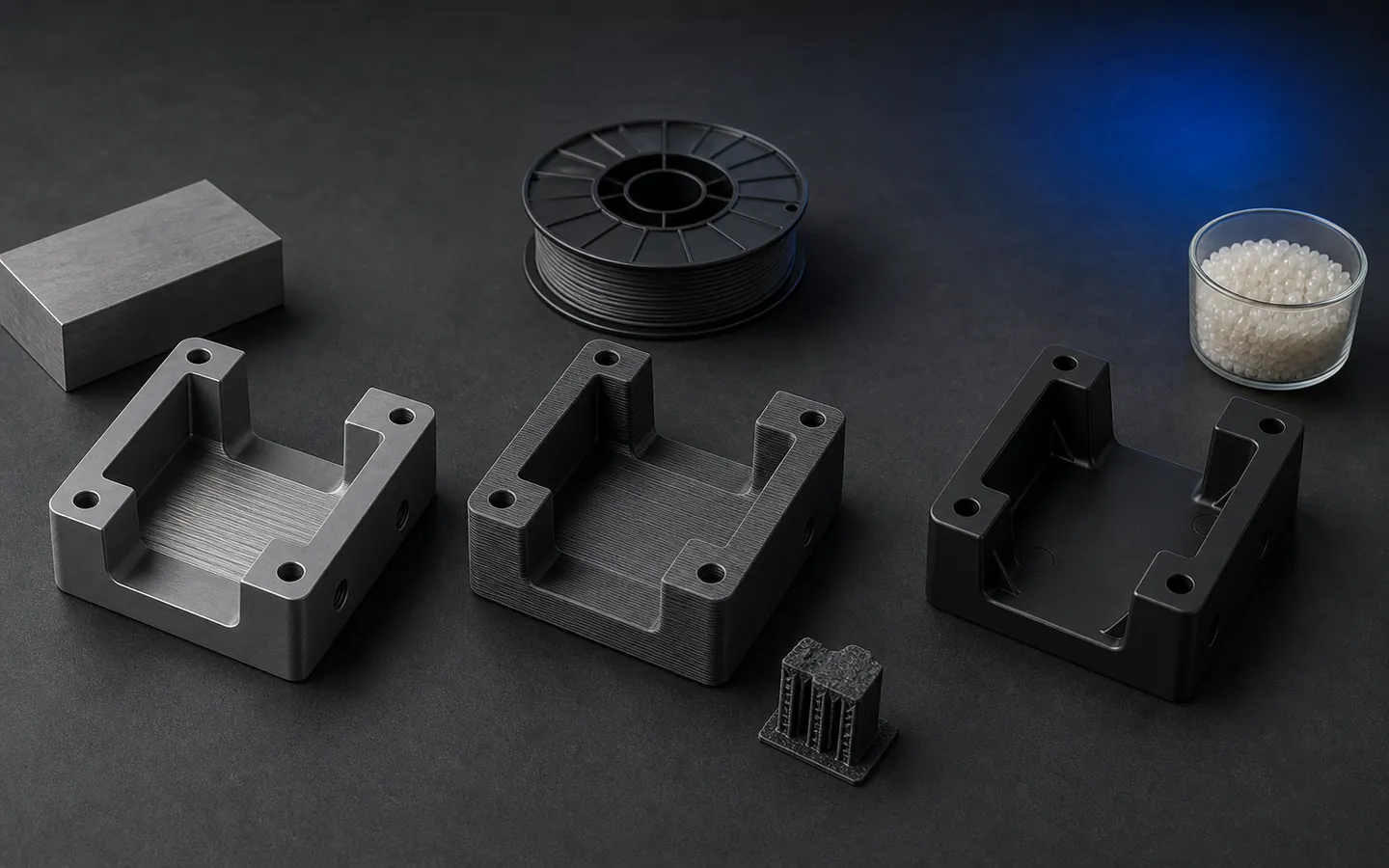
Start with program stage and function. A machined ABS component may provide controlled geometry from available stock; an FDM part may support rapid form, fit or fixture learning with visible orientation and layer effects; an injection molded component may fit production-intent geometry and quantities after tooling and sample validation. The same nominal ABS family can differ by resin manufacturer, grade, color, additive, stock or filament and processing history.
Define mechanical, temperature, chemical, UV, flame, cosmetic, dimensional and assembly requirements plus the quantities across prototype, bridge and production stages. State whether a process is mandated or whether alternatives may be reviewed. Do not use a printed or machined sample as proof of molded properties, surface or shrink. MakeNexa returns a route-specific quote with material and tooling assumptions rather than declaring one process universally faster or better.
Where the material fits
Each route answers different geometry, material, appearance and commercial questions.
Billet or plate machining can support controlled interfaces and small quantities when stock grade, wall support, burrs, heat and surface finish are acceptable. Identify where stock material differs from future molding resin.
FDM can support form, fit, fixture and selected functional learning when orientation, layer behavior, support marks, internal fill and thermal history are acceptable. Document those differences before comparing to molding.
Molding fits production-intent geometry and repeat releases when resin, draft, wall, ribs, bosses, shrink, gates, ejectors, appearance, tool and sample acceptance are defined together.
Pigment, texture, process, tool surface, print layers and machining marks affect appearance. Mark viewing zones and use process-specific references rather than expecting a universal ABS finish.
Material tradeoffs
A matched shape can still have different material, surface, tolerance and behavior by process.
State exact resin, stock or filament grade when properties, color, additives, flame or compliance matter. Broad family names do not establish equivalence across suppliers and processes.
Layer direction, support, wall path, internal structure and thermal history can affect feature behavior and appearance. Define build and post-process expectations for any functional print.
Machined stock does not reproduce molded flow, knit lines, shrink, gates, ejector marks or resin-processing history. Use it for the decisions it can support and plan molded validation separately.
Texture, gloss, color, gate, ejector and weld-line sensitivity should be reviewed before a production-intent tool is finalized. Vague cosmetic adjectives create late changes.
Grade and route choices
The route should fit current decisions while preserving a clear transition to the intended final process.
Use exact ABS stock for small quantities, fixtures or geometry learning when subtractive access, wall stability and finish fit. Document material and process differences from later parts.
Use FDM or another reviewed additive process for rapid form and fit or selected functional use. Define grade, orientation, layer, support, finish and acceptance for the actual print.
Use prototype or production tooling when molded resin, appearance and repeat supply are required. Quote resin, tool, samples, secondary operations, finished part and lifecycle controls together.
Material comparison
Typical published values for unfilled ABS. Printed, machined and moulded ABS do not share a datasheet, and actual values vary with grade and supplier, so the project requirement is confirmed on the reviewed quote rather than from this table.
| Route or property | Typical published value | Requirements to provide |
|---|---|---|
| Tensile strength, moulded | About 40 to 45 MPa | The reference figure — printed and machined parts do not match it |
| Tensile strength, FDM printed | Commonly 30 to 40 MPa in plane, with interlayer strength at only 30 to 70% of that | Load direction and orientation, not just the material name |
| Tensile modulus | About 2.3 GPa | Below acetal at 3.1 GPa and polycarbonate at about 2.4 GPa |
| Heat deflection temperature | About 98 °C at 0.45 MPa; well under that at higher load | The service temperature the part actually sees, including transport and cleaning |
| Density | About 1.04 g/cm³ | Among the lightest of the common engineering plastics |
| Impact resistance | Good and the main reason to choose ABS, though well below polycarbonate | State the impact requirement and the temperature it applies at |
| Moulding shrinkage | About 0.4 to 0.7%, against 1.8 to 2.5% for acetal | One reason ABS is a forgiving material to tool |
| Water absorption | About 0.3% | Resin must be dried before moulding; a wet resin gives splay and lost strength |
| UV behaviour | Degrades and yellows in sunlight unless a UV-stabilised grade or a coating is specified | State outdoor exposure explicitly — the standard grade is an indoor material |
| Solvent behaviour | Dissolves in acetone and attacked by many solvents; this is also what makes solvent bonding and vapour smoothing work | Specify permitted cleaning agents on the drawing |
| Machining | Cuts cleanly from extruded plate and rod, holding about ±0.1 mm | The usual route for a one-off prototype housing |
| Flame rating | Standard grades are not flame rated; UL 94 V-0 grades exist as separate materials with different mechanical properties | State the rating requirement before the grade is fixed |
Material RFQ inputs
Provide design stage and final-process intent so a prototype route is not mistaken for the production requirement.
Complete packages move faster: revision-matched CAD, critical dimensions, quantity and material notes are enough to open engineering review across the network.
Get a QuoteSubmit the controlled model, drawing, revision and part application
State exact ABS stock, filament or molding grade, color, additives and evidence needs
Provide prototype, bridge and production quantities with design maturity and release cadence
Define machining, build orientation, layer, molding draft, wall, ribs, gates and tool state as relevant
Mark cosmetic zones, texture, color, assembly interfaces, environment and tests
List inspection, documents, secondary operations, packaging and transition-validation needs
Questions before routing
These answers prepare the request; the reviewed quote controls project-specific commitments.
Depends on what the prototype must prove. Machined ABS from extruded plate holds about ±0.1 mm with isotropic properties near the moulded figure of 40 to 45 MPa, so it represents a production part reasonably well for fit and function. FDM printed ABS is faster and cheaper for geometry checks but publishes 30 to 40 MPa in plane and only 30 to 70% of that across layers, with ±0.2 mm or ±0.2% accuracy. If the test is structural, machine it; if it is a form check, print it.
No. Moulded ABS is isotropic at about 40 to 45 MPa tensile; printed ABS is a stack of welded layers, publishing 30 to 40 MPa in plane and only 30 to 70% of that in the build direction, with visible layer surfaces and typically some porosity. Printed parts also warp during the build, which is why ABS is one of the harder filaments to print large. Use the process-specific data rather than the resin datasheet.
When quantity justifies the tool and consistency matters. ABS is a forgiving material to mould — shrinkage of about 0.4 to 0.7% against 1.8 to 2.5% for acetal — so tooling is comparatively straightforward. The trigger is usually the point at which per-part machining or printing cost multiplied by quantity exceeds the tooling cost, combined with a need for the properties and surface finish only moulding gives. State the quantity, the annual forecast and the cosmetic requirement so the comparison can be made.
Standard ABS will not. It degrades and yellows under UV, losing impact strength as it does, so an outdoor part needs a UV-stabilised grade, a pigment system or a coating — each of which is a different material or a separate operation. Its heat-deflection figure of about 98 °C at 0.45 MPa also drops quickly under load, which matters in a car interior or a sunlit enclosure. State the exposure explicitly rather than treating ABS as one material.
No. Standard ABS grades carry no flame rating; UL 94 V-0 grades exist but are separate materials with different mechanical properties, cost and colour availability, and a rating belongs to a specific grade at a specific thickness rather than to ABS as a family. Food contact and other regulatory routes are separate questions again. State the requirement before the grade is fixed, and it is reviewed and confirmed on the quote.
Next step
Send the material requirement with geometry and use context. MakeNexa routes capable suppliers from a global network covering competitor-class process categories, then returns a prepared quote or focused clarification for your revision.