 MAKENEXA
Functional prototypes
Machining can evaluate a real engineering-plastic grade and critical interfaces before tooling or a larger production decision.
Manufacturing service decision
Source machined plastic prototypes and production parts across engineering thermoplastics and high-performance polymers. MakeNexa reviews material grade, stock condition, geometry, thermal and moisture context, surface expectations and inspection needs before confirming a machining route.
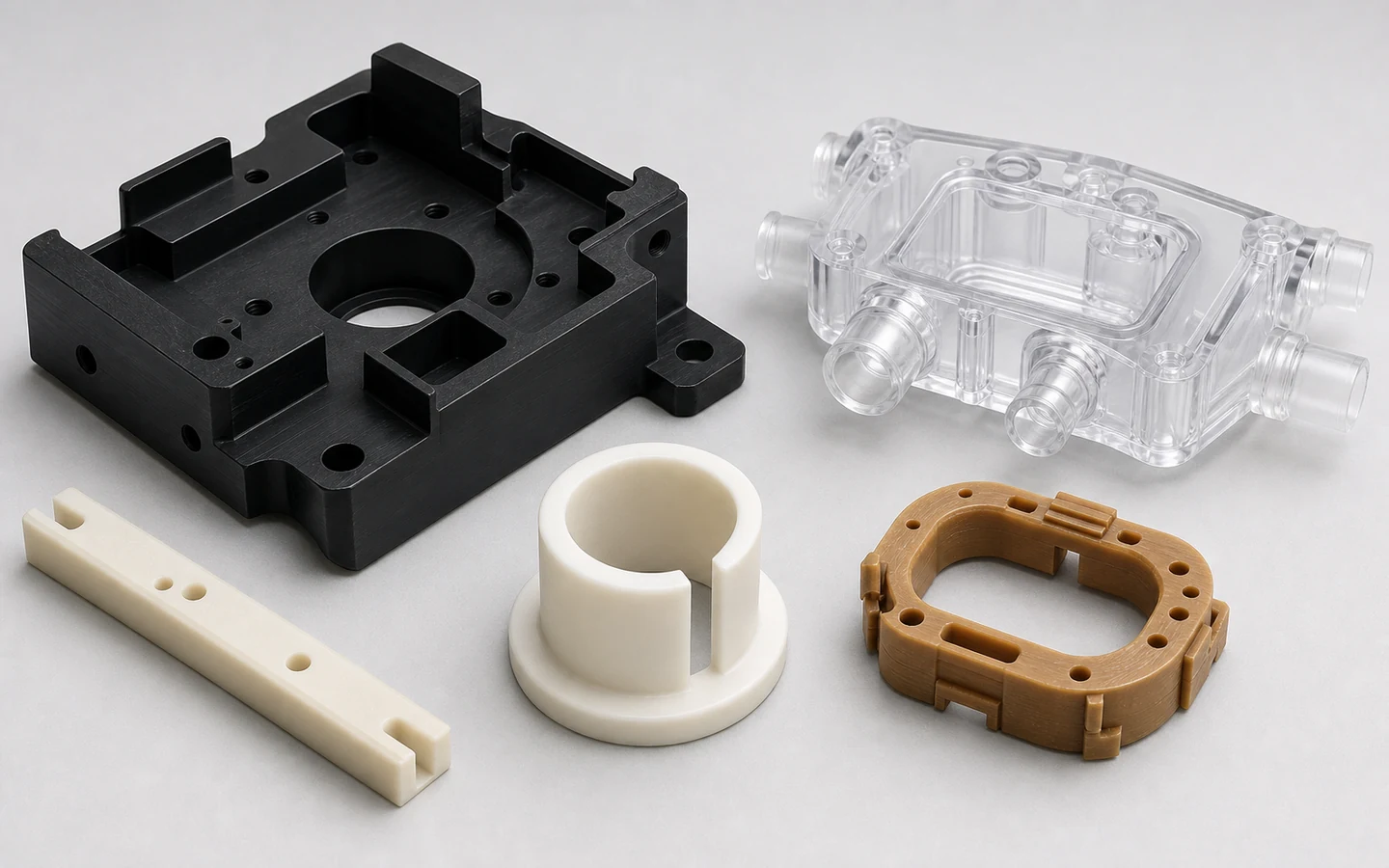
Route decision
CNC machining is often useful when a plastic part needs production-grade material without molding tooling, has a geometry suited to plate or rod stock, or requires low and repeat quantities with controlled interfaces. It can support housings, insulators, wear components, manifolds, guides, fixtures and replacement parts, but a material name by itself is not enough to define the job.
Engineering plastics can move with temperature, moisture, residual stress, clamping and material removal. Thin walls, large flat areas, deep pockets, tight fits, transparency and cosmetic faces need explicit discussion. MakeNexa reviews grade and stock form, conditioning or annealing requirements when specified, workholding risk, edge quality, dimensional condition and documentation with the selected supplier.
Best-fit parts and programs
The route is most useful when it aligns with material form, quantity and functional requirements.
Machining can evaluate a real engineering-plastic grade and critical interfaces before tooling or a larger production decision.
Plate, sheet, tube or rod stock can support controlled batches when molding tooling is not justified or the design may change.
Bushings, guides, insulators, seals, manifolds and fixtures may be routed from wear, friction, chemical, thermal and dielectric needs.
A controlled drawing and material definition can support discontinued or custom components when the original process is unavailable or unnecessary.
Feasibility checks
Applying metal-part assumptions to plastic often creates avoidable distortion or acceptance disputes.
Define the temperature, moisture or conditioning state when it materially affects measurement or assembly.
Thin sections, deep pockets and heavy asymmetric material removal may relax stress or deflect under workholding.
Burrs, fuzzing, whitening, heat marks, scratches and transparency expectations differ by polymer and feature.
Specify grade, filler, color, brand restriction and certificate or traceability needs rather than using only a generic polymer family.
Route options
Geometry and stock form guide the operation sequence.
Used for housings, manifolds, plates, guides and prismatic parts where pocketing, flatness and workholding need joint review.
Used for bushings, rollers, spacers, seals and rotational parts with controlled bores, diameters and edge conditions.
Threaded inserts, bonding, marking, polishing, cleaning or inspection may be sequenced when material compatibility is confirmed.
Decision comparison
Typical published capability for CNC machining engineering plastics. Achievable tolerance depends far more on the polymer than on the machine, and the project requirement is confirmed on the reviewed quote rather than from this table.
| Decision area | Typical published value | Review focus |
|---|---|---|
| Machine capability against material capability | A mill holds ±0.025 mm on metal; the same machine on unfilled nylon cannot hold it because the material moves more than that with humidity | The polymer sets the tolerance, not the equipment |
| Acetal | ±0.05 mm is realistic on small features; ±0.025 mm needs a stress-relieved blank and temperature control | The most dimensionally predictable of the common machinable plastics |
| Nylon 6/6 | ±0.1 mm at best on unfilled stock — the material grows 0.5 to 0.8% from dry to equilibrium moisture | On a 100 mm feature that is 0.5 mm and more, larger than any tolerance |
| PEEK and PEI | ±0.05 mm on small features, with an annealing step between roughing and finishing on precision parts | Residual stock stress releases as material is removed |
| HDPE and UHMW | ±0.25 mm is realistic; the material relaxes after cutting and moves with shop temperature | Do not specify a tolerance the polymer cannot hold |
| PTFE | ±0.1 mm, limited by a 0.5 GPa modulus that deflects under clamping and 100 to 160 µm per metre per °C expansion | Free-state measurement at a stated temperature |
| Thermal expansion in general | Engineering plastics move 5 to 20 times more than steel per °C | The measurement temperature stated with every tight dimension |
| Surface finish | Ra 0.8 to 1.6 µm from a finishing pass on acetal and PEEK; softer polymers smear rather than cutting cleanly | Whether a finish callout is achievable without a secondary operation |
| Minimum wall | About 1.0 mm before deflection under cutting load dominates, against 0.8 mm in metal | Thin plastic walls move during cutting and after |
| Heat at the cut | Plastics melt rather than work-harden; sharp tooling, high rake and chip clearance matter more than speed | Why a metal-shop programme does not transfer directly |
| Threads | Machined threads in soft polymers strip easily; a threaded insert is often the better answer | Whether the thread is loaded or locating |
| Optical surfaces | Machined acrylic and polycarbonate edges are matte and scatter light until flame or vapour polished | Which surfaces are optical and which are not |
Quote inputs
State the service environment and material definition before tightening dimensions by default.
Complete packages move faster: revision-matched CAD, critical dimensions, quantity and material notes are enough to open engineering review across the network.
Get a QuoteCAD and drawing with critical interfaces and datum intent
Exact resin grade, filler, color, stock form and permitted alternatives
Operating temperature, moisture, chemical, wear and electrical context
Quantity, prototype or production stage and likely repeat demand
Surface, burr, cleanliness, transparency and cosmetic requirements
Inspection condition, material records, packaging and delivery needs
Questions before routing
These answers prepare the request; the reviewed quote controls project-specific commitments.
All the common machinable engineering polymers route through the network in rod, plate and sheet: acetal, nylon in PA6, PA66 and PA12, PEEK and glass-filled PEEK, PEI, PTFE and its filled grades, polycarbonate, acrylic, ABS, HDPE and UHMW. What varies is stock availability by grade and blank size, which is usually the long-lead item on a polymer quote rather than the machining — high-performance grades especially. Tolerance is set by the polymer rather than the machine: acetal reaches about ±0.05 mm where unfilled nylon 6/6 is limited to ±0.1 mm by moisture movement. Send the grade and blank size for availability and lead time.
Not usually, and the limit is the material rather than the machine. Acetal reaches about ±0.05 mm on small features; PEEK and PEI similar with an annealing step; nylon 6/6 struggles past ±0.1 mm because it grows 0.5 to 0.8% from dry to equilibrium moisture; HDPE is nearer ±0.25 mm. Engineering plastics also expand 5 to 20 times more than steel per °C, so any tight dimension needs a stated measurement temperature.
No. A machined or sawn edge on either material is matte and scatters light — it looks frosted, not clear. Flame polishing, vapour polishing or mechanical polishing are separate operations, and cast acrylic polishes far more predictably than extruded. Polishing also adds local heat and stress that can become a crack initiation site later. State which surfaces are optical, which stock form is required, and the acceptance basis.
Commonly, and they are often the better answer than a machined thread — cut threads in soft polymers strip under modest torque. Heat-set brass inserts are the usual route, with at least 1.5 mm of material planned around the insert. Provide insert type, installation method, load, torque and inspection needs. On nylon, note that moisture-driven growth relaxes the boss's grip as the part conditions.
Two causes, and they need different answers. Residual stress in extruded or moulded stock releases as material is removed, so a thin-walled or asymmetric part bows after roughing — the fix is an annealing step before the finishing passes, which is normal on precision PEEK and PEI. The other is moisture: nylon 6/6 grows 0.5 to 0.8% reaching equilibrium regardless of how it was machined, and there is no process fix for that, only a material change to acetal or PA12.
Next step
Send geometry and process requirements for review. MakeNexa routes capable suppliers from a global network covering competitor-class process categories, then returns a prepared quote or focused clarification for your revision.