 MAKENEXA
Highly loaded machined brackets
Strength-to-weight can matter in structural links, supports and mounts when geometry and load direction are understood.
Material selection decision
Consider Aluminum 7075 when strength-to-weight is a controlling requirement for a machined component. MakeNexa reviews exact temper, product form, geometry, corrosion environment, joining, finish, inspection and material records before supplier routing.
Selection criteria
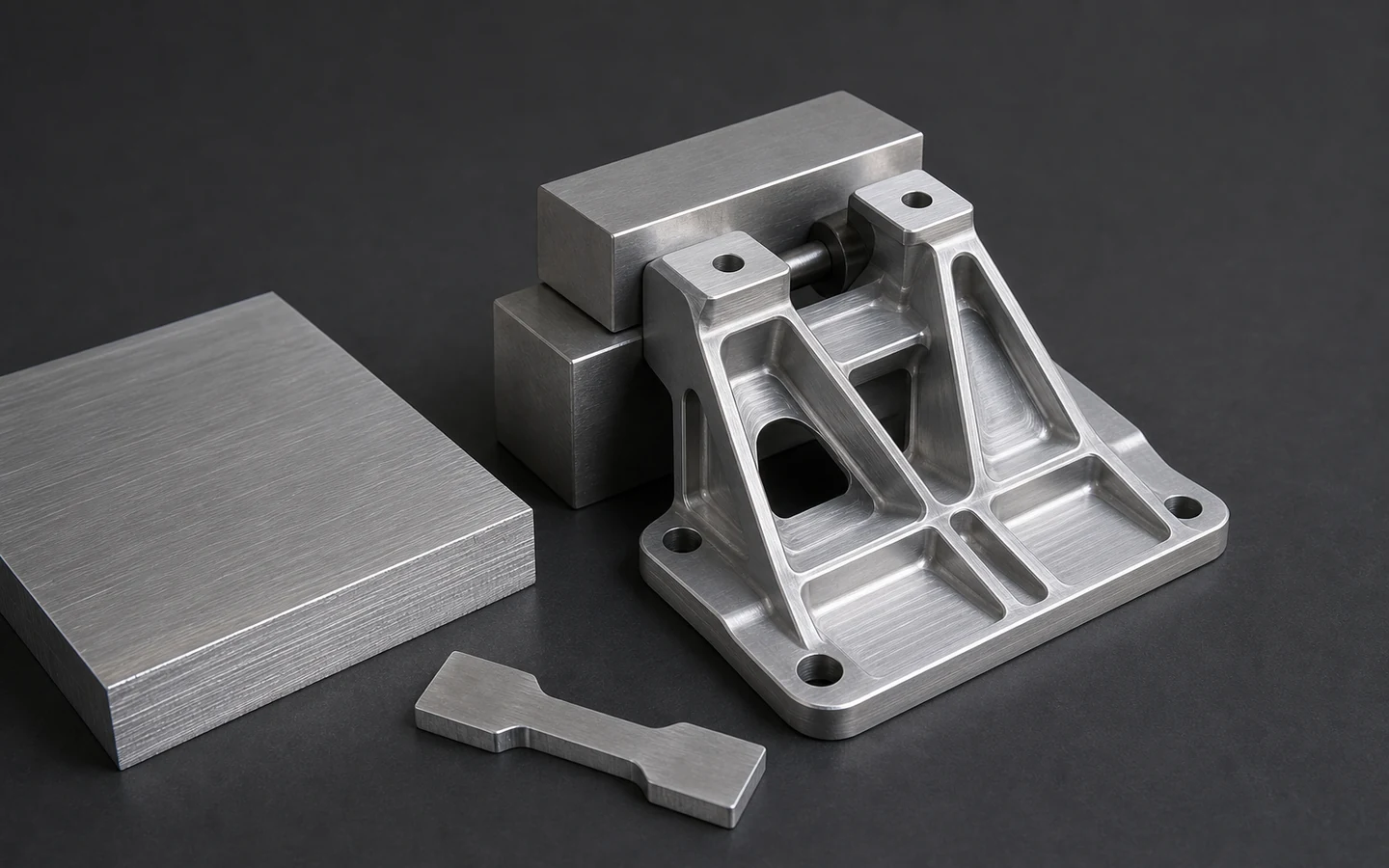
Aluminum 7075 is commonly evaluated for highly loaded brackets, structural components, fixtures and other machined parts where a higher-strength aluminum route is valuable. That benefit comes with tradeoffs in corrosion behavior, joining, material cost, finish expectations and stock condition that must be compared with 6061, steel, stainless steel or titanium for the actual use environment.
The exact temper is part of the purchasing definition. Geometry, section thickness, material direction, stress-relief condition, heavy stock removal and finish sequence may affect dimensional planning. MakeNexa reviews supplier, stock, process and documentation fit per RFQ rather than presenting 7075 as universally available or appropriate.
Where the material fits
Start with load, mass and environment rather than the alloy name.
Strength-to-weight can matter in structural links, supports and mounts when geometry and load direction are understood.
Fixtures, plates and handling tools may benefit when mass reduction matters without moving to a polymer or lower-strength alloy.
Machining a controlled part from suitable stock may consolidate geometry, subject to distortion, access and material-direction review.
Programs that already define 7075 and temper should include the governing specification and required material evidence in the RFQ.
Material tradeoffs
Higher strength does not eliminate environmental and manufacturing constraints.
Exposure, protective finish, contact with other materials and damaged-surface risk should be reviewed against the application.
Do not assume the same welding route used for 6061. Mechanical fastening, inserts, assembly and alternative alloys may need comparison.
Exact temper, stress-relief condition, product form, section and material direction can affect sourcing and dimensional behavior.
Anodizing or coating needs a defined function and cosmetic standard; appearance should be confirmed rather than inferred from an alloy label.
Grade and route choices
7075 is primarily a material decision inside a complete process route.
Reviewed for brackets, frames, plates and complex structural geometry with controlled datums and load interfaces.
Reviewed for high-strength rotational or mixed-feature components when appropriate stock and workholding are available.
Anodizing, coating, marking, inserts and fastening are reviewed for corrosion, dimensions, contact surfaces and acceptance.
Material comparison
Typical published values for the tempers named. Actual values vary with product form, section thickness and the supplier's material certification, and the project requirement is confirmed on the reviewed quote rather than from this table.
| Property or candidate | Typical published value | What to review before selection |
|---|---|---|
| Tensile yield strength | 503 MPa / 73 ksi in T6; about 435 MPa / 63 ksi in T73 | T73 trades roughly 14% of the yield for materially better stress-corrosion resistance |
| Ultimate tensile strength | 572 MPa / 83 ksi in T6 | Margin against peak load, and whether the T73 overage still clears it |
| Modulus of elasticity | 71.7 GPa / 10.4 Msi | Only about 4% above 6061 — 7075 does not fix a deflection problem |
| Density | 2.81 g/cm³ | Roughly 4% heavier than 6061, so the strength-to-weight gain comes from strength, not mass |
| Hardness | About 150 HB in T6 | Chips break more cleanly than 6061 at about 95 HB, which helps unattended machining |
| Elongation at break | About 11% in T6 | Limited forming; this is a machining and fastening alloy, not a bending one |
| Fusion welding | Not considered weldable by conventional fusion methods because of hot cracking | Mechanical fastening or friction stir welding as the joining route |
| Stress-corrosion cracking | Susceptible in T6, particularly in short-transverse loading of thick plate | Whether the service environment and sustained stress justify T73 or T7351 |
| Residual stress | Thick plate carries quench stress that moves the part between operations, which is why T651 and T7351 exist | A stress-relieved temper and a roughing pass before final sizing |
| Thermal expansion | About 23.6 µm per metre per °C | Same as 6061 — a 200 mm feature moves roughly 0.05 mm across a 10 °C change |
| Relative stock cost | Commonly 1.5 to 2 times 6061 for equivalent product form | Whether the strength is needed across the whole part or only at one feature |
| Common specifications | ASTM B209 for sheet and plate, ASTM B211 for bar, AMS 4045 and AMS 4126 where a programme requires them | Which specification the mill certificate must reference |
| Aluminum 6061 | 276 MPa / 40 ksi yield, 2.70 g/cm³, readily welded | Whether its strength meets the real load case |
| Titanium Grade 5 | 880 MPa / 128 ksi yield, 114 GPa modulus, 4.43 g/cm³ | Material specification, machining cost, lead time and supplier route |
Material RFQ inputs
Give engineering the load and environment context behind the material callout.
Complete packages move faster: revision-matched CAD, critical dimensions, quantity and material notes are enough to open engineering review across the network.
Get a QuoteExact 7075 temper, product form and governing specification
Load, stiffness, fatigue, weight and environmental context
CAD, drawing, datums, material direction and critical interfaces
Quantity, revision, program stage and approved alternatives
Finish, masking, contact surfaces, assembly and corrosion protection
Material certificates, traceability, inspection and delivery requirements
Questions before routing
These answers prepare the request; the reviewed quote controls project-specific commitments.
No. On strength it wins decisively — about 503 MPa / 73 ksi yield against 276 MPa / 40 ksi in T6 — but stiffness is nearly identical at 71.7 GPa against 68.9 GPa, so a deflection-limited part gains nothing. 7075 is also denser at 2.81 g/cm³, commonly 1.5 to 2 times the stock cost, not fusion weldable, and susceptible to stress-corrosion cracking in the T6 temper. It is the right answer for a strength-led machined part and the wrong one for a welded frame.
Yes, but less predictably than 6061. The zinc and copper content makes anodized colour harder to hold consistent across lots, and the corrosion resistance of the bare alloy is lower to begin with. Type II sulphuric anodize typically adds 5 to 25 µm, growing about half outward; Type III hard anodize runs 25 to 50 µm and can reduce fatigue life on a highly stressed part. State colour reference, thickness, masking and whether dimensions apply before or after coating.
Because the tempers are not interchangeable and the difference is measurable. T6 publishes about 503 MPa / 73 ksi yield; T73 gives up roughly 14% of that at about 435 MPa / 63 ksi but resists stress-corrosion cracking far better. T651 and T7351 add a stretch stress-relief that keeps thick plate from moving during machining. Writing 7075 alone leaves four materially different materials on the table.
Thick plate is quenched fast to develop its strength, and that locks residual stress into the section. Opening a deep pocket releases it asymmetrically and the part bows — commonly a few tenths of a millimetre on a long thin part, which is enough to lose a flatness callout. The usual controls are a stress-relieved temper such as T651 or T7351, a roughing pass with material left on, and final sizing after the stress has redistributed. Say on the drawing which dimensions are final.
Yes — 7075 routes through the network in bar, plate and sheet supplied against AMS specifications such as AMS 4045 and AMS 4126 where a programme requires them, alongside ASTM B209 and ASTM B211 material for general work. The supplier network includes manufacturers holding AS9100 certification with NADCAP-accredited special processes for heat treatment and chemical processing. Naming an AMS reference narrows supply and extends lead time compared with ASTM stock, so state it only where the programme actually requires it. Send the temper, product form, thickness, specification and traceability requirement for availability and lead time on the reviewed quote.
Next step
Send the material requirement with geometry and use context. MakeNexa routes capable suppliers from a global network covering competitor-class process categories, then returns a prepared quote or focused clarification for your revision.