 MAKENEXA
Balanced machined components
Housings, brackets, plates and fixtures can benefit from useful machinability, moderate structural performance and broad finishing choices.
Material selection decision
Use Aluminum 6061 when its balance of machinability, corrosion behavior, weight, availability and finish options fits the part. MakeNexa reviews the exact temper or condition, stock form, process, geometry, finish and material records before the reviewed quote is prepared.
Selection criteria
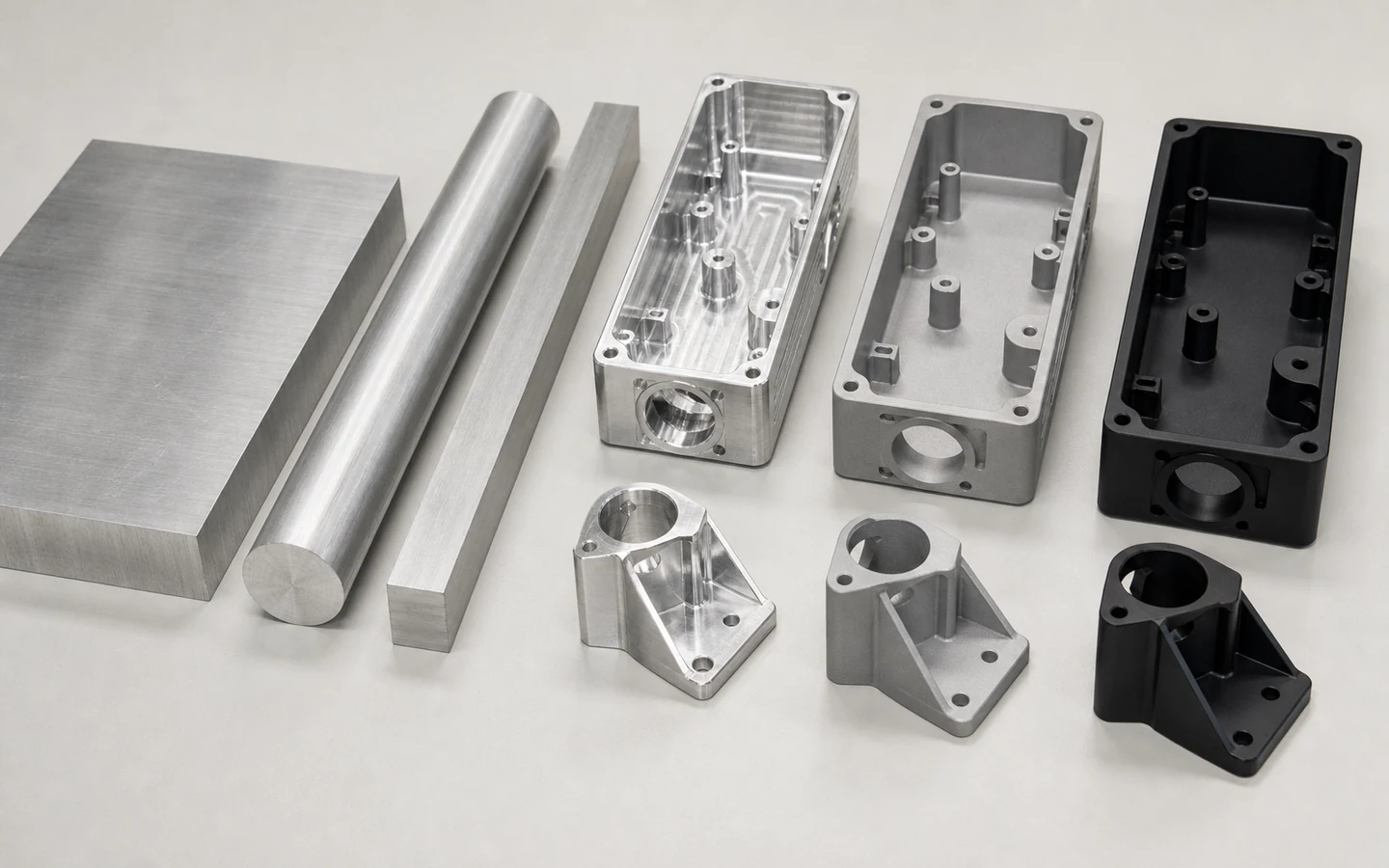
Aluminum 6061 is widely considered for machined housings, brackets, plates, fixtures, structural components and fabricated assemblies because it offers a practical balance rather than one extreme property. The correct purchasing definition still depends on temper or supplied condition, stock form, geometry, joining, final finish and whether the drawing controls a specific governing specification.
Do not treat 6061, 6061-T6 and 6061-T651 as interchangeable words without reviewing the product form and requirement. MakeNexa can source broad aluminum capability through its network, while exact grade, condition, dimensions, supplier, certificate, price and lead time are confirmed per RFQ.
Where the material fits
Selection should follow function and manufacturing route.
Housings, brackets, plates and fixtures can benefit from useful machinability, moderate structural performance and broad finishing choices.
6061 is commonly reviewed with anodizing, conversion coating, powder coating or other compatible finishes when the exact specification is defined.
Some 6061 product forms and conditions are considered for welded assemblies, but joint design, post-weld properties, distortion and finish need project review.
The alloy is often considered where reduced mass matters but the project does not require the higher-strength tradeoffs associated with 7075.
Material tradeoffs
The alloy designation alone does not define the finished part.
Plate, sheet, bar, tube, extrusion and forging conditions can carry different dimensional and property assumptions.
Large plates, broad faces, thin walls and heavy pocketing may need stock-condition and distortion review.
Anodized color and cosmetic uniformity can vary with alloy condition, surface preparation, geometry and supplier process; define acceptance rather than assuming a sample.
State whether a certificate, heat or lot traceability, governing specification or approved source is actually required.
Grade and route choices
The network route depends on part form, geometry and quantity.
Used for housings, plates, shafts, spacers, manifolds and other controlled custom geometry.
Considered when the design is driven by bends, profiles, joining or efficient near-net stock rather than removal from block.
Anodizing, conversion coating, coating, marking, inserts and assembly are reviewed for compatibility and dimensional impact.
Material comparison
Typical published values for 6061-T6. Actual values vary with product form, section thickness and the supplier's material certification, and the project requirement is confirmed on the reviewed quote rather than from this table.
| Property or candidate | Typical published value | What to review before release |
|---|---|---|
| Tensile yield strength | 276 MPa / 40 ksi in T6 | Whether the real load case needs more than this before moving to a 7xxx alloy |
| Ultimate tensile strength | 310 MPa / 45 ksi in T6 | Margin against the peak rather than the nominal load |
| Modulus of elasticity | 68.9 GPa / 10.0 Msi | Deflection-limited parts gain almost nothing from a stronger alloy — stiffness barely moves across the aluminium family |
| Density | 2.70 g/cm³, about one third of steel | Mass budget against the section the strength requires |
| Hardness | About 95 HB in T6 | Softer than 7075 at roughly 150 HB; needs sharp tooling and chip evacuation for a clean finish |
| Elongation at break | 12 to 17% in T6 | Forming and bend allowance if the part is not purely machined |
| Thermal expansion | About 23.6 µm per metre per °C | A 200 mm feature moves roughly 0.05 mm across a 10 °C change — state the measurement temperature on tight fits |
| Common specifications | ASTM B221 for extrusion, ASTM B209 for sheet and plate, ASTM B211 for bar | Which specification the mill certificate must reference |
| Aluminum 7075 | 503 MPa / 73 ksi yield, 2.81 g/cm³, about 150 HB | Corrosion, joining, finish, cost and exact temper — and that it is not fusion weldable |
| Aluminum 5052 | 193 MPa / 28 ksi yield in H32, and it bends without cracking | Strength, machinability, bend and product-form needs |
| Stainless steel 304 | 215 MPa / 31 ksi yield but 193 GPa modulus and 8.0 g/cm³ | Nearly three times the stiffness and three times the mass — a different design, not a substitution |
| Engineering plastic | Acetal at 70 MPa and 1.41 g/cm³, PEEK at 100 MPa | Creep, temperature, moisture, stiffness and dimensional stability |
Material RFQ inputs
Control the condition and evidence only to the level the project needs.
Complete packages move faster: revision-matched CAD, critical dimensions, quantity and material notes are enough to open engineering review across the network.
Get a Quote6061 temper or supplied condition and governing specification
Stock form, thickness or section restrictions and grain direction if relevant
CAD, drawing, datums, critical dimensions and mating context
Quantity, production stage, revision and acceptable material alternatives
Finish type, color, masking, cosmetic zones and inspection state
Certificate, traceability, packaging and delivery requirements
Questions before routing
These answers prepare the request; the reviewed quote controls project-specific commitments.
Not for purchasing. T651 is T6 plus a controlled stretch that relieves residual stress, and it is the normal plate condition. Published strengths are the same — around 276 MPa / 40 ksi yield — but a T6 plate that has not been stretched can move measurably when a pocket is opened up, which is what T651 exists to prevent. State the exact temper on the drawing rather than writing T6 and accepting whatever arrives.
Yes, and it is one of the more predictable alloys to anodize because its magnesium-silicon chemistry gives a clean, consistent film. Type II sulphuric anodize typically adds 5 to 25 µm and grows about half of that outward, so a 20 µm coating adds roughly 10 µm per surface. Type III hard anodize runs 25 to 50 µm. Both are electrically insulating, so mask any grounding path, and state whether drawing dimensions apply before or after coating.
Compare on the constraint that actually governs. 7075-T6 publishes about 503 MPa / 73 ksi yield against 276 MPa / 40 ksi for 6061-T6, so it wins clearly on strength. But stiffness is nearly identical — 71.7 GPa against 68.9 GPa — so a deflection-limited bracket gains nothing. 7075 is also denser at 2.81 against 2.70 g/cm³, commonly 1.5 to 2 times the stock cost, not fusion weldable, and susceptible to stress-corrosion cracking in T6. 6061 remains the default unless the load case forces the change.
About 23.6 µm per metre per °C, roughly double steel. On a 200 mm feature that is around 0.05 mm across a 10 °C swing — enough to matter when a fit is held to ±0.025 mm. Machining also releases residual stress, so a thin-walled part cut from plate can move after the roughing pass. State the measurement temperature with any tight dimension, and specify a stress-relieved temper such as T651 where the geometry is stress-sensitive.
6061 is the most widely stocked aluminium alloy in the world, and the supplier network sources it in bar, plate, sheet, extruded profile and tube. T6 and T651 are the common tempers — T651 is the stretched, stress-relieved plate condition worth specifying when a machined part must hold flatness. Certificates reference ASTM B221 for extrusion, ASTM B209 for sheet and plate, or ASTM B211 for bar. Send the grade, temper, product form and quantity, and available sizes, certification and lead time come back on the reviewed quote.
Next step
Send the material requirement with geometry and use context. MakeNexa routes capable suppliers from a global network covering competitor-class process categories, then returns a prepared quote or focused clarification for your revision.