 MAKENEXA
Functional nylon geometry
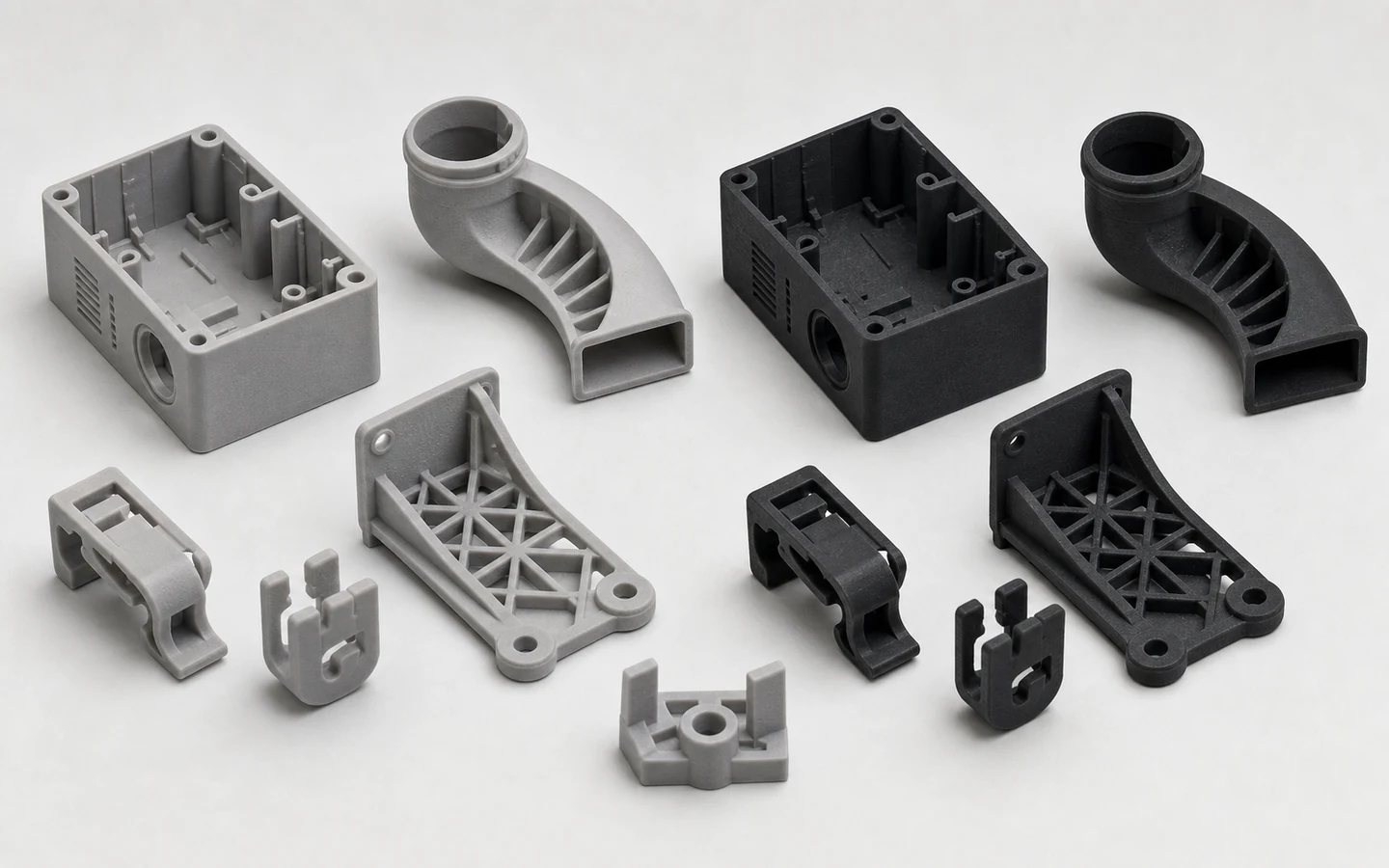
Housings, clips, ducts and brackets can combine complex features without attached support structures when powder is removable.
Manufacturing service decision
Source Multi Jet Fusion for functional prototypes and selected production parts with complex polymer geometry. MakeNexa reviews material, wall and feature design, surface and color expectations, quantity, repeatability, post-processing and inspection needs before confirming project fit.
Route decision
MJF can support dense powder-bed builds, fine functional features and repeat batches of nylon components without conventional tooling. It is often considered for housings, clips, brackets, ducts, jigs and customized end-use parts. The route still depends on powder removal, thermal behavior, feature scale, part orientation, finishing and the relationship between functional surfaces and the rest of the build.
MakeNexa compares MJF with SLS, FDM, SLA, CNC machining and injection molding using the complete demand pattern. A prototype order and a recurring mixed build may justify different commercial assumptions. The RFQ should state material and color requirements, critical dimensions, environment, surface treatment, traceability and expected repeats. Exact equipment, build strategy, supplier, capability, price and timing are confirmed after review.
Best-fit parts and programs
Geometry, demand and required polymer behavior should align before the process is selected.
Housings, clips, ducts and brackets can combine complex features without attached support structures when powder is removable.
Multiple parts or variants may share build capacity when envelope, scheduling, material and quantity align.
Integrated channels, clips, labels or assemblies can reduce component count when service and cleaning remain practical.
Selected applications can avoid tooling while demand develops, subject to material, consistency and unit-economics review.
Feasibility checks
The buyer should define the finished part, including color, touch surfaces and dimensional condition.
Natural gray, dyed black and coated appearances have different processing and acceptance considerations.
As-built texture and media finishing can influence lettering, sharp edges, holes and mating features.
Long spans, broad planes and nonuniform mass may require geometry or orientation review for flatness and shape.
Recurring orders should identify critical features, material documentation, color expectation and sampling strategy.
Route options
The best choice depends on part function and demand across more than one order.
Compared for powder-bed capability, available materials, surface, feature behavior and supplier fit.
Considered when stock-material properties, controlled bores, sealing faces or smaller quantities lead the decision.
Compared when stable higher demand, molded finish, resin choice and tooling economics justify the transition.
Decision comparison
Typical published values for Multi Jet Fusion in PA12, the most common MJF material. Achievable accuracy and appearance depend on machine, powder refresh ratio, nesting and post-processing, and the project requirement is confirmed on the reviewed quote rather than from this table.
| Decision area | Typical published value | Review focus |
|---|---|---|
| Layer thickness | 0.08 mm as the standard production setting | Finer than SLS at 0.1 mm, which shows in small features |
| Dimensional accuracy | Commonly quoted as ±0.3 mm or ±0.3% of the nominal length, whichever is larger | Critical fits, stated so they can be nested deliberately |
| Minimum wall | 0.5 mm is achievable; 0.7 mm and above is the practical recommendation for a self-supporting wall | Whether a thin wall is cosmetic or structural |
| Directional consistency | More isotropic than SLS — the fusing agent and heat source give Z-direction properties closer to XY | The reason MJF is preferred for functional parts over SLS |
| PA12 mechanical behaviour | About 48 MPa tensile strength with roughly 15 to 20% elongation and a density near 1.0 g/cm³ | The load case and any elongation requirement |
| As-built surface | Ra 8 to 15 µm with a uniform fine grain, finer than SLS | Cosmetic zones and whether finishing is in scope |
| Natural colour | Parts come out grey and are commonly dyed black as a standard finish; other colours are not a standard offering | Whether the colour requirement matches what the process gives |
| Support structures | None — surrounding powder supports the build, so undercuts and lattices are free | Powder escape rather than support removal is the design constraint |
| Powder escape | At least two escape holes of 4 to 5 mm diameter per enclosed volume | Every internal cavity and its openings |
| Moving-part clearance | 0.5 mm between surfaces that must move relative to each other after depowdering | Which interfaces must move as printed |
| Build envelope | Common production machines build within about 380 × 284 × 380 mm, and cost follows the volume a part occupies in the nest | Envelope, quantity and whether parts may be reoriented |
| Porosity | Powder-bed parts are slightly porous and can leak under pressure and take up more moisture than moulded PA12 | Any sealing or pressure requirement |
Quote inputs
State both the first-order need and the credible production pattern.
Complete packages move faster: revision-matched CAD, critical dimensions, quantity and material notes are enough to open engineering review across the network.
Get a Quote3D model and drawing for controlled features and notes
Material grade or performance requirements and permitted alternatives
Quantity by variant, repeat pattern and revision maturity
Critical fits, holes, threads, channels and powder-removal access
Surface, dye, coating, color and cosmetic-zone requirements
Inspection, documentation, packaging, labeling and delivery needs
Questions before routing
These answers prepare the request; the reviewed quote controls project-specific commitments.
No — it is used in production for housings, brackets, ducting and functional covers, and its relative isotropy is the reason. PA12 publishes about 48 MPa tensile with 15 to 20% elongation, and MJF's Z-direction properties sit closer to its XY values than SLS manages. What limits production use is not the process but the requirements: accuracy is commonly ±0.3 mm or ±0.3%, parts are slightly porous, and lot consistency depends on powder refresh ratio and nesting position.
Grey as built, and commonly dyed black as the standard finish — that black is a post-process, not a pigmented material. Other colours are not a standard offering and generally mean painting, which is a separate operation with its own cost and thickness. Dye penetrates a shallow depth, so a machined or worn surface shows grey underneath. State the colour requirement and whether a machined face is acceptable.
Same polymer family and similar economics, with three practical differences. MJF runs a 0.08 mm layer against 0.1 mm for SLS, giving finer detail and a smoother Ra 8 to 15 µm surface. MJF is more isotropic, so Z-direction strength sits closer to the in-plane value. And MJF parts come out grey and dye black consistently. Accuracy is comparable at commonly ±0.3 mm or ±0.3%. For functional parts MJF is usually the default; SLS remains competitive on larger builds.
Snap fits, routinely — PA12's roughly 15 to 20% elongation supports them, and MJF's relative isotropy means the snap does not have to be oriented carefully to survive. Living hinges are a different matter: they depend on the molecular orientation that injection moulding creates and that powder-bed fusion does not, so a printed hinge fatigues in tens of cycles rather than thousands. State the cycle count required, because that decides whether the design needs moulding.
Not reliably as printed. Powder-bed parts are slightly porous, so a wall that looks solid leaks under pressure and takes up more moisture than moulded PA12 — its 0.25% in 24 h figure understates a printed part. Sealing routes exist: increased wall thickness, infiltration or coating, each as a separate operation. State the pressure, fluid, duration and acceptance test so the route can be reviewed rather than assumed.
Next step
Send geometry and process requirements for review. MakeNexa routes capable suppliers from a global network covering competitor-class process categories, then returns a prepared quote or focused clarification for your revision.