 MAKENEXA
Turned and milled features
Bar stock can support bushings, fittings, connectors, sleeves and complex turned-milled parts. Control grade, stock condition, concentric features, small tools, chips, threads and final burr condition.
Material selection decision
Brass can support machined details, formed features, conductivity, corrosion behavior and a distinctive appearance, but composition and performance vary by alloy and product form. MakeNexa reviews geometry, grade, finish and quantity across its supplier network; lead content, regulatory suitability, achieved properties, price and timing remain specific to the submitted RFQ.
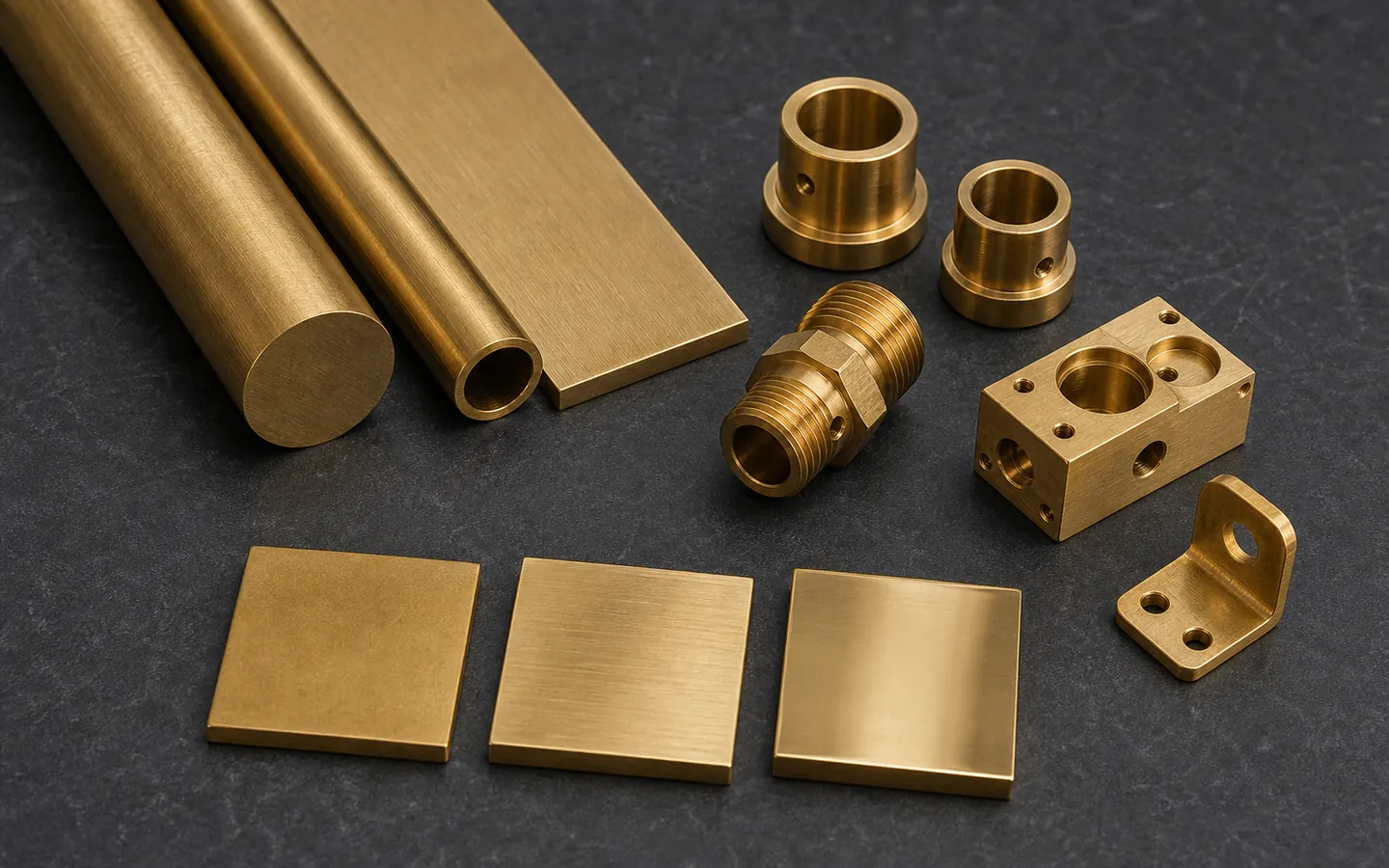
Selection criteria
Define what brass is doing in the part: carrying current, transferring heat, providing a bearing or threaded interface, resisting a particular environment, enabling productive machining or presenting a controlled appearance. Then identify composition restrictions, exact alloy, temper and product form. Free-machining, low-lead, naval, cartridge and other brass families can create different machining, forming, joining, corrosion and documentation decisions. A generic yellow-metal description is not a material specification.
Provide stock form, geometry, thread and burr-sensitive features, mating materials, finish, cleaning and any chemical or regulatory restrictions. If conductivity, mechanical properties, dezincification resistance, lead content or food-contact suitability matters, state the exact requirement and evidence rather than assuming it from the word brass. MakeNexa can return a reviewed network route and material questions but does not present representative parts as application proof.
Where the material fits
Machinability is useful, but it is only one layer of a grade and process decision.
Bar stock can support bushings, fittings, connectors, sleeves and complex turned-milled parts. Control grade, stock condition, concentric features, small tools, chips, threads and final burr condition.
State current, temperature, contact, resistance or heat-transfer needs and the method used to accept them. Conductivity varies by alloy, condition, geometry, surface and joint; do not infer a value from appearance.
Sheet, tube and selected brass grades can be formed, brazed, soldered or otherwise joined when alloy, temper, thickness, filler, heat and final cleanliness fit. Define the joint and final inspection state.
Polishing, brushing, plating, coating and chemical finishing change appearance and interfaces. Mark cosmetic zones, contact areas, threads and allowed tarnish or color variation with a reviewed reference where needed.
Material tradeoffs
A brass part can machine well and still be wrong for the material, environment or compliance requirement.
Composition varies among brass alloys. Where lead content or a regulatory limit matters, name the exact material and required documentation; do not request generic brass and expect the supplier to infer the restriction.
Water chemistry, temperature, stress, joining, dezincification and galvanic contacts can change service behavior. Provide the environment and required evidence for the selected alloy and final assembly.
Fine threads, cross holes, thin walls and small passages can retain chips or deform during finishing. Define edge, cleaning, thread and gauge requirements appropriate to the actual feature.
Bare brass can tarnish and show fingerprints or process variation. Define whether the surface is functional, decorative, plated, protected or intentionally allowed to age, then specify packaging and handling.
Grade and route choices
A proposed route should state the exact alloy and why its process and evidence fit the part.
Use bar machining for concentric bodies, threads, ports and controlled interfaces when the selected alloy and stock support the geometry. Include chip control, deburring, cleaning and final surface needs.
Use formed stock when wall, shape and quantity justify it. Review temper, bend, springback, joining, tool marks and whether the final mechanical state differs from the incoming material.
Bronze, copper or another copper alloy may better fit wear, conductivity, corrosion or forming needs. Return exact composition, stock, process, finish and validation consequences before changing material.
Material comparison
Typical published values for the alloys and tempers named. Actual values vary with temper, product form and the supplier's material certification, and the project requirement is confirmed on the reviewed quote rather than from this table.
| Alloy and typical use | Typical published properties | What it is chosen for |
|---|---|---|
| C360, free-cutting brass | About 310 MPa / 45 ksi yield half hard, 8.50 g/cm³, machinability rating 100% | The benchmark machining brass; about 3% lead restricts potable-water use |
| C260, cartridge brass | Machinability around 30% but excellent ductility — it draws and bends where C360 cracks | Formed and deep-drawn parts rather than machined ones |
| C464, naval brass | Machinability around 30%, with tin added for seawater resistance | Marine fittings and hardware |
| C69300 and C27450, low-lead brasses | Machinability around 80 to 90% without the lead content | Potable-water and lead-restricted applications |
| Machinability scale | C360 at 100% is the benchmark the whole scale is measured against — C110 copper sits near 20%, 304 stainless near 45% | Brass is chosen when cycle time dominates the price |
| Electrical conductivity | About 26% IACS for C360, against 101% for C110 copper | Brass is a connector-body material, not a conductor |
| Modulus of elasticity | About 97 to 110 GPa across the common alloys | Between aluminium at 68.9 GPa and steel at 200 GPa |
| Density | 8.4 to 8.5 g/cm³ | Roughly three times aluminium — brass parts are heavy for their size |
| Dezincification | Higher-zinc alloys can lose zinc selectively in some waters, leaving a porous copper structure | State the fluid; inhibited or lower-zinc alloys exist for the problem |
| Stress-corrosion cracking | Brasses under sustained tensile stress crack in the presence of ammonia and some amines | State any sustained-stress condition and the atmosphere |
| Common specifications | ASTM B16 for free-cutting rod and bar, ASTM B36 for sheet, strip and plate | Which specification the mill certificate must reference |
Material RFQ inputs
Define composition, function and final surface so the quoted material is more than a color description.
Complete packages move faster: revision-matched CAD, critical dimensions, quantity and material notes are enough to open engineering review across the network.
Get a QuoteSubmit the controlled model, drawing, revision and application environment
State exact brass alloy, temper, product form and lead or composition restrictions
Describe mechanical, electrical, thermal, wear, corrosion and appearance functions
Mark threads, cross holes, thin walls, small features, joining and burr-sensitive areas
Define polishing, plating, coating, contact zones, cleaning, tarnish and packaging
List quantities, material records, tests, inspection and approved-alternative rules
Questions before routing
These answers prepare the request; the reviewed quote controls project-specific commitments.
The free-cutting grades are the easiest common metal to machine — C360 is rated at 100% and defines the scale that gives C110 copper about 20% and 304 stainless about 45%. But that rating belongs to C360 specifically, not to brass as a family: cartridge brass C260 and naval brass C464 sit nearer 30%, because they trade the lead content for formability and corrosion resistance. Name the alloy, not the family, when machining cost matters.
For connector bodies, terminals and housings, routinely — but brass is not a conductor in the way copper is. C360 publishes about 26% IACS conductivity against 101% for C110 copper. That is fine for a contact housing and inadequate for a busbar. If a current-carrying path or a thermal path is involved, state the required conductivity so the alloy can be reviewed rather than assumed.
No. Lead is added to the free-cutting grades — about 3% in C360 — specifically to break chips, and it is what makes them restricted for potable-water contact in many markets. Cartridge brass C260 and naval brass C464 are not leaded, and low-lead machining alternatives such as C69300 and C27450 reach machinability ratings around 80 to 90%. Raise any lead restriction before the alloy is fixed.
Brass is often left as-machined because a finishing pass yields Ra 0.4 to 0.8 µm with a bright surface, but bare brass tarnishes in air within weeks. Common routes are lacquer, nickel or chrome plating — electroless nickel typically adds 5 to 50 µm deposited evenly including inside bores — or a deliberate patina. Supply a controlled reference rather than a colour name, state which surfaces are cosmetic, and say whether dimensions apply before or after plating.
Next step
Send the material requirement with geometry and use context. MakeNexa routes capable suppliers from a global network covering competitor-class process categories, then returns a prepared quote or focused clarification for your revision.