 MAKENEXA
Appearance prototypes
Painted, textured, colored or clear models can support design and presentation reviews when cosmetic criteria are defined.
Manufacturing service decision
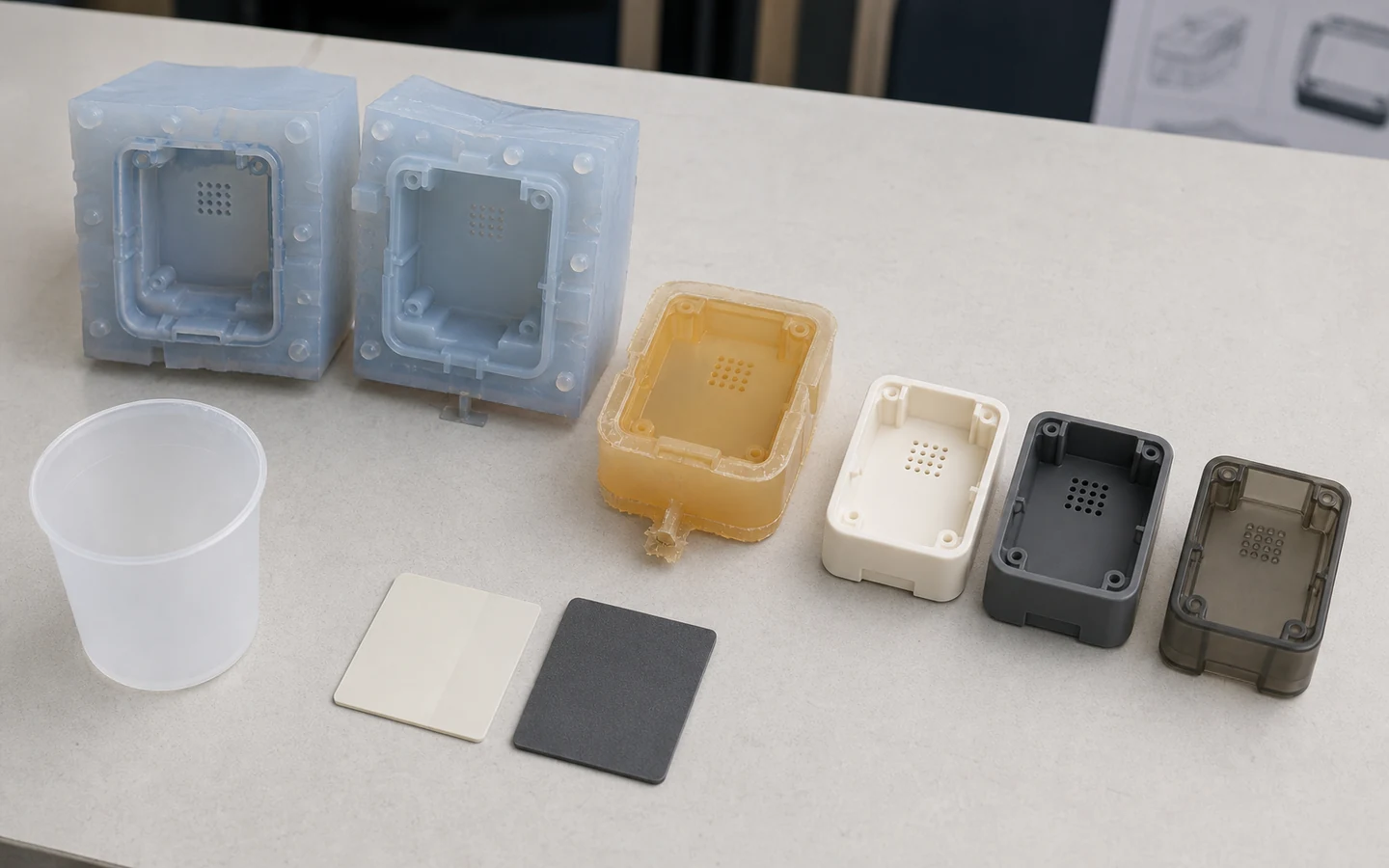
Source cast urethane housings, covers, seals, display models and limited production parts without injection-molding tooling. MakeNexa reviews the master pattern, resin behavior, silicone mold strategy, color, texture, inserts, quantity, variation and inspection before the reviewed quote is prepared.
Route decision
Urethane casting can reproduce detailed parts from a master with relatively low tooling commitment, which makes it useful for design validation, presentation sets and bridge supply. Cast polyurethane systems can be selected to approximate stiffness, color, flexibility or clarity, but they are not automatically equivalent to a named injection-molding resin in chemistry, aging, heat, UV, creep, flame behavior or regulated evidence.
The master defines every surface and imperfection that transfers into the silicone mold. Mold wear, resin reaction, pigment, bubbles, shrink and manual finishing can create variation across a batch. MakeNexa reviews master production, split lines, vents, gates, inserts, finish, usable mold output, replacement mold assumptions and final inspection. Exact material, mold quantity, supplier, price, tolerance and lead time remain RFQ-specific.
Best-fit parts and programs
Casting is most useful when the replicated shape and finish justify a master and soft tool.
Painted, textured, colored or clear models can support design and presentation reviews when cosmetic criteria are defined.
Repeated housings, covers and interfaces can support assembly learning beyond a single printed model.
Casting may supply limited parts while a design, demand or injection-molding tool is still developing.
Gaskets, grips and flexible components may be evaluated across project-specific hardness and behavior ranges.
Feasibility checks
The process is manual and tool condition changes, so acceptance should focus on function and visible standards.
Layer lines, machining marks, seams and repairs can transfer unless the master finish is explicitly prepared and accepted.
Geometry, resin, undercuts and handling influence useful output; replacement molds and batch consistency need commercial definition.
Required stiffness, hardness, heat, color and environment should be stated without presenting cast resin as an exact production polymer substitute.
Thin features, clear parts, deep geometry and pigment can require specific bubble, sink, seam and color acceptance criteria.
Route options
Quantity, material fidelity, appearance and expected design change determine the useful route.
Fine-detail printed masters can support repeated cast parts after surface preparation and dimensional review.
Compared when each part can be printed economically and casting finish or material behavior adds limited value.
Considered when stable demand, exact molded resin, repeat process behavior and tooling economics justify the transition.
Decision comparison
Typical published practice for vacuum casting into silicone tooling. Achievable tolerance, mould life and material behaviour depend on geometry, resin and the supplier's process, and the project requirement is confirmed on the reviewed quote rather than from this table.
| Decision area | Typical published value | Review focus |
|---|---|---|
| Silicone mould life | Commonly 20 to 25 parts before the mould degrades; complex or abrasive geometry gives fewer | The quantity band the process actually serves |
| Typical quantity | Roughly 10 to 100 parts, above printing and below injection tooling | Whether the quantity fits the process at all |
| Lead time | Commonly 5 to 15 days including master pattern, mould making and casting | Faster than the 2 to 4 weeks aluminium tooling needs |
| Dimensional accuracy | Commonly ±0.2 mm or ±0.3% of the nominal, whichever is larger — looser than moulding at ±0.1 mm | Which fits the process can actually hold |
| Minimum wall | About 1.5 mm; 2.0 mm and above fills more reliably on a large part | Whether thin features cast at all |
| Material hardness range | Cast urethanes run from about 30 Shore A for flexible parts through to 85 Shore D for rigid ones | The hardness stated as a number, with the trade-offs understood |
| Material behaviour | Urethanes approximate moulded thermoplastics rather than matching them — lower heat resistance, higher creep and different impact behaviour | Whether the test depends on true production properties |
| Heat resistance | Commonly 60 °C to 80 °C for standard resins, well below moulded ABS at about 98 °C | Any thermal requirement stated explicitly |
| UV stability | Most cast urethanes yellow and embrittle in daylight without a stabilised grade | Whether the parts are stored, displayed or used outdoors |
| Clear parts | Achievable and better than printed clear, but with more distortion and yellowing than moulded polycarbonate at 88 to 90% transmission | The clarity requirement and its acceptance basis |
| Colour | Pigmented in the resin, so colour goes through the part rather than sitting on it | A controlled colour reference where appearance is contractual |
| Inserts | Threaded inserts and metal components can be cast in place, positioned by the mould | Insert drawings, position tolerance and retention |
Quote inputs
Define the master, copies and expected material behavior together.
Complete packages move faster: revision-matched CAD, critical dimensions, quantity and material notes are enough to open engineering review across the network.
Get a Quote3D model and drawing with critical and cosmetic requirements
Master source, finish standard, ownership and permitted repair
Required hardness, stiffness, color, clarity and service environment
Split-line, gate, vent, insert and protected-surface preferences
Quantity, variants, repeat batches and future production context
Dimensional, visual, bubble, test, packaging and delivery criteria
Questions before routing
These answers prepare the request; the reviewed quote controls project-specific commitments.
No — it approximates it. Cast urethanes are formulated to resemble common thermoplastics in stiffness and appearance, but they publish lower heat resistance at commonly 60 °C to 80 °C against about 98 °C for ABS, creep more under sustained load, and behave differently on impact. For appearance models, fit checks and short-run functional parts that is usually close enough. For a thermal, fatigue or long-term load test it is not.
Commonly 20 to 25 before the mould degrades, and fewer where the geometry is complex, has sharp features or an abrasive filled resin. That is what defines the process's quantity band: roughly 10 to 100 parts, made across several moulds if needed. Above that, aluminium injection tooling at commonly 1,000 to 10,000 shots becomes the economic route despite its 2 to 4 week lead time.
Yes, and better than printing — but not to moulded standards. Clear cast urethane carries more internal distortion than moulded polycarbonate at 88 to 90% light transmission, and most grades yellow in daylight without a stabilised resin. Achieving good clarity also depends on the master pattern's surface, which is normally an SLA part sanded and polished. State the clarity requirement, the acceptance basis and whether the part will be stored in light.
Yes — threaded inserts and metal components are commonly cast in place, positioned by features in the silicone mould. Retention is mechanical, so the insert needs knurls, grooves or undercuts, and position tolerance is looser than in injection moulding because the mould itself is flexible. Provide the insert drawing, the required position tolerance and any pull-out or torque requirement so the approach can be reviewed.
Commonly ±0.2 mm or ±0.3% of the nominal, whichever is larger — noticeably looser than injection moulding at around ±0.1 mm, because a silicone mould flexes and each mould in a series varies slightly from the master. Minimum wall is about 1.5 mm, with 2.0 mm filling more reliably on larger parts. State the few dimensions that are critical, and expect them to be measured rather than assumed.
Next step
Send geometry and process requirements for review. MakeNexa routes capable suppliers from a global network covering competitor-class process categories, then returns a prepared quote or focused clarification for your revision.