 MAKENEXA
Complex unsupported geometry
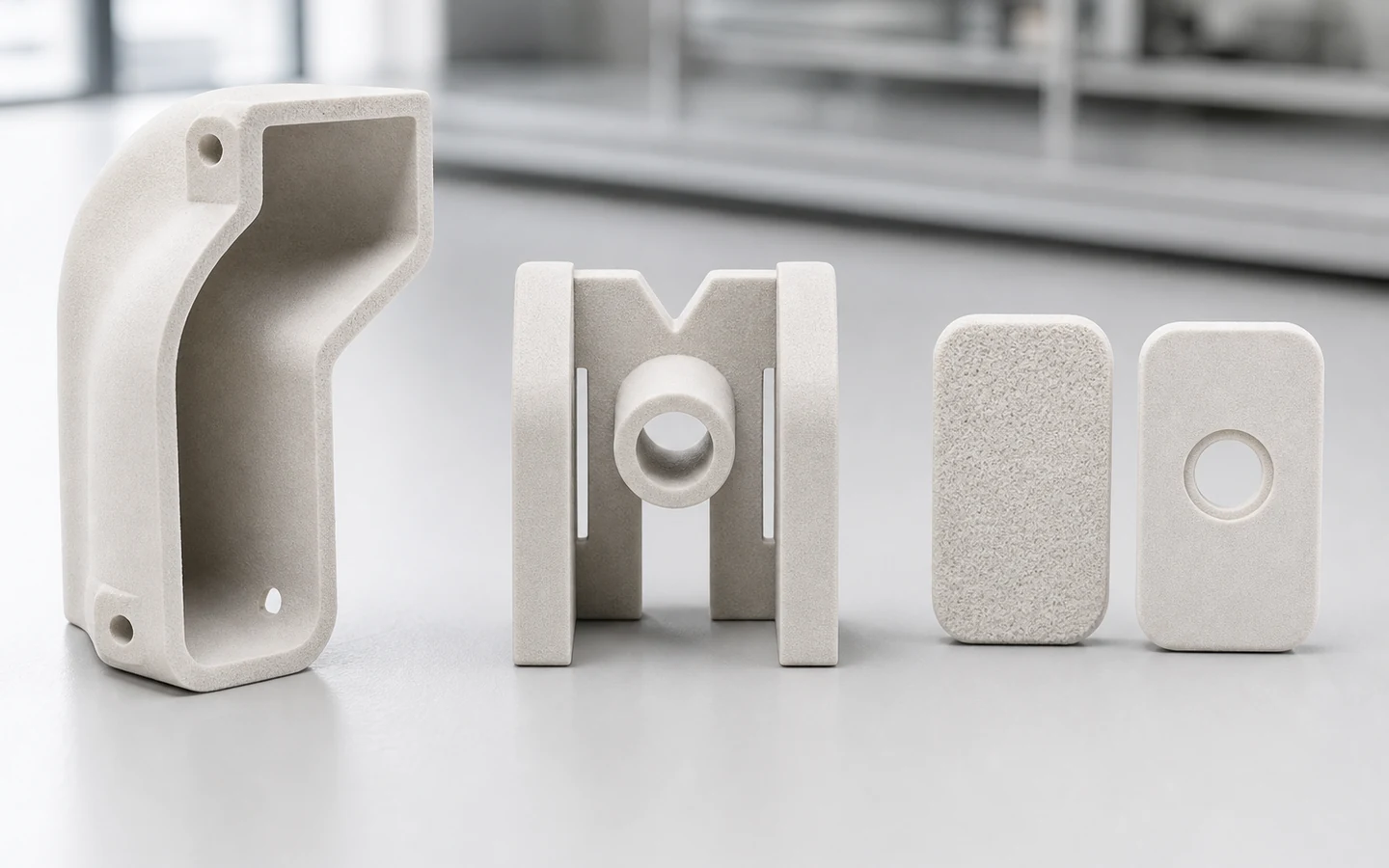
Internal channels, organic forms and consolidated features may benefit from powder-bed support when trapped powder can be removed.
Manufacturing service decision
Source selective laser sintering for prototypes, end-use components, housings, ducts, clips and complex polymer geometry. MakeNexa reviews the material specification, part envelope, wall and feature design, orientation-sensitive requirements, post-processing, quantity and inspection plan before confirming the route.
Route decision
SLS builds polymer parts in a powder bed without dedicated support structures, which can make enclosed passages, nested builds and mechanically functional shapes practical. That freedom does not remove design constraints. Thin features, powder escape, large flat surfaces, mating interfaces, threads, snap behavior and cosmetic expectations still need review, and the as-built surface is not equivalent to an injection-molded or polished finish.
MakeNexa compares SLS with MJF, FDM, SLA, CNC machining and molding based on function rather than process familiarity. The RFQ should identify the exact material family or performance requirement, critical interfaces, operating environment, appearance zones and repeat demand. Build orientation, nesting, machine, refresh strategy, post-processing, supplier, tolerance, price and lead time remain project-specific until the reviewed quote states them.
Best-fit parts and programs
These are routing signals; final suitability depends on material, geometry and acceptance requirements.
Internal channels, organic forms and consolidated features may benefit from powder-bed support when trapped powder can be removed.
Housings, brackets, clips and ducts can be evaluated in a real printed polymer without molding tooling.
Build nesting may support multiple parts or variants when quantity, envelope and scheduling align with the supplier route.
SLS can support selected production applications when material records, surface, consistency and inspection needs are defined.
Feasibility checks
Powder-bed freedom can hide cleaning, surface and dimensional constraints that affect acceptance.
Blind cavities and channels need access for depowdering; escape paths and cleanliness criteria should be visible in the design.
As-built texture, media finishing, dyeing and coating change appearance and sometimes edge or dimensional condition.
Broad thin surfaces, uneven mass and long spans can move during building or cooling and need route-specific assessment.
Pins, holes, slots, threads and snap interfaces should be marked by function and reviewed with orientation and finishing in mind.
Route options
The selected route should support the required material behavior, detail, surface and quantity.
Compared for powder-bed polymer parts where available materials, dimensional behavior, surface and production pattern fit the job.
Considered when cost, scale, material behavior, fine detail or smooth presentation surfaces carry more weight.
Compared when stock-grade properties, tight interfaces, finish, repeat volume or tooling economics change the decision.
Decision comparison
Typical published values for laser-sintered PA12, the most common SLS material. Machine, powder refresh rate, nesting density and post-processing all move these figures, so the project requirement is confirmed on the reviewed quote rather than read off this table.
| Process variable | Typical published value | What to state in the RFQ |
|---|---|---|
| Layer thickness | 0.1 mm is the usual production setting; 0.06 mm is used where fine detail justifies the longer build | Features whose detail depends on the finer layer |
| Dimensional accuracy | Commonly quoted as ±0.3 mm or ±0.3% of the nominal length, whichever is larger | Critical fits, so they can be nested and measured deliberately |
| Minimum wall | 0.8 mm is the usual floor for a self-supporting wall; 1.5 mm and above where the wall carries load or spans a large flat area | Whether a thin wall is cosmetic, structural or a flexure |
| Powder escape | At least two escape holes of 4 to 5 mm diameter per enclosed volume; unrelieved cavities trap sintered cake that cannot be removed later | Every internal volume, its openings, and the cleanliness the application needs |
| Moving-part clearance | 0.5 mm between surfaces that must move relative to each other after depowdering; 0.3 mm on small assemblies at the risk of fusing | Which interfaces must move as printed rather than after assembly |
| As-built surface | Ra 8 to 15 µm with a uniform matte grain; media finishing, dyeing or vapour smoothing improves it as separate operations | Cosmetic zones, colour reference and whether finishing may soften edges |
| PA12 mechanical behaviour | Published values near 48 MPa tensile strength, 1.7 GPa modulus and a density around 1.0 g/cm³, with roughly 15% elongation at break | The load case and any elongation or impact requirement |
| Temperature limits | PA12 melts near 180 °C, with a heat-deflection figure around 95 °C at 1.82 MPa | Service temperature including transport, cleaning and sterilisation |
| Build envelope | Common production machines build within about 330 × 330 × 600 mm, and cost follows the volume a part occupies in the nest | Envelope, batch quantity and whether parts may be reoriented for nesting |
Quote inputs
Keep material, geometry and post-processing under the same revision.
Complete packages move faster: revision-matched CAD, critical dimensions, quantity and material notes are enough to open engineering review across the network.
Get a QuoteWatertight 3D model and drawing for controlled requirements
Material grade or functional properties and permitted alternatives
Quantity by part and variant plus repeat-demand context
Critical dimensions, interfaces, threads and assembly conditions
Powder-removal, cleanliness, surface, dye and coating requirements
Inspection, material records, packaging, labeling and delivery needs
Questions before routing
These answers prepare the request; the reviewed quote controls project-specific commitments.
No. The surrounding unsintered powder supports the build, which is why SLS handles undercuts and lattices that would need support elsewhere. The design must still allow powder removal: plan at least two escape holes of 4 to 5 mm per enclosed volume, and account for orientation, heat, feature resolution and post-processing.
Accuracy is commonly quoted as ±0.3 mm or ±0.3% of the nominal length, whichever is larger. Large flat areas and long spans are the usual problem: thermal gradients in the powder bed pull them out of plane, and a part that measures well at 50 mm can drift noticeably at 300 mm. State the fits that matter so nesting, orientation and any machined-after-print feature can be reviewed.
As-built SLS carries a uniform matte grain at roughly Ra 8 to 15 µm, which reads as a finished texture on many products but shows powder witness on down-facing surfaces. Media finishing, dyeing or vapour smoothing improve appearance and can round edges by a few tenths of a millimetre. State the required surface, colour reference, protected features and comparison standard in the RFQ.
Potentially, when the selected material, environment, consistency, documentation, surface and inspection plan suit the application. PA12 publishes near 48 MPa tensile strength with about 15% elongation, which covers many functional housings and brackets, but powder refresh ratio and nesting position affect lot-to-lot consistency. The reviewed quote confirms the supplier route and project-specific controls.
Geometry may be buildable but unusable if powder cannot be removed. A channel below about 3 mm diameter is difficult to clear over any length, and a fully enclosed volume cannot be cleared at all. Provide channel dimensions, openings, cleanliness and flow requirements so escape access and an alternative construction can be reviewed.
Next step
Send geometry and process requirements for review. MakeNexa routes capable suppliers from a global network covering competitor-class process categories, then returns a prepared quote or focused clarification for your revision.