 MAKENEXA
General corrosion-resistant hardware
Brackets, covers, fittings and machine components may use 304 when the operating environment is understood and suitable.
Material selection decision
Use Stainless Steel 304 for custom parts when its general corrosion resistance, formability, joining and cleanable surface fit the environment. MakeNexa reviews grade, condition, stock form, geometry, finish, passivation and documentation before confirming the manufacturing route.
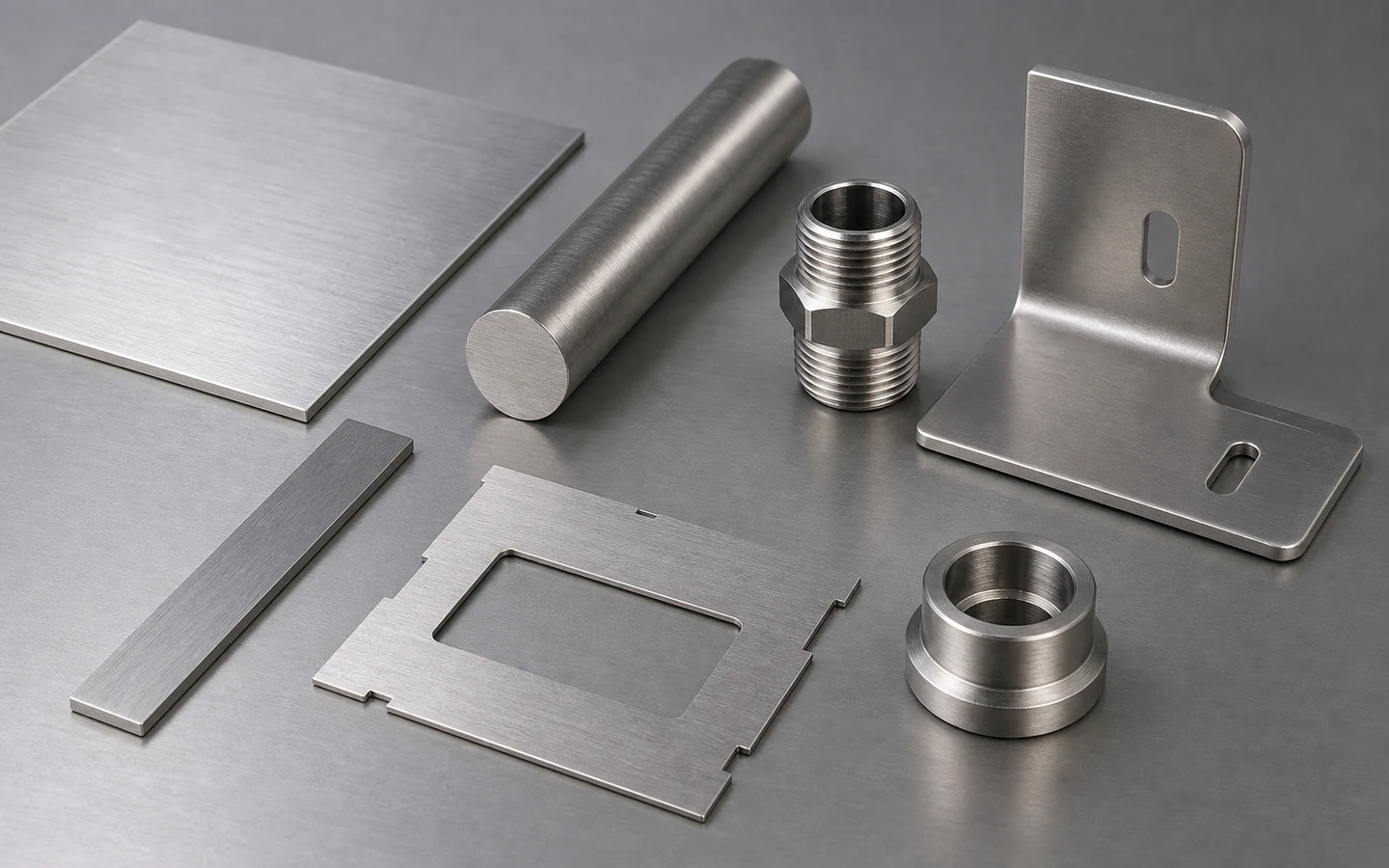
Selection criteria
Stainless Steel 304 is commonly considered for housings, brackets, panels, fittings, food and laboratory equipment components, fixtures and general industrial parts. Its corrosion behavior and familiar supply do not make it universal: chloride exposure, chemicals, temperature, crevices, surface contamination and cleaning method may justify 316 or another alloy.
Machining, forming and welding can change the route and final surface condition. Work hardening, heat input, distortion, embedded contamination, weld cleanup, passivation and cosmetic finish should be planned together. Exact supplier capability, stock, dimensions, certificate, inspection, price and timing remain subject to RFQ review.
Where the material fits
The useful question is whether its balance fits the complete part.
Brackets, covers, fittings and machine components may use 304 when the operating environment is understood and suitable.
Sheet, tube and fabricated components can be considered with joint, distortion, cleanup and final surface requirements.
Smooth surfaces and corrosion resistance may support cleaning needs when finish, crevices and chemical exposure are explicitly reviewed.
Housings, fittings and manifolds may be routed with attention to threads, sealing surfaces, passages, burrs and cleaning.
Material tradeoffs
Stainless does not mean immune to every environment or manufacturing defect.
Identify chlorides, cleaning chemicals, temperature, moisture, crevices and dissimilar-metal contact rather than relying on the word stainless.
Feature access, tool engagement, thin sections and repeated passes can affect process planning and supplier selection.
Joint design, distortion, discoloration, cleanup and final corrosion expectations should be defined for fabricated parts.
Passivation, electropolishing, brushing, blasting or as-machined finish need separate specifications and acceptance criteria.
Grade and route choices
Product form and final surface guide supplier fit.
Reviewed for fittings, housings, manifolds, shafts and precision features with controlled burr and surface requirements.
Reviewed for panels, enclosures, guards and assemblies with bend, weld, distortion and cleanup controls.
Passivation, electropolishing, mechanical finishing or coating are considered from function, appearance and cleanliness needs.
Material comparison
Typical published values for 304 in the annealed condition. Actual values vary with product form, cold work and the supplier's material certification, and the project requirement is confirmed on the reviewed quote rather than from this table.
| Property or candidate | Typical published value | Key review |
|---|---|---|
| Tensile yield strength | 215 MPa / 31 ksi annealed | Cold-drawn bar runs considerably higher; state the product form and condition |
| Ultimate tensile strength | 505 MPa / 73 ksi annealed | Margin against peak load in the released condition |
| Modulus of elasticity | 193 GPa / 28 Msi | Nearly three times aluminium at 68.9 GPa — the reason stainless is chosen for stiffness |
| Density | 8.00 g/cm³ | Roughly three times 6061 aluminium at 2.70 g/cm³; check the mass budget early |
| Hardness | About 70 HRB annealed, up to 201 HB | Work-hardens rapidly under a dull tool, which is the main machining risk |
| Elongation at break | About 40% annealed | Excellent forming and deep-draw behaviour |
| Composition | Roughly 18% chromium, 8% nickel, no molybdenum | The absence of molybdenum is what separates it from 316 |
| Pitting resistance | PREN around 18 to 20, against 24 to 26 for 316 | Chloride exposure — coastal air, de-icing salt, saline process fluids |
| Magnetic response | Essentially non-magnetic annealed, but cold work and machining raise it measurably | A magnet test does not distinguish 304 from a plain carbon steel part |
| Thermal expansion | About 17.3 µm per metre per °C, roughly 45% more than plain carbon steel | Weld distortion and fits measured at a stated temperature |
| Common specifications | ASTM A276 for bar, ASTM A240 for sheet and plate | Which specification the mill certificate must reference |
| Stainless 316 | 205 MPa / 30 ksi yield, 515 MPa / 75 ksi ultimate, 2 to 3% molybdenum | Whether the environment actually contains chlorides |
| Stainless 303 | Free-machining sulphur addition; noticeably lower corrosion resistance and not recommended for welding | Whether machining cost or corrosion governs |
| Aluminum 6061 | 276 MPa / 40 ksi yield at 2.70 g/cm³ and 68.9 GPa modulus | Higher yield but a third of the stiffness and a third of the mass |
Material RFQ inputs
Define the final surface and service environment, not only the base alloy.
Complete packages move faster: revision-matched CAD, critical dimensions, quantity and material notes are enough to open engineering review across the network.
Get a QuoteExact 304 grade, condition, product form and governing specification
Chemical, chloride, moisture, temperature and cleaning exposure
CAD, drawing, welds, critical features, passages and mating surfaces
Quantity, revision, production stage and permitted alternatives
Passivation, electropolishing, brushing, blasting or cosmetic finish
Material records, cleanliness, inspection, packaging and delivery requirements
Questions before routing
These answers prepare the request; the reviewed quote controls project-specific commitments.
Decide on chlorides. Mechanically the two are close — 304 publishes 215 MPa / 31 ksi yield and 505 MPa / 73 ksi ultimate, 316 gives 205 MPa / 30 ksi and 515 MPa / 75 ksi, and both share a 193 GPa modulus and 8.00 g/cm³ density. What separates them is 2 to 3% molybdenum in 316, which lifts the pitting resistance number from roughly 18 to 20 for 304 to 24 to 26. In dry indoor service 304 is the cheaper, more available choice; in coastal air, de-icing salt or saline process fluid, 316 is the one that survives.
No. It is a separate specified operation, normally called to ASTM A967, and it removes free iron picked up from tooling and fixturing so the chromium oxide layer can reform evenly. Machining, grinding and handling all embed iron that will rust in service even though the base metal is stainless. State whether passivation is required, which specification and method apply, and how the result is verified.
Yes, and it is one of the more weldable stainless grades — but the standard grade carries up to 0.08% carbon, which can precipitate chromium carbides at grain boundaries in the heat-affected zone and leave the weld line corroding faster than the parent metal. For welded assemblies that see a corrosive service, 304L at 0.03% maximum carbon is the usual answer. Machining needs sharp tooling and a positive feed: 304 work-hardens quickly, and rubbing rather than cutting glazes the surface.
More than carbon steel. At about 17.3 µm per metre per °C, 304 expands roughly 45% more than plain carbon steel while conducting heat away more slowly, so the same weld puts more distortion into the part. Plan the joint sequence, allow for post-weld machining on any surface that must hold flatness, and state whether dimensions apply before or after welding and scale removal.
No. A mill certificate to ASTM A276 or ASTM A240 records the chemistry and mechanical properties of the incoming stock, not the machining, welding, finishing, passivation or handling that follows. Free iron from tooling, weld scale and heat tint all affect corrosion behaviour after the certificate was issued. State separately what evidence you need for the finished part.
Next step
Send the material requirement with geometry and use context. MakeNexa routes capable suppliers from a global network covering competitor-class process categories, then returns a prepared quote or focused clarification for your revision.