 MAKENEXA
Mechanical function
Loads, stiffness, impact, wear, fatigue, creep, friction and failure consequence define the required behavior.
Engineering design resource
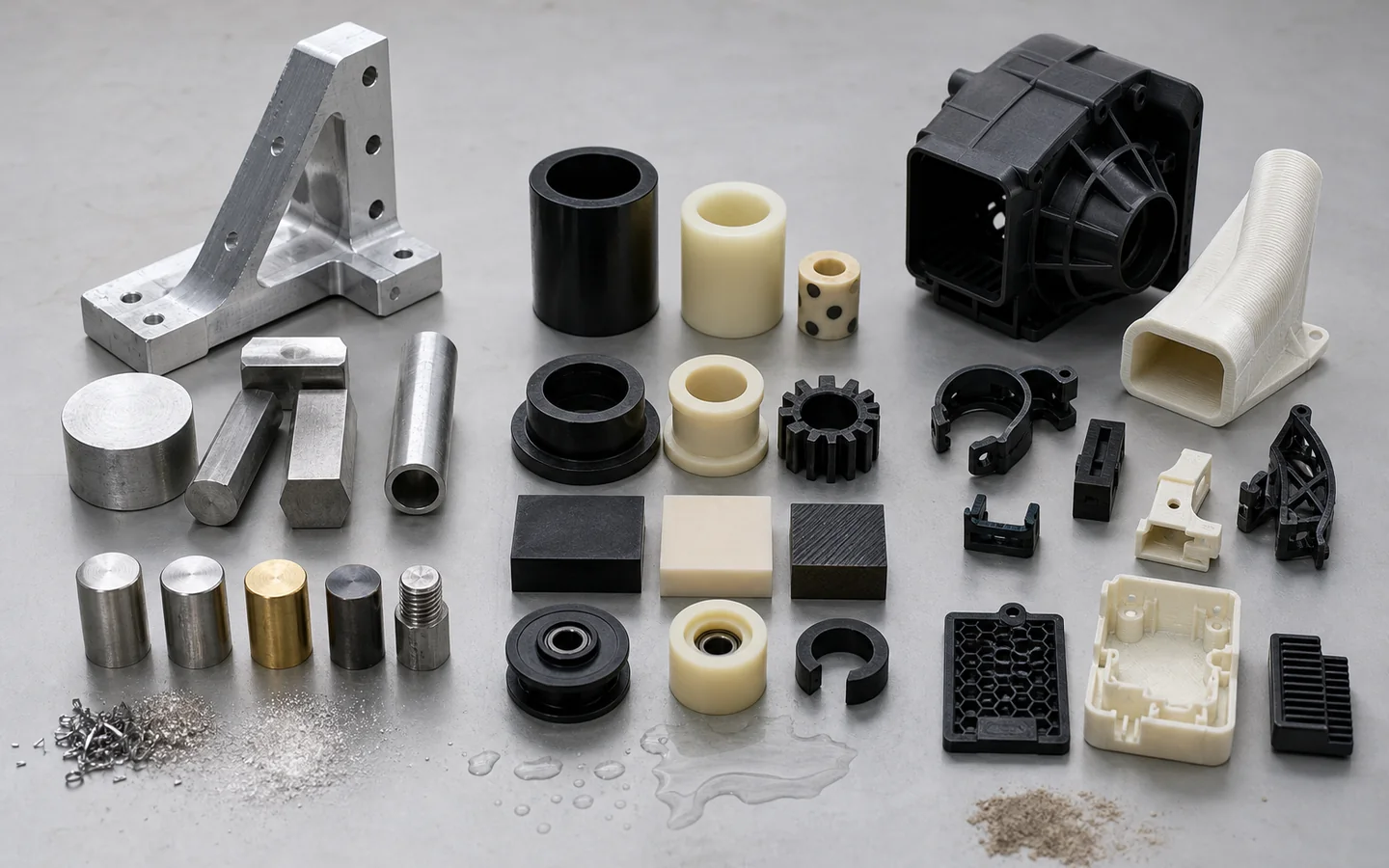
Choose material from the part's function, manufacturing route and acceptance evidence rather than a familiar grade name alone. This guide helps buyers organize loads, environment, geometry, quantity, finish, supply and documentation before MakeNexa reviews the RFQ.
Use this guide
Material selection is a filtering problem. Begin with requirements that can eliminate candidates: temperature, chemicals, electrical behavior, mass, stiffness, strength, impact, wear, moisture, flammability, cleanliness, regulatory evidence and failure consequence. Then compare the surviving options against process, geometry, stock, tooling, finish, inspection and credible demand. A material with attractive handbook properties may be a poor purchasing choice if the required form or evidence is unavailable.
Avoid specifying more precision than the design needs. Exact brand, temper, filler and certification can be appropriate, but unnecessary restrictions reduce supplier options and create cost without improving function. Conversely, a generic callout can hide critical differences. MakeNexa uses the RFQ to resolve that boundary and confirm material, permitted alternatives, supplier route, documentation, price and timing for the project.
Design priorities
Write observable needs before opening a material database or copying a legacy drawing.
Loads, stiffness, impact, wear, fatigue, creep, friction and failure consequence define the required behavior.
Temperature, moisture, chemicals, UV, radiation, cleaning, pressure and contact materials remove unsuitable candidates.
Feature size, walls, stock form, welds, mold flow, print direction and finishing limit practical choices.
Quantity, repeats, availability, country restrictions, material records and tests affect the sourceable specification.
Common review gaps
These patterns create unnecessary cost or parts that cannot be released confidently.
Highest strength, temperature or corrosion label can hide weight, brittleness, wear, processing and supply tradeoffs.
Aluminum, stainless, nylon and PEEK each contain conditions and modifications that are not interchangeable.
Wrought, cast, molded, printed and heat-treated material can carry different structure, directionality, surface and evidence.
Legacy brand, source or certificate notes should be validated against current function instead of carried forward automatically.
Practical choices
Narrow candidates in stages and record why each constraint exists.
Remove materials that cannot meet the real temperature, environment, load, electrical or evidence requirement.
Evaluate stock, molding, printing, forming, joining, finish and inspection with the actual geometry and quantity.
Use supplier data, samples or application-relevant tests only where uncertainty affects risk or cost.
Design decision table
Typical published values for one representative grade per group. Actual values vary with grade, condition, product form and the supplier's material certification, and the project requirement is confirmed on the reviewed quote rather than from this table.
| Material group | Typical published properties | Questions before selection |
|---|---|---|
| Aluminium | 6061-T6 at 276 MPa / 40 ksi yield, 68.9 GPa modulus, 2.70 g/cm³; 7075-T6 at 503 MPa | Whether the part is strength-limited or deflection-limited |
| Stainless steel | 304 at 215 MPa / 31 ksi yield, 193 GPa modulus, 8.00 g/cm³; 316 adds molybdenum for chlorides | Whether the environment contains chlorides, and whether mass is constrained |
| Carbon and alloy steel | 1018 at 370 MPa / 54 ksi yield cold drawn; 4140 up to roughly 1520 MPa quenched and tempered | Whether the part needs hardening, and how thick the section is |
| Tool steel | D2 at 58 to 62 HRC for abrasion; H13 at 44 to 52 HRC for hot work | Whether the failure mode is abrasion, impact or heat |
| Titanium | Grade 5 at 880 MPa / 128 ksi yield, 114 GPa modulus, 4.43 g/cm³ | Whether mass or chloride corrosion justifies the cost and cycle time |
| Copper alloys | C110 copper at 101% IACS; C360 brass at 26% IACS and 100% machinability | Whether the requirement is conductivity or machined cost |
| Engineering plastics | Acetal at 70 MPa and 0.2% water absorption; nylon 6/6 at 82 MPa dry but 1.5% absorption | Whether dimensional stability or toughness governs |
| High-performance plastics | PEEK at 100 MPa with heat deflection near 152 °C at 1.8 MPa; PEI at 105 MPa and about 200 °C | The service temperature and the chemistry |
| Stiffness across all metals | Aluminium 68.9 GPa, titanium 114 GPa, steel and stainless around 200 GPa | A deflection problem is solved by section, not usually by grade |
| Density comparison | Aluminium 2.70, titanium 4.43, steel 7.85, copper 8.94 g/cm³ | The mass budget against the section the strength requires |
| Thermal expansion | Steel about 11, stainless 17.3, aluminium 23.6, acetal 110 µm per metre per °C | Mixed-material assemblies with tight fits across temperature |
| Specifications | ASTM B221 and ASTM B209 for aluminium, ASTM A276 and ASTM A240 for stainless, ASTM A29 for steel | Which specification the mill certificate must reference |
Turn the guide into an RFQ
Give engineering enough context to compare candidates without guessing the application.
Complete packages move faster: revision-matched CAD, critical dimensions, quantity and material notes are enough to open engineering review across the network.
Get a QuoteLoads, stiffness, impact, wear, fatigue and failure consequence
Temperature, moisture, chemicals, UV, cleaning and service duration
Mass, electrical, thermal, magnetic and appearance constraints
Geometry, manufacturing routes, finish and assembly interfaces
Prototype, first-order, repeat and lifetime quantity context
Required material records, tests, traceability and permitted alternatives
Questions before routing
These answers prepare the request; the reviewed quote controls project-specific commitments.
Specify the exact grade and condition, and separately state whether alternatives are acceptable and within what limits. The grade alone is often not enough: 6061-T6 and 6061-T651 publish the same 276 MPa yield but differ in residual stress, and 4140 ranges from about 415 MPa annealed to roughly 1520 MPa quenched and tempered under one number. Saying which properties actually govern lets a substitution be reviewed rather than guessed.
They predict the stock, not the part. Published figures are measured on standard specimens in a defined condition — nylon data quoted dry differs from conditioned by roughly a quarter in strength and 0.5 to 0.8% in size, machining releases residual stress, welding drops 6061 out of its T6 condition locally, and finishing changes dimensions by 5 to 100 µm depending on the process. Treat handbook values as a starting point for comparison, not as a prediction.
When the material property is the requirement rather than an assumption — a structural or pressure part, a programme with a traceability obligation, or a case where an incoming lot must be verified independently of the mill's own report. For most parts a mill certificate against a named specification such as ASTM A276 or ASTM B221 is proportionate. State what evidence is needed and it is confirmed on the reviewed quote.
Start from the constraint that governs, and the candidates narrow fast. Deflection-limited? Modulus decides, and it barely moves within a family — aluminium 68.9 GPa, titanium 114 GPa, steel around 200 GPa — so the answer is section, not grade. Strength-limited? 6061 at 276 MPa, 7075 at 503 MPa, 4140 up to roughly 1520 MPa quenched and tempered. Corrosion? 304 at a pitting resistance number of 18 to 20, 316 at 24 to 26, titanium above both. Mass? Magnesium 1.77, aluminium 2.70, titanium 4.43, steel 7.85 g/cm³. Material review is part of the RFQ — state service temperature, load, chemistry, mass and cost target.
Almost never. Modulus barely moves within a family — aluminium alloys span 68 to 73 GPa from 117 MPa to 503 MPa in yield strength — and across families it is set by the metal, not the grade: aluminium 68.9 GPa, titanium 114 GPa, steel around 200 GPa. If a bracket deflects too much, adding section depth, a rib or a gusset fixes it; upgrading from 6061 to 7075 does not.
Next step
Apply the guide to a real drawing and RFQ package. MakeNexa routes capable suppliers from a global network covering competitor-class process categories, then returns a prepared quote or focused clarification for your revision.