 MAKENEXA
Chloride-bearing environments
Components near salt, brine or chloride cleaning may justify comparison with 304, subject to concentration, temperature and design details.
Material selection decision
Consider Stainless Steel 316 when the service environment needs more corrosion resistance than a general stainless route may provide. MakeNexa reviews exact grade and condition, exposure, geometry, machining or fabrication sequence, surface treatment and documentation before supplier confirmation.
Selection criteria
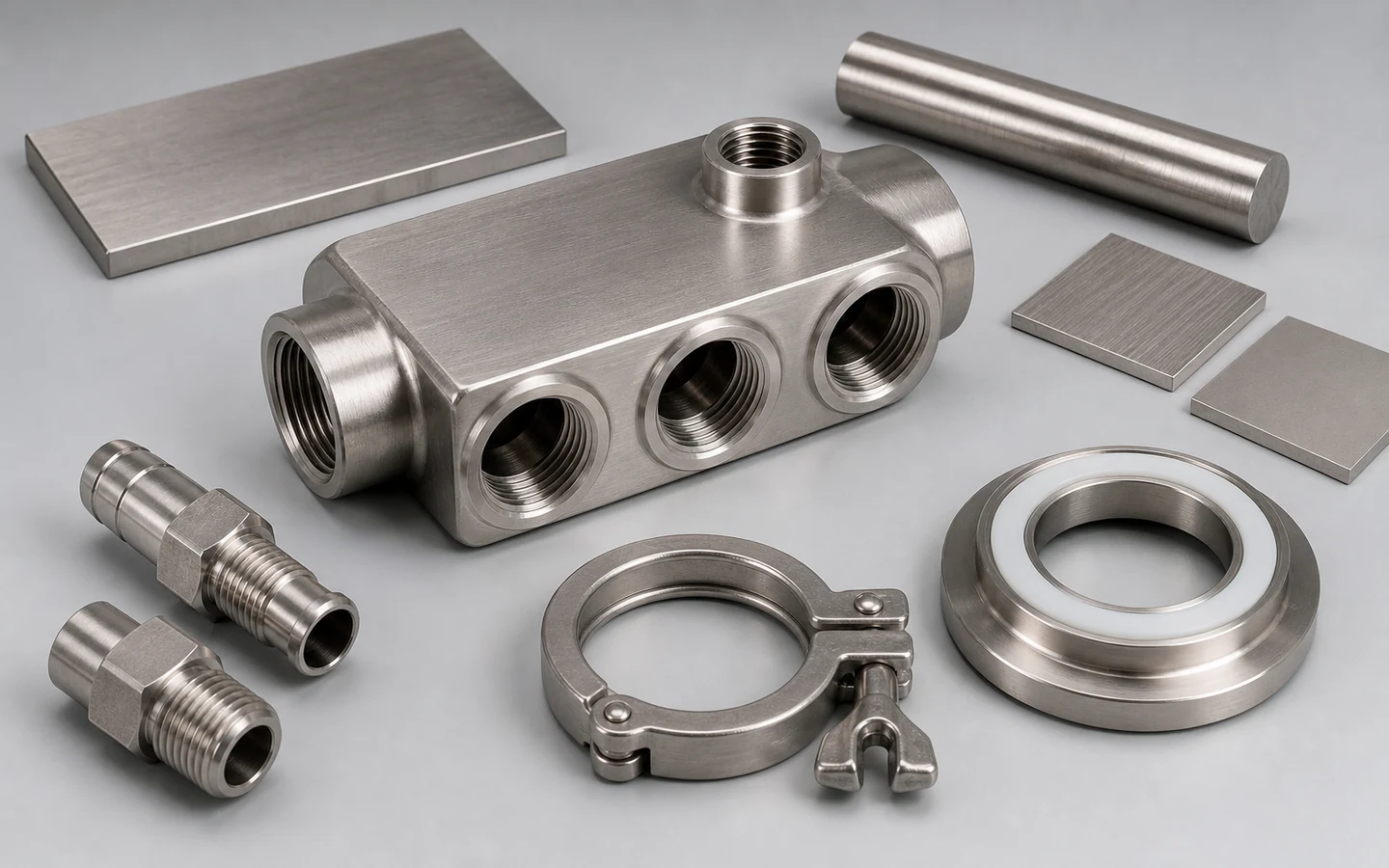
Stainless Steel 316 is often evaluated for parts exposed to chlorides, chemicals, moisture or demanding cleaning conditions. It may be considered for fluid components, fasteners, housings, instrumentation, marine-adjacent equipment and processing hardware, but the grade name does not prove suitability for a particular concentration, temperature, crevice or regulatory context.
The RFQ should identify the actual environment, intended lifetime, cleaning method, contacting materials and consequence of corrosion. Machining behavior, weld sequence, surface contamination, passivation, electropolishing, roughness and documentation are reviewed with the selected supplier. Exact compliance and qualification claims require project evidence.
Where the material fits
Use exposure and acceptance needs to support the choice.
Components near salt, brine or chloride cleaning may justify comparison with 304, subject to concentration, temperature and design details.
Fittings, manifolds, housings and fixtures can be reviewed against named chemicals, cleaning cycles and surface requirements.
Persistent moisture, contamination, crevices and contact with other metals should be included in the material and finish decision.
Parts needing passivation, electropolishing or defined roughness require an explicit surface and verification plan rather than an alloy-only callout.
Material tradeoffs
More corrosion resistant does not mean corrosion proof or automatically compliant.
Compatibility can change with concentration, heat, aeration, deposits and cleaning method; provide real service conditions.
Geometry, joints, seals, surface condition and drainage can matter as much as nominal alloy selection.
Specify 316, 316L or another controlled designation only when the governing requirement calls for it; do not merge them casually.
Tooling, handling, welding, blasting and storage can affect final surface condition, so cleaning and treatment scope must be clear.
Grade and route choices
The sequence is reviewed from geometry and final exposure.
Reviewed for manifolds, fittings, housings, shafts and instrumentation components with passages, threads and sealing surfaces.
Reviewed for formed or welded hardware with grade, joint, distortion, cleanup and final surface controls.
Reviewed when the specified surface process, roughness, cleanliness or corrosion objective requires it and can be verified.
Material comparison
Typical published values for 316 in the annealed condition. Actual values vary with product form, cold work and the supplier's material certification, and the project requirement is confirmed on the reviewed quote rather than from this table.
| Property or candidate | Typical published value | Key review |
|---|---|---|
| Tensile yield strength | 205 MPa / 30 ksi annealed | Marginally below 304 — 316 is not chosen for strength |
| Ultimate tensile strength | 515 MPa / 75 ksi annealed | Margin against peak load in the released condition |
| Modulus of elasticity | 193 GPa / 28 Msi | Identical to 304; the grade choice does not change stiffness |
| Density | 8.00 g/cm³ | Same as 304, roughly three times 6061 aluminium |
| Hardness | About 79 HRB annealed | Work-hardens faster than 304 and is the tougher of the two to machine |
| Elongation at break | About 40% annealed | Good forming and deep-draw behaviour |
| Composition | Roughly 16 to 18% chromium, 10 to 14% nickel, 2 to 3% molybdenum | The molybdenum is the entire reason to pay for 316 |
| Pitting resistance | PREN around 24 to 26, against 18 to 20 for 304 | Chloride concentration, temperature and whether the surface can be rinsed |
| Chloride limit | Commonly held below about 200 ppm at ambient temperature; resistance falls as temperature rises | Pitting is a threshold behaviour, not a gradual one |
| Thermal expansion | About 16.0 µm per metre per °C, slightly below 304 | Weld distortion and fits measured at a stated temperature |
| Relative stock cost | Commonly 1.2 to 1.5 times 304 for equivalent product form | Whether the whole part needs it or only the wetted surface |
| Common specifications | ASTM A276 for bar, ASTM A240 for sheet and plate | Which specification the mill certificate must reference |
| Stainless 316L | 170 MPa / 25 ksi yield at 0.03% maximum carbon | The welded-assembly version of the same grade |
| Duplex 2205 | Roughly 450 MPa / 65 ksi yield with a PREN above 34 | Where 316 is not enough for the chloride environment |
Material RFQ inputs
Describe the actual service environment and the evidence needed at receipt.
Complete packages move faster: revision-matched CAD, critical dimensions, quantity and material notes are enough to open engineering review across the network.
Get a QuoteExact 316-series grade, condition, product form and specification
Chemicals, chlorides, concentration, temperature, cleaning and moisture
CAD, drawing, joints, passages, seals, crevices and drainage context
Quantity, revision, program stage and permitted alternatives
Passivation, electropolishing, roughness, cleanliness and packaging
Material records, traceability, inspection, compliance context and delivery
Questions before routing
These answers prepare the request; the reviewed quote controls project-specific commitments.
No. 316 resists chlorides far better than 304 — a pitting resistance number around 24 to 26 against 18 to 20 — but pitting is a threshold behaviour, not a gradual one. Above roughly 200 ppm chloride at ambient temperature, and at lower concentrations as temperature rises, 316 pits like any other grade. Crevices under gaskets and fasteners fail first because the trapped fluid concentrates. State the fluid, concentration, temperature, crevice geometry and cleaning cycle rather than relying on the grade name.
Carbon content, and it matters at the weld. Standard 316 allows up to 0.08% carbon; 316L caps it at 0.03%. Above about 0.03%, chromium carbides precipitate at grain boundaries in the heat-affected zone during welding, and the weld line then corrodes faster than the parent metal. The cost is a little strength — 316L publishes about 170 MPa / 25 ksi yield against 205 MPa / 30 ksi for 316. For a welded assembly in corrosive service, specify 316L; for a machined part that is never welded, standard 316 is fine.
It is not automatic and has to be specified, normally to ASTM A967. Machining, grinding and fixturing embed free iron in the surface, and that iron rusts in service even though the base metal does not. Passivation dissolves it and lets the chromium oxide film reform evenly. State whether passivation is required, which specification and method apply, whether weld scale and heat tint must be removed first, and how the result is verified.
Marginally, and not in a way that should drive the choice. 316 publishes 205 MPa / 30 ksi yield and 515 MPa / 75 ksi ultimate against 215 MPa / 31 ksi and 505 MPa / 73 ksi for 304 — the yield is actually slightly lower. Modulus is identical at 193 GPa and density identical at 8.00 g/cm³. 316 costs commonly 1.2 to 1.5 times 304, and every bit of that premium buys chloride resistance, not mechanical performance.
316 is one of the standard grades for both, and the supplier network includes manufacturers holding ISO 9001 and ISO 13485 certification for medical component work. What can be supplied with the parts is a mill certificate against ASTM A276 or ASTM A240, passivation records to ASTM A967, surface roughness measurement on wetted faces — commonly Ra 0.8 µm or better — and lot traceability. What stays project-specific is the routed supplier's certificate scope and expiry, and device-level regulatory conclusions, which belong to the device owner rather than a component. State the evidence you need in the RFQ and it comes back confirmed on the quote.
Next step
Send the material requirement with geometry and use context. MakeNexa routes capable suppliers from a global network covering competitor-class process categories, then returns a prepared quote or focused clarification for your revision.