 MAKENEXA
Bent brackets and enclosures
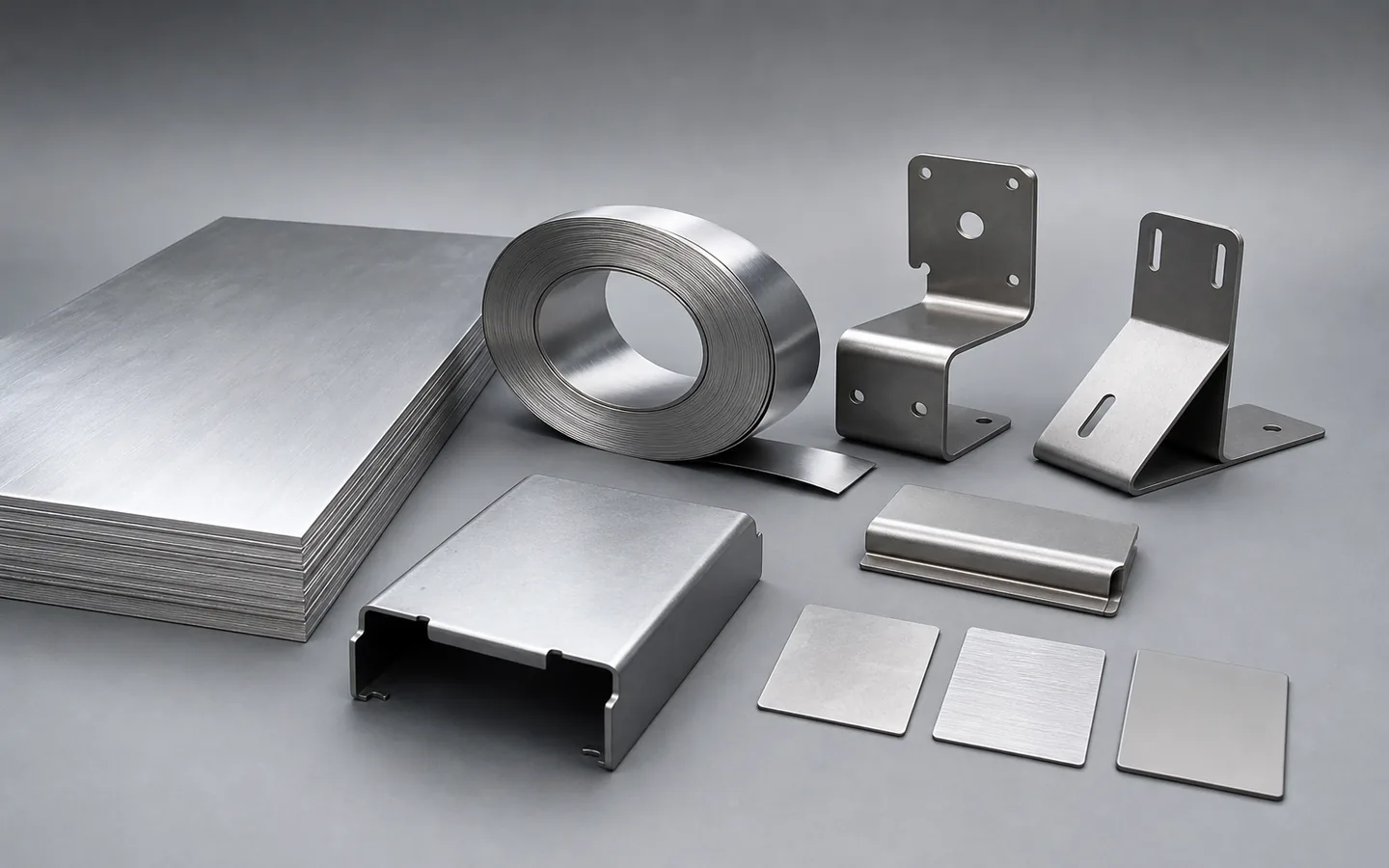
5052 sheet can support brackets, covers, panels and enclosures when bend radius, grain direction, flange access, reliefs and final interface tolerances are reviewed with the selected temper and thickness.
Material selection decision
Aluminum 5052 is commonly considered for sheet and plate parts where forming, corrosion context, joining and moderate structural needs matter, but the alloy name does not define the finished component. Temper, thickness, grain direction, bends, welds, machining, finish and inspection must be reviewed together. MakeNexa confirms exact stock and supplier fit per RFQ.
Selection criteria
Start with the released shape and service conditions. Identify formed flanges, deep or tight bends, welded seams, hardware, machined interfaces, cosmetic faces and the environment the part must tolerate. Specify the governing 5052 requirement, temper and product form when fixed. If material selection is open, provide the properties and restrictions that control the decision rather than treating every 5000-series sheet as interchangeable.
The manufacturing route should connect stock surface and grain to cutting, bending, welding, hardware, cleaning, conversion coating, anodizing, paint or another finish. Heat from welding and local forming can affect shape and appearance. State which dimensions apply before or after finish, how the part is supported during inspection and what material or process records are required.
Where the material fits
The alloy is most useful when temper, thickness, forming and finish are selected for the complete component.
5052 sheet can support brackets, covers, panels and enclosures when bend radius, grain direction, flange access, reliefs and final interface tolerances are reviewed with the selected temper and thickness.
Welded or mechanically joined construction may suit frames, trays and housings. Define joint purpose, access, distortion control, visible seams, hardware sequence and final datum relationships before the quote is prepared.
Stock surface, handling film, brushing, cleaning, conversion coating, anodizing or paint can affect appearance. Mark viewing zones, grain direction, masked features and acceptable reference conditions.
Cutting and bending may be combined with machined holes, sealing lands or mounting faces. Identify features that require secondary machining and the final state in which their relationship is accepted.
Material tradeoffs
Many 5052 issues come from a broad alloy callout that omits the condition in which the part is formed and measured.
Temper influences forming response and mechanical behavior. State the specified temper and required records or allow engineering to review alternatives against bend, strength, appearance and supply needs.
Bend feasibility depends on thickness, temper, radius, grain, flange length, reliefs and tooling. Define functional envelope and let the reviewed route confirm the bend plan.
Heat, joint pattern, sequence and restraint can move thin panels and long seams. Tie final geometry to functional datums and define any post-weld machining or restrained inspection.
Coatings and anodized finishes do not erase scratches, weld variation, edge damage or inconsistent preparation. Protect cosmetic stock and establish surface acceptance before finishing.
Grade and route choices
Material selection should follow forming, strength, machining, finish and supply priorities for the released part.
Use exact 5052 sheet or plate when its forming, joining and corrosion context fits. Control temper, stock surface, grain, bends, welds, finish and documentation as one route.
6061 may better fit some machined or heat-treated structural parts, but forming, welding, strength, temper and finish trade-offs require a fresh review. Do not substitute by family name alone.
Another aluminum grade, stainless sheet, coated steel, machining or a hybrid construction may better balance stiffness, appearance, environment and quantity. Compare the complete assembly requirement.
Material comparison
Typical published values for 5052 in the tempers named. Bend behaviour depends on thickness, grain direction and tooling, and the project requirement is confirmed on the reviewed quote rather than from this table.
| Property or decision factor | Typical published value | What it means for the fabricated part |
|---|---|---|
| Tensile yield strength | 193 MPa / 28 ksi in H32; about 90 MPa / 13 ksi annealed | Strength comes from work hardening, not heat treatment — 5052 cannot be re-aged after forming |
| Ultimate tensile strength | 228 MPa / 33 ksi in H32 | Adequate for enclosures and brackets; below 6061-T6 at 310 MPa / 45 ksi |
| Modulus of elasticity | 70.3 GPa / 10.2 Msi | Panel stiffness comes from gauge and formed features, not from the alloy |
| Density | 2.68 g/cm³, the lightest of the common structural aluminium alloys | Mass budget on large sheet assemblies |
| Hardness | About 60 HB in H32 | Soft: it forms cleanly but machines gummily and marks easily in handling |
| Elongation at break | About 12% in H32, and over 20% annealed | The reason 5052 bends where 6061 cracks |
| Minimum bend radius | Roughly 1× material thickness in H32 for a 90° bend across the grain; tighter radii need annealed stock or a larger radius | Bend lines that run with the grain need more radius than the same bend across it |
| Corrosion resistance | The magnesium 5xxx chemistry gives the best salt-water resistance of the common alloys | Marine, outdoor and washdown service without a coating |
| Welding | Readily welded, commonly with 5356 filler; strength in the heat-affected zone drops toward the annealed value | Design the joint so the weld is not at the highest-stress section |
| Anodizing | Anodizes clear well; dyed colour is less consistent than on 6061 because of the magnesium content | Colour reference and lot-to-lot matching if appearance is controlled |
| Common specification | ASTM B209 for sheet and plate | Which specification the mill certificate must reference |
| Aluminum 6061 | 276 MPa / 40 ksi yield but a minimum bend radius nearer 2 to 3× thickness in T6 | Choose 6061 for machined strength, 5052 for formed sheet |
Material RFQ inputs
Provide the complete fabricated and finished state so temper and routing are not inferred from the alloy name.
Complete packages move faster: revision-matched CAD, critical dimensions, quantity and material notes are enough to open engineering review across the network.
Get a QuoteSubmit the controlled model, drawing, revision and assembly context
State the 5052 specification, temper, thickness, product form and permitted alternatives
Mark bends, grain direction, reliefs, critical flanges and machined interfaces
Define welds, hardware, joint access, distortion and cleanup requirements
Specify cosmetic zones, surface direction, finish, masking and protected edges
List quantities, final-state inspection, sampling, material records and process documents
Questions before routing
These answers prepare the request; the reviewed quote controls project-specific commitments.
It is the usual first choice for formed sheet. In H32 it takes a 90° bend at roughly 1× material thickness across the grain, against nearer 2 to 3× for 6061-T6, which cracks at radii 5052 handles without complaint. Elongation is about 12% in H32 and over 20% annealed. Bends running with the grain need a larger radius than the same bend across it, so state grain direction on the flat pattern when the bend is tight.
Yes, readily, commonly with 5356 filler. The trade-off is that 5052 gets its 193 MPa / 28 ksi yield from work hardening rather than heat treatment, so the heat-affected zone relaxes toward the annealed value near 90 MPa / 13 ksi and cannot be recovered by re-ageing. Place welds away from the highest-stress section, and state distortion limits and post-weld flatness on the drawing.
Decide from whether the part is formed or machined. 5052-H32 publishes 193 MPa / 28 ksi yield and bends at roughly 1× thickness; 6061-T6 publishes 276 MPa / 40 ksi but needs 2 to 3× thickness and cracks at tighter radii. 5052 also resists salt water better and welds without losing a heat-treated condition it never had. For a machined bracket 6061 wins; for a folded enclosure 5052 usually does.
Both. Clear anodize works well; dyed colour is less consistent than on 6061 because the magnesium content affects the film, so supply a controlled reference rather than a colour name when appearance is contractual. Type II anodize typically adds 5 to 25 µm, growing about half outward. Powder coating adds far more — typically 50 to 100 µm per surface — so mask threads, bores and grounding points and say whether dimensions apply before or after finishing.
Next step
Send the material requirement with geometry and use context. MakeNexa routes capable suppliers from a global network covering competitor-class process categories, then returns a prepared quote or focused clarification for your revision.