 MAKENEXA
Material definition
Name the grade or controlling specification, revision where relevant, condition, temper, product form and any buyer-specific property. State whether an equivalent can be proposed and who may approve it.
Manufacturing requirement decision
A material name on a drawing and a material record delivered with parts answer different questions. This guide helps buyers define what the document must establish, how the manufactured item should link back to the source lot, and which substitutions or tests require approval before supplier selection.
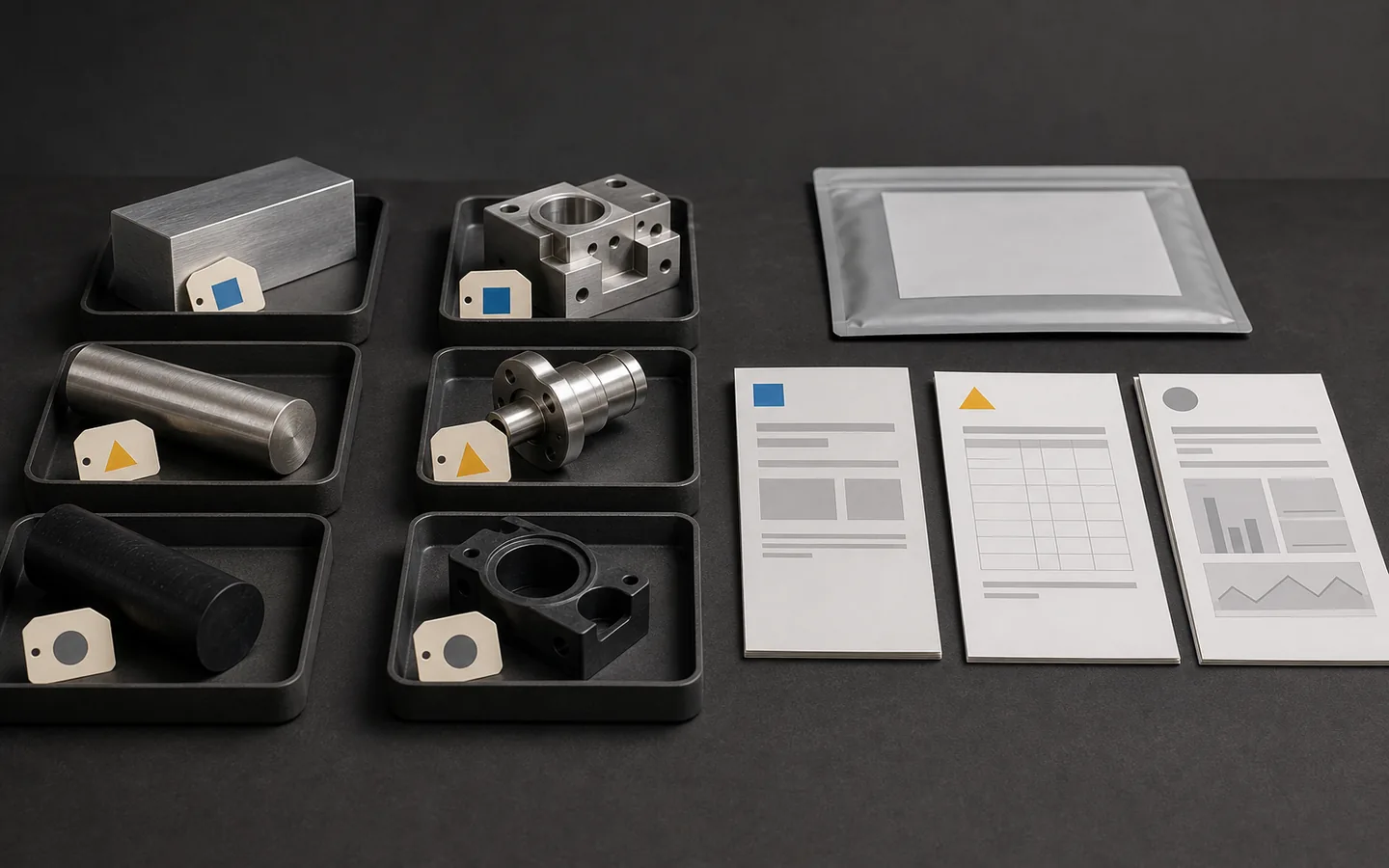
Requirement and review scope
Start with the purchased requirement: exact grade or specification, condition or temper, product form, any composition or property limit, and the consequence of receiving the wrong material. Then choose evidence that can address that requirement. A supplier declaration, distributor record, original producer report or project-specific test result may carry different information and different linkage to the actual part. The label certificate is not enough unless the RFQ defines the expected source, fields and traceability path.
Traceability also needs a practical boundary. The buyer should state whether records must connect the finished part to a heat, melt, batch, lot, sheet, bar or other source identity; how mixed lots are handled; whether marking is required; and what record travels with the shipment. MakeNexa can request and route project-specific material documentation, but no document type, traceability system, test result or supplier practice is assumed across every RFQ. Availability, content, cost and retention are confirmed for the selected route.
What the requirement controls
Each link should identify who made the statement, what material it covers and how it relates to the delivered item.
Name the grade or controlling specification, revision where relevant, condition, temper, product form and any buyer-specific property. State whether an equivalent can be proposed and who may approve it.
Specify whether a supplier declaration, distributor certificate, original mill or resin-producer record, laboratory report or another defined source is needed. List the fields that make the record useful instead of relying on an informal name.
Define the identifier that should connect source material, incoming stock, manufacturing traveler and delivered parts. Decide whether split lots are allowed and how the shipment or packaging preserves the relationship.
State the required file format, language, shipment timing, part or purchase reference, retention period and correction path. Protect sensitive source information and grant access only to the roles that need it.
Common definition gaps
A polished record can still fail the receiving need when its scope or connection to the part is unclear.
A template or catalog statement may describe a grade family but not the material used for the order. Require the relevant source identifier and a chain that links that identifier to the manufactured lot when traceability matters.
Grade alone may omit temper, heat treatment, filler, product form, thickness range or another condition that affects the requirement. Keep drawing, purchase data and delivered record consistent.
A report only establishes the tests, samples, methods and acceptance context it actually contains. Identify which composition, mechanical, electrical, thermal or other characteristic is required and whether source data or project testing is acceptable.
An alternate grade, condition, source or product form can affect function and evidence. Require a proposed deviation before use, with the changed requirement and documentation consequence visible to the buyer.
Evidence and review choices
The appropriate record depends on the application, purchasing system and consequence of a material mismatch.
Use a defined declaration when the buyer needs confirmation of the purchased material identity but does not require original producer values. Specify the order, part, revision, lot and statement fields expected.
Request a mill, resin-producer, distributor or equivalent source document when original heat, batch, composition or property data is needed. Confirm that the source identifier can be linked to the delivered material.
Use defined testing when the required characteristic is absent, disputed or must be verified in a particular condition. Agree the laboratory, method, sample source, acceptance rule and disposition before testing begins.
Requirement planning table
Typical published practice for material documentation. Which records apply to a project is a buyer decision, and availability, format and scope are confirmed on the reviewed quote rather than from this table.
| Evidence layer | What it can establish | RFQ definition needed |
|---|---|---|
| Mill test report | Chemistry and mechanical properties of a specific heat or lot against a named specification | Which specification — ASTM A276 for stainless bar, ASTM B221 for aluminium extrusion, ASTM A29 for steel bar |
| Aerospace-grade specification | Where a programme requires it, an AMS reference such as AMS 4928 for titanium Grade 5 or AMS 6382 for 4140 | Whether the programme mandates it, since it narrows supply |
| Heat or lot identity | The boundary within which the reported properties apply | Where the lot boundary sits, and whether lots may be mixed |
| Certificate of conformance | A statement that the supplied material meets the stated specification | An assertion, not a measurement |
| Independent test report | Chemistry or mechanical properties verified separately from the mill's own report | Whether independent verification is required, and who performs it |
| Temper and condition | The state the properties were measured in — 6061-T6 at 276 MPa yield differs from T651 in residual stress at the same strength | The full designation, not the alloy number |
| Heat-treatment record | The cycle applied after the material arrived, and the resulting hardness range | Because on 4140 the property ranges from 415 MPa annealed to about 1520 MPa quenched and tempered |
| Hardness verification | A measured value with its location and test method, such as 28 to 32 HRC on pre-hardened stock | Stated as a range with a measurement location |
| Product form | Bar, plate, sheet, extrusion or tube — properties differ between them at the same grade | Product form named alongside the grade |
| Traceability chain | The link from heat identity through each process handoff to the delivered part | Which handoffs must preserve identity |
| Part marking | How the delivered part carries its lot or heat identity, at a legible character height around 1.0 mm or more | Where marking is permitted on the part |
| What documentation cannot do | No certificate describes machining, welding, finishing or handling after the material was tested | What separate evidence the finished part needs |
Requirement RFQ inputs
Define the record before routing so its source, traceability and commercial impact can be evaluated with the quote.
Complete packages move faster: revision-matched CAD, critical dimensions, quantity and material notes are enough to open engineering review across the network.
Get a QuoteState exact material grade or specification, condition, temper, product form and controlling revision where relevant
Identify the required document type, issuing source and mandatory fields rather than requesting a generic certificate
Define heat, melt, batch, lot or stock linkage and how mixed or split lots must be handled
List any required composition, property or independent tests with sample, method and acceptance context
State permitted substitutions, prior-approval responsibility and the record needed for an approved deviation
Define delivery format, language, timing, part reference, retention, confidentiality and correction requirements
Questions before routing
These answers prepare the request; the reviewed quote controls project-specific commitments.
It is a record of the incoming stock, not of the finished part. A mill test report states the chemistry and mechanical properties of a specific heat or lot against a named specification — ASTM A276 for stainless bar, ASTM B221 for aluminium extrusion, ASTM A29 for steel bar, or an AMS reference where a programme requires one. Name the specification you need on the drawing; a request for a certificate without one leaves it open.
No, and requiring one by default narrows supply and adds cost without adding confidence on many parts. It matters where the material property is the requirement — a structural component, a pressure part, a programme with a traceability obligation — and matters much less on a bracket whose function does not depend on which 6061 lot it came from. State where certification is genuinely required rather than applying it across a whole bill of materials.
No, and this gap causes real problems. The certificate describes the stock as tested at the mill. It says nothing about machining, welding, embedded free iron from tooling, heat treatment — which on 4140 moves the yield from about 415 MPa annealed to as much as 1520 MPa quenched and tempered — finishing at 5 to 25 µm anodize or 50 to 100 µm powder, or handling. State separately what evidence the finished part requires.
Because the temper often carries more of the property than the alloy does. 6061-T6 and 6061-T651 both publish about 276 MPa yield, but only T651 carries a stretch stress-relief that keeps a machined part from bowing. 4140 ranges from about 415 MPa annealed to roughly 1520 MPa quenched and tempered under one grade number. 7075-T6 at about 503 MPa yield is stress-corrosion susceptible where T73 at 435 MPa is not. State the full designation.
Traceability routes through the supplier network as a defined scope rather than a single document, and it is available up to heat-to-part linkage with serialised identity where a programme requires it. Define five things in the RFQ and it comes back priced and confirmed: the specification the mill certificate must reference — ASTM A276, ASTM B221 or an AMS reference; where the lot boundary sits and whether lots may be mixed; which process handoffs must preserve identity, since heat treatment and finishing are where identity is usually lost; how the delivered part carries its identity, at a legible character height around 1.0 mm or more; and what record accompanies delivery.
Next step
Send the controlled requirement with the drawing and project context. MakeNexa routes capable suppliers from a global network covering competitor-class process categories, then returns a prepared quote or focused clarification for your revision.