 MAKENEXA
Controlled product definition
Identify the part number, model, drawing revision, specification revisions and approved deviations. Resolve model-versus-drawing authority and freeze the scope used to balloon or list characteristics.
Manufacturing requirement decision
A first article is a controlled sample and evidence package used to review whether a defined manufacturing route produced the scoped requirements of a specific revision. It is most useful when the buyer, supplier and MakeNexa agree in advance what will be checked, which condition the sample represents and who decides the next step.
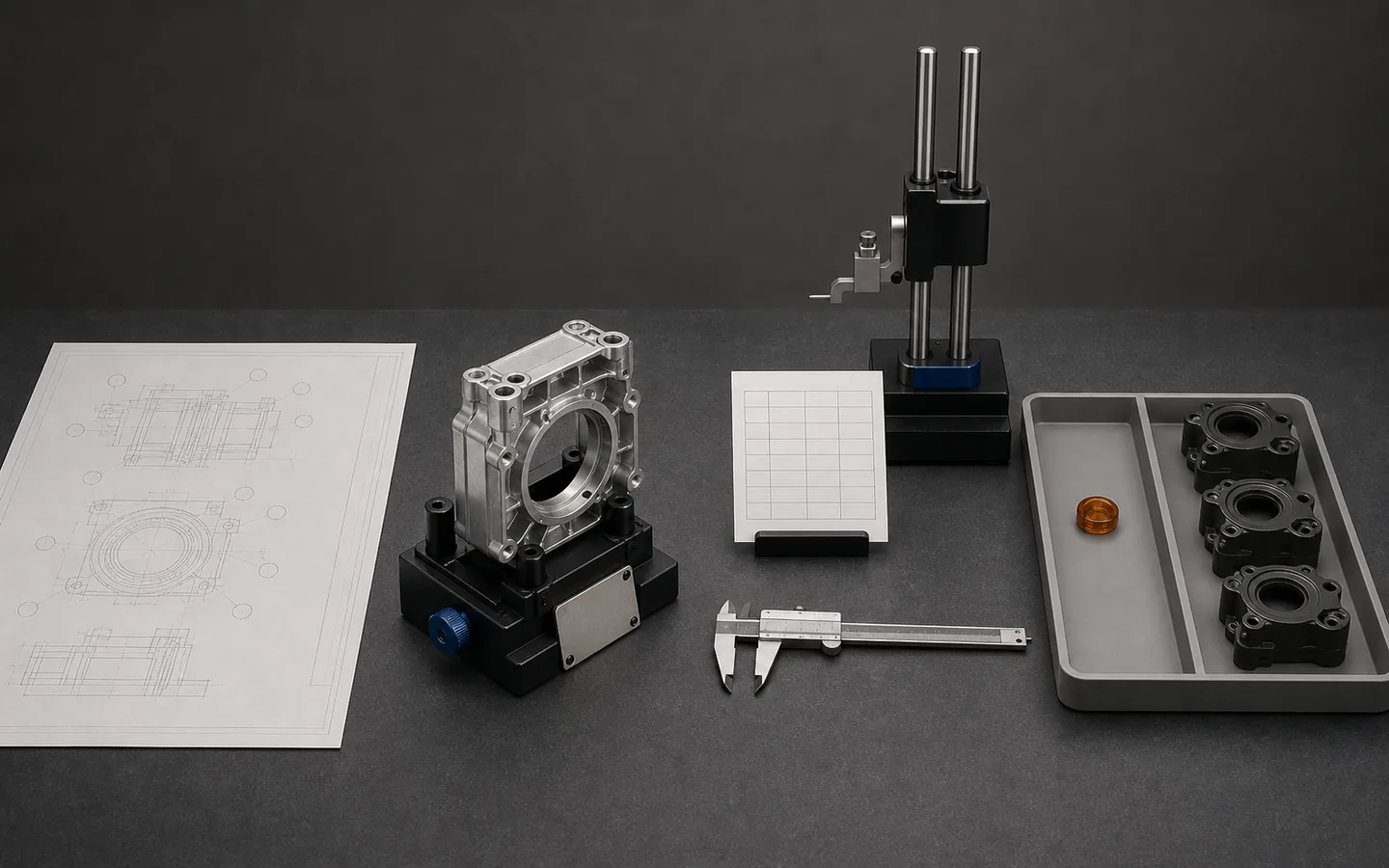
Requirement and review scope
Use first-article review when a new part, supplier route, tool, fixture, critical revision or process change creates enough risk to justify evidence before a broader release. The scope can cover every drawing characteristic or a defined risk-based set, but it should identify the authoritative model and drawing, sample quantity, material lot, manufacturing and finish condition, measurement method, report fields and accompanying records. A report prepared after production starts cannot repair an undefined approval plan.
The review must also define what happens when evidence differs from the requirement. A deviation may be rejected, accepted for a limited quantity, reworked, corrected in the design or routed through another controlled disposition. Approval applies only to the stated revision, sample and process context; it is not proof that every future part will conform. MakeNexa coordinates project-specific first-article needs through the selected supplier route but does not imply a formal industry scheme unless that scheme is explicitly required and confirmed in the RFQ.
What the requirement controls
A useful review connects one controlled definition to a representative sample, traceable evidence and an explicit release decision.
Identify the part number, model, drawing revision, specification revisions and approved deviations. Resolve model-versus-drawing authority and freeze the scope used to balloon or list characteristics.
State whether the sample must use production material, tooling, fixtures, programs, operators, secondary operations, finish and packaging. Record any intentional departure so the review does not claim more than the sample represents.
Define the dimensions, notes, material records, finish evidence, functional checks and other characteristics to report. Include method, units, sample mapping and any source documents needed for interpretation.
Name who reviews results, how questions and nonconformities are handled, whether conditional approval is allowed, and what quantity or next operation may proceed after each decision.
Common definition gaps
The report loses value when the definition, sample or approval boundary cannot be reconstructed later.
A numbered drawing is only useful when it matches the controlling revision and captures applicable notes, specifications and model-defined requirements. Resolve conflicts before measurements are assigned.
A sample chosen outside the intended process sequence may not represent production. Record its lot, cavity or position where relevant, route, rework and selection method so the reviewer understands the evidence.
A dimensional table does not automatically cover material, treatment, finish, cleanliness, assembly or functional requirements. List every scoped record and mark items not evaluated rather than implying complete acceptance.
A supplier, material, tool, program, fixture, location, process or design change may alter the approved condition. Define which changes require notification, partial review or a new first article.
Evidence and review choices
The buyer can choose different evidence scopes as long as the release boundary is explicit and suitable for the project.
Review all applicable drawing and specification characteristics when a new or changed route warrants comprehensive baseline evidence. Define how model-only geometry and notes are included in the characteristic list.
Limit the report to critical, changed or process-sensitive characteristics when the unchanged baseline is otherwise controlled. State why the reduced scope is appropriate and what evidence remains in force.
Use an engineering pilot to resolve route and measurement questions, then run a separately identified first article in the intended production condition. Keep learning deviations out of the formal approval sample unless explicitly accepted.
Requirement planning table
Typical published practice for first-article inspection. Scope, sampling and acceptance are project decisions confirmed on the reviewed quote rather than from this table.
| Review layer | Typical published practice | Release question |
|---|---|---|
| What a first article establishes | That the process produced one correct part under controlled conditions at a stated drawing revision | It does not establish that later parts will match |
| Report basis | A ballooned drawing at a named revision, each characteristic mapped to a measured result | Which revision, and who balloons it |
| Scope | Commonly every dimensional characteristic on a genuine first article, unlike routine reporting | Whether full scope is proportionate for this part |
| Measurement method | Named per characteristic, since a CMM, a micrometer and a thread gauge answer different questions | A ±0.025 mm feature wants roughly 0.005 mm of measurement capability |
| Reference temperature | Metrology referenced to 20 °C; aluminium moves about 23.6 µm per metre per °C away from it | The measurement condition stated on tight features |
| Part state | Measured in the delivered condition — after heat treatment, welding and finishing, since powder adds 50 to 100 µm per surface and anodize 5 to 25 µm | Which condition each characteristic is reported in |
| Capability data | A separate deliverable — a Cpk of 1.33 on a critical characteristic requires a population, not one part | Whether capability is required alongside the first article |
| Deviation handling | What happens when one characteristic is out of tolerance: correct, deviate with authority, or reject | Decided before the first article, not after |
| Approval authority | Who reviews the report, against which revision, and how approval is recorded | Named in the RFQ |
| Re-triggering | A design revision, a process change, a supplier change, a tool change or a long production gap normally re-triggers it | Which changes require a new first article, stated |
| Ongoing control | After approval, control passes to sampling — commonly drawn to ANSI Z1.4 for attribute characteristics — and stated frequencies on critical ones | The ongoing plan defined at the same time |
| Drawing standard | ASME Y14.5 where geometric controls are used, since datum interpretation drives the measurement setup | That the report and the drawing are read the same way |
Requirement RFQ inputs
Agree the review scope and decision path before the supplier commits to the sample or repeat quantity.
Complete packages move faster: revision-matched CAD, critical dimensions, quantity and material notes are enough to open engineering review across the network.
Get a QuoteIdentify the trigger, part number, controlled model, drawing and applicable specification revisions
Define full or risk-based characteristic scope, ballooning method and treatment of model-only requirements
State sample quantity, material lot, tooling, fixture, program, process, finish and packaging condition
Specify report format, measurement methods, units, sample mapping and supporting material or process records
Name reviewer and approval responsibility plus rejection, rework and limited-deviation paths
Define what quantity may proceed and which design, supplier, material, tooling or process changes trigger re-review
Questions before routing
These answers prepare the request; the reviewed quote controls project-specific commitments.
Before repeat production begins, and again whenever something material changes — a design revision, a process or tooling change, a supplier change, or a long gap in production. Its purpose is to establish that the process can produce a correct part under controlled conditions before quantity is committed. On a one-off part it is usually disproportionate; on the first release of a repeating part it is the cheapest insurance available.
Commonly yes, and this is where it differs from routine dimensional reporting. A genuine first article maps every characteristic on a ballooned drawing at a named revision to a measured result, because its purpose is to prove the whole definition was achievable. Routine reporting afterward drops back to the critical characteristics with attribute sampling — commonly drawn to ANSI Z1.4 — on the rest.
That should be decided before the first article rather than negotiated after it. The options are to correct the process and re-run, to accept the part under a documented deviation with named authority and a stated scope, or to reject. Each has different consequences for the drawing, the tooling and the production plan. Name the approval authority and the deviation path in the RFQ.
No, and treating it as though it does is a common failure. A first article evidences one part made under controlled conditions at one moment. Ongoing conformance comes from the sampling plan and capability control that follow it — stated frequencies on critical characteristics, commonly with a Cpk target of 1.33, and attribute sampling on the rest. Define the ongoing plan at the same time as the first article, not afterward.
In the delivered condition, and it needs stating because several operations move dimensions. Heat treatment moves a part past ±0.05 mm, welding moves an assembly 1 mm per metre and more, powder adds 50 to 100 µm per surface and anodize 5 to 25 µm growing about half outward. A first article measured before finishing does not evidence the part that ships. State the measurement stage, the temperature and the free-state condition.
Next step
Send the controlled requirement with the drawing and project context. MakeNexa routes capable suppliers from a global network covering competitor-class process categories, then returns a prepared quote or focused clarification for your revision.