 MAKENEXA
Bridge and early production
Support market introduction, pilot equipment or early assemblies with controlled releases while demand and design stabilize. Define the event that triggers a new tooling or sourcing review.
Manufacturing service decision
Low-volume sheet metal work sits between one-off learning and stable production. The right route should manage revision changes, repeatable bends and joints, hardware, finish, inspection, packaging and release cadence without assuming that every program needs high-volume tooling. MakeNexa coordinates a project-specific supplier route; capacity, price, timing and repeatability are confirmed for each RFQ.
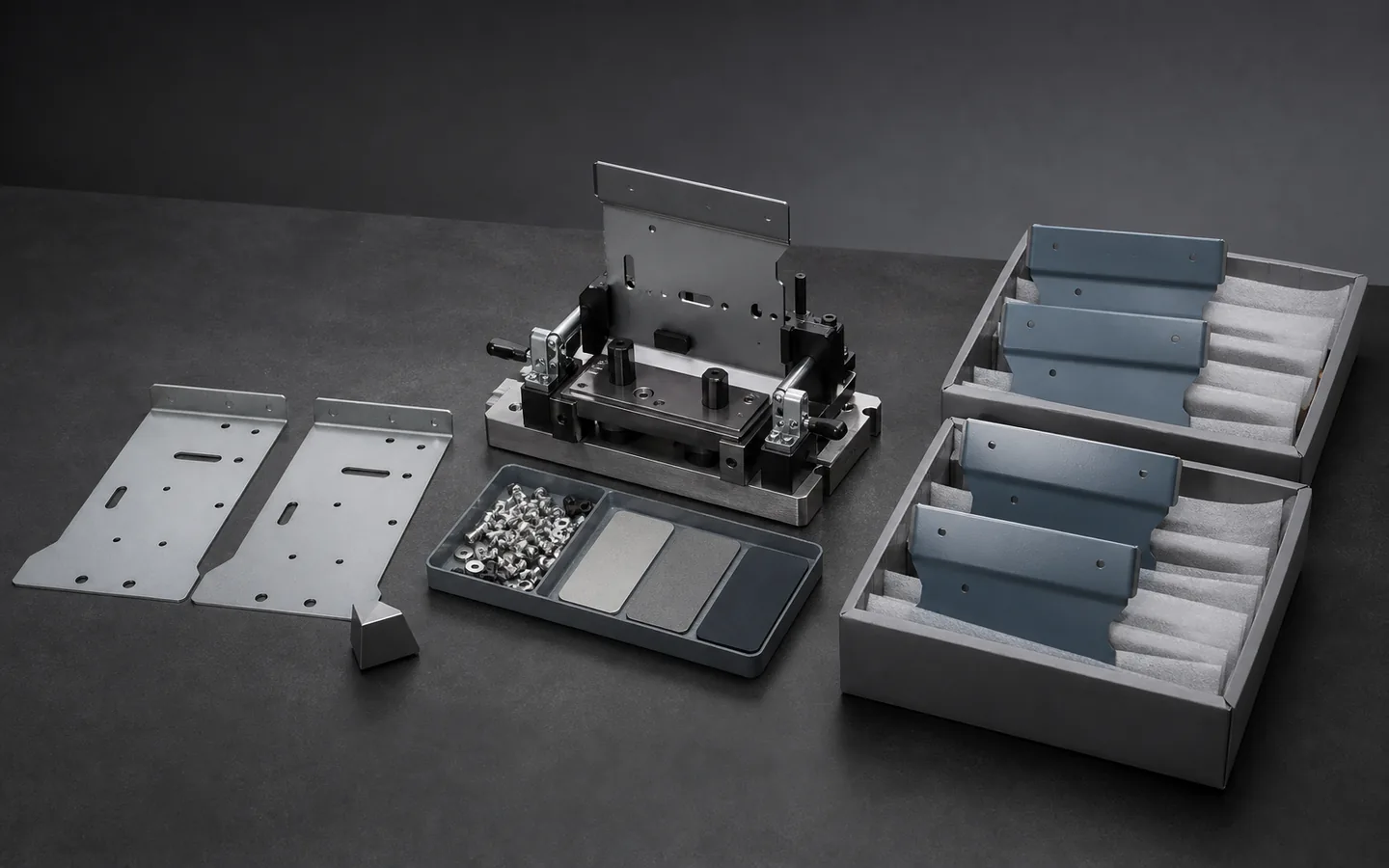
Route decision
Define the expected quantities per release, annual or program context where useful, revision maturity, likely changes and delivery pattern. Separate one-time engineering, tooling or fixture work from recurring part scope. A low-volume route may use flexible cutting and forming, simple fixtures and manual assembly, but repeat acceptance still requires controlled files, material, finish, hardware and inspection expectations.
Treat the first release as the start of a documented repeat process, not a large prototype. Record approved deviations, setup-critical features, cosmetic references, hardware identity, packaging and required evidence. If demand or design stabilizes, the route can be reviewed for dedicated tooling, improved fixtures, alternate suppliers or different batch sizes without erasing revision history.
Best-fit parts and programs
This route is strongest for controlled batches whose geometry or demand does not yet justify a fixed high-volume process.
Support market introduction, pilot equipment or early assemblies with controlled releases while demand and design stabilize. Define the event that triggers a new tooling or sourcing review.
Panels, brackets, covers, frames and guards may repeat in modest batches across equipment builds. Part numbering, revision, installed hardware and finish consistency are often more important than a generic volume label.
Related variants can share material, finish, hardware or fixtures while retaining separate controlled geometry. Provide the family structure and mix rather than quoting each item without common context.
Flexible fabrication can accommodate managed revisions when obsolete files, work in progress, inventory and interchangeability are controlled. State cut-in rules and disposition expectations before a change.
Feasibility checks
Low quantity does not remove the need for configuration, process and evidence control.
Temporary material, hand adjustment, substitute hardware or cosmetic touch-up should not become an unstated production method. Close or formally accept each concession before repeat release.
Use clear part numbers, revision markings, file packages and effective dates. Define whether old and new parts are interchangeable and how remaining inventory is handled.
Weld, drill, inspection or assembly fixtures may be needed for repeat relationships. State ownership, storage, maintenance, replacement and change impact in the quote.
Batch, substrate, preparation and application can affect appearance. Mark cosmetic zones and define a practical reference and viewing condition where consistency matters.
Route options
The initial process should fit current demand while preserving evidence for the next sourcing decision.
Use programmable cutting, general-purpose forming and controlled manual secondary work when revisions and mix remain active. Protect repeat-critical setup and inspection information.
Add bending, welding, drilling, hardware or inspection fixtures where repeat relationships justify them. Quote the fixture and recurring operation separately with ownership and change rules.
When design and demand stabilize, compare dedicated tooling, automation, batch size, inventory and supplier alternatives. Revalidate the resulting part, process and evidence before switching.
Decision comparison
Typical published practice for repeat sheet-metal batches. Achievable tolerance and economics depend on quantity, geometry and the supplier's tooling, and the project requirement is confirmed on the reviewed quote rather than from this table.
| Program layer | Typical published value or practice | Routing consequence |
|---|---|---|
| Typical quantity band | Batches of roughly 10 to 1,000, released repeatedly rather than as a single order | Setup is amortised across the batch, not the programme |
| Tolerance held | ±0.13 mm on cut flat features, ±0.5 mm across bends and ±1° on bend angle as standard practice | Which dimensions are functional, stated with their datum |
| Setup versus part cost | Below roughly 10 parts setup dominates; by a few hundred, per-part forming and finishing time dominates | Where the batch size sits changes what is worth optimising |
| Forming tooling | Standard press-brake tooling covers most work; dedicated tooling or fixtures pay back over repeated batches | Whether tooling is worth commissioning, and who owns it |
| Batch-to-batch variation | Different operators, tooling sets and material lots produce measurable variation between batches | Whether a first article is required per batch or per programme |
| Material lot effects | Temper and thickness vary within specification, and springback follows them | Whether material certification per batch is required |
| Revision control | Each revision changes the flat pattern; open orders, work in progress and finished stock all need a stated treatment | No change inferred from an informally replaced file |
| First-article scope | A dimensional report on the critical characteristics rather than every dimension | Which characteristics are critical, named on the drawing |
| Hardware and finishing | Self-clinching hardware minimums, and powder at 50 to 100 µm per surface closing clearances and threads | The full route quoted together rather than as separate operations |
| Packaging and identification | Lot segregation, labelling and protection specified so parts arrive identifiable and undamaged | Protects product identity between batches |
| Scaling up | Higher quantities may move the part to punching, progressive tooling or a different supplier, with different tolerances | Whether the current tolerances survive a route change |
| Forecast against firm order | A credible forecast supports material and capacity planning but is not a commitment | Stated separately so commercial assumptions stay clear |
| Common gauge range | 1.0 mm, 1.5 mm and 2.0 mm cover most low-volume work in steel and aluminium | Gauge, hardware minimums and stiffness reviewed together |
| Anodize allowance | Type II sulphuric adds 5 µm to 25 µm and grows about half outward | Whether clearance holes and threads allow for it |
| Across-bend chain | Each additional bend in a dimension chain adds roughly ±0.25 mm of its own | Why a four-bend dimension is not a ±0.5 mm dimension |
| Assembly clearance | 0.5 mm to 1.5 mm designed clearance on mating panels absorbs batch variation that tighter tolerances cannot | Design allowance rather than tolerance tightening |
Quote inputs
Provide both the current batch and the repeat context so the quote can separate one-time and recurring scope.
Complete packages move faster: revision-matched CAD, critical dimensions, quantity and material notes are enough to open engineering review across the network.
Get a QuoteSubmit controlled models, drawings, BOM, part numbers and current revisions
State quantities per release, product mix, cadence and forecast context if available
Define material, forming, joints, hardware, finish, marking and packaging
Identify repeat-critical relationships, cosmetic zones and inspection evidence
List existing tools or fixtures plus ownership, storage and change expectations
Describe likely revisions, cut-in rules, obsolete inventory and scale-transition trigger
Questions before routing
These answers prepare the request; the reviewed quote controls project-specific commitments.
In practice, batches of roughly 10 to 1,000 released repeatedly rather than a single order. Below about 10, setup dominates the price so completely that the part behaves like a prototype; by a few hundred, per-part forming and finishing time dominates and dedicated tooling starts to pay back. Where your batch sits changes what is worth optimising, so state the batch size and the expected release cadence.
Usually not dedicated tooling — standard press-brake tooling covers most work, which is why sheet metal scales down more gracefully than moulding. Dedicated forming tools, welding fixtures or assembly jigs become worthwhile once batches repeat and the setup cost repays. That is a commercial decision with ownership, storage and maintenance attached, and it should be stated in the RFQ rather than assumed.
By controlled revision, and by stating explicitly how open orders, work in progress, material and finished inventory should be treated. A revision changes the flat pattern, which changes the cut file and often the setup — so it is not a silent update. No change should be inferred from an informally replaced model file, and the drawing should carry a revision identifier and a change authority.
Because several inputs change between them. Material lots vary within specification in temper and thickness, and springback follows — so bend angles drift within the ±1° band. Different operators, tooling sets and setups add their own variation. The controls are a stated first-article requirement, named critical characteristics rather than every dimension, and material certification per batch where it matters. State which applies.
Higher quantities route through the network, and a process change is likely enough that its consequences should be reviewed rather than assumed. Moving from press-brake forming to punching or progressive tooling changes achievable tolerances, edge condition and often the thickness that makes commercial sense — a design that formed happily at ±0.5 mm across a bend may need different clearances on a progressive die. Tooling cost and minimum run quantity appear at the same time. State the expected volume growth early so the current design and tolerances can be checked against the likely future route.
Next step
Send geometry and process requirements for review. MakeNexa routes capable suppliers from a global network covering competitor-class process categories, then returns a prepared quote or focused clarification for your revision.