 MAKENEXA
Thin or flexible geometry
Use distributed support and controlled clamping when thin walls, plates or rings can move under load. Define the accepted free state and avoid forcing the part into geometry it cannot retain after release.
Manufacturing service decision
A CNC fixture should solve a defined workholding problem: locate the part from functional datums, resist machining loads, expose required features, control deformation or make repeat setups practical. It is not automatically required for every CNC RFQ. MakeNexa reviews part, quantity, process and evidence needs across its network; fixture design, ownership, cost, timing and achieved capability remain quote-specific.
Route decision
Submit the part model and drawing, expected blank or prior-operation state, quantities, critical datums, distortion-sensitive features and surfaces that must remain accessible. Explain whether the fixture supports machining, inspection, assembly or more than one operation. The functional part requirement should drive locating and clamping; a convenient rough-stock edge should not silently become the long-term datum strategy.
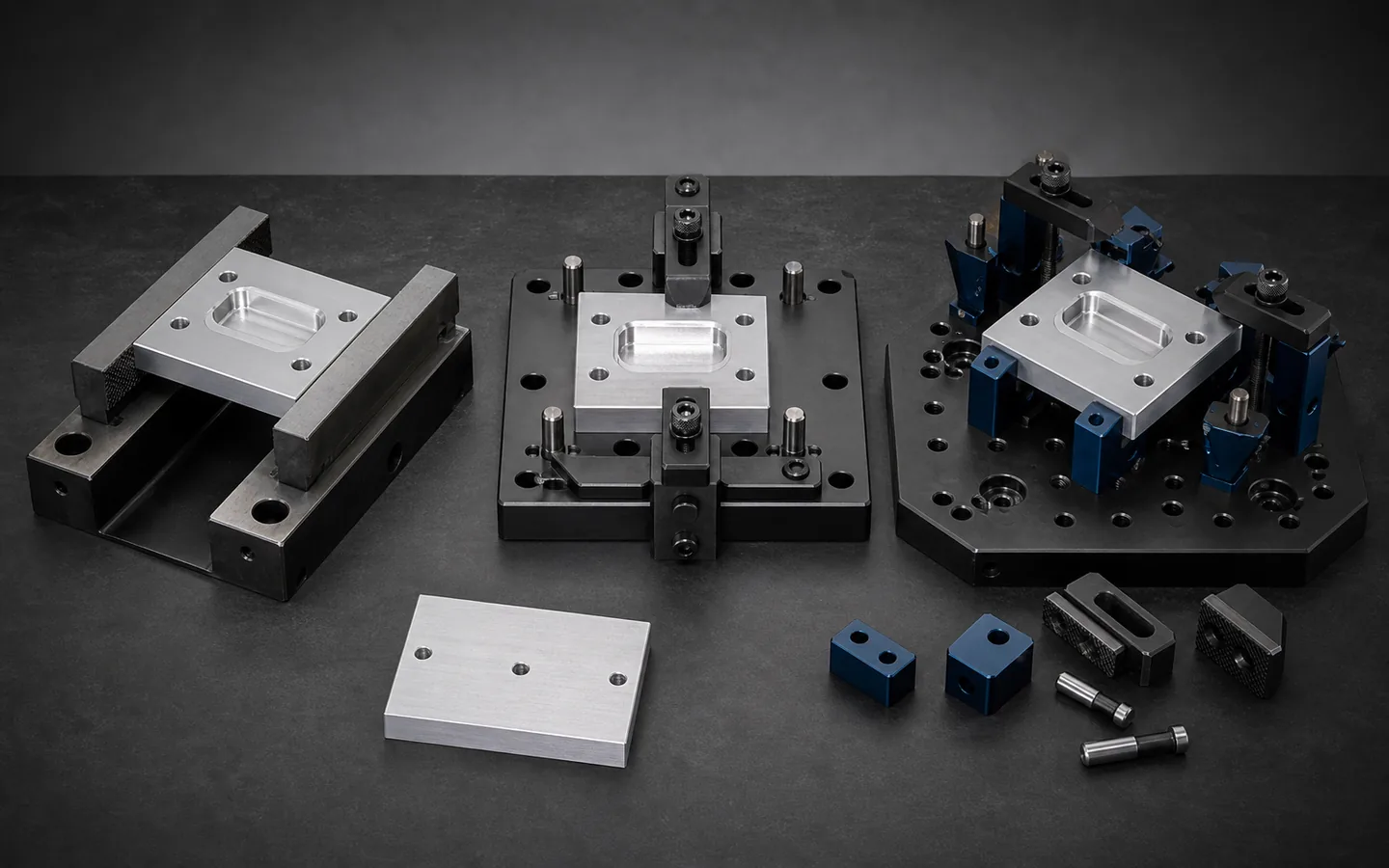
A reviewed route may use standard vise jaws, soft jaws, modular locating, a dedicated plate, tombstone, expanding mandrel, vacuum support or another compatible concept. The choice depends on part geometry, stiffness, access, cutting loads, chip evacuation, changeover, part variation, machine interface and repeat demand. Fixtures require their own revision, maintenance and change rules when they become controlled production assets.
Best-fit parts and programs
The fixture must make the intended datums, access and accepted part state more repeatable—not simply look specialized.
Use distributed support and controlled clamping when thin walls, plates or rings can move under load. Define the accepted free state and avoid forcing the part into geometry it cannot retain after release.
A dedicated fixture can reduce re-location or expose several faces when orientation relationships matter. Mark tool paths, protected surfaces, clamps, probing and chip-clearance needs before the concept is frozen.
Recurring quantities may justify controlled locating, faster changeover and retained setup knowledge. Compare expected releases and revision stability with fixture cost, storage, maintenance and replacement.
Modular or adjustable details may support related variants when datum logic and clamp envelope are shared. List the family range and prevent adjustment from hiding variant-specific support or collision risk.
Feasibility checks
Workholding becomes risky when it defines unintended datums, distortion or ownership assumptions.
Too many locators or clamps can create inconsistent seating and deform the part. Use a clear restraint strategy and identify which contacts establish datums versus support machining loads.
Clamps, screws, supports and fixture bodies must remain clear of cutters, spindles, probes and chip flow. Review the operation sequence rather than evaluating the fixture as a static holder.
A flexible part may inspect well while clamped and relax afterward. Define whether acceptance is free, restrained or assembled, and separate process support from the final-state requirement.
State who owns the fixture, where it is stored, what documentation is delivered, how maintenance is handled and whether design changes require modification, replacement or requalification.
Route options
The fixture route should balance engineering effort with access, repeat demand and part risk.
Use standard workholding or machined soft jaws when geometry, access and quantities permit. Record setup-critical contacts and any replacement-jaw controls needed for repeat work.
Use a purpose-built plate, nest, mandrel or other fixture when part control, access, deformation or changeover justifies it. Quote fixture design, build, prove-out and recurring use separately.
Use replaceable locators or adjustable details for a controlled family when shared datums and envelopes are real. Validate each variant and keep the fixture configuration revision-linked.
Decision comparison
Typical published practice for custom workholding. Achievable repeatability and the fixture's cost depend on part geometry, quantity and the supplier's standard tooling, and the project requirement is confirmed on the reviewed quote rather than from this table.
| Decision layer | Typical published value | Fixture consequence |
|---|---|---|
| Setup-to-setup error without a fixture | Each re-fixture typically adds around 0.05 mm of positional error between faces | The number a fixture exists to reduce |
| Fixture repeatability | A well-designed locating scheme repeats within about 0.01 to 0.02 mm across loads | Whether the part tolerance needs that repeatability at all |
| Locating principle | The 3-2-1 scheme constrains six degrees of freedom with three, two and one contact point | Over-constraining a part is what makes a fixture repeat badly, not under-constraining it |
| Datum alignment | The fixture should locate on the drawing's functional datums, not on whichever face is convenient | A mismatch between fixture datums and drawing datums shows up as an unexplained tolerance loss |
| Clamping deflection | Thin walls and unsupported spans deflect under clamping, and the part springs back when released | Where clamps and supports go, and whether soft jaws are required |
| Quantity threshold | Below roughly 10 parts, standard vices and soft jaws usually beat a dedicated fixture; above a few hundred, a fixture pays for itself in cycle time | The quantity stated so the trade can be made |
| Fixture material | Aluminium tooling plate for most work; steel where clamping loads or wear demand it, and hardened details at 58 HRC and above on wear points | Fixture life against fixture cost |
| Wear details | Locating pins and pads wear; replaceable hardened details extend fixture life without rebuilding it | Whether the fixture is a one-batch tool or a repeat asset |
| Chip clearance | A fixture that traps chips locates on chips, not on the part | Drainage and access designed in from the start |
| Multi-part fixtures | Holding several parts per cycle amortises setup, but a single crash scraps the whole load | Quantity, part value and cycle time together |
| Ownership and storage | Who owns the fixture, who stores it and who maintains it are commercial questions separate from its cost | Stated in the RFQ rather than assumed |
| Variant families | One fixture can hold a family of variants where the locating features are common across them | Which features are confirmed common across the family |
| Part tolerance context | A fixture is only worth its cost when the part needs tighter than the ±0.125 mm standard practice a vice already supports | Whether the tolerance justifies the tooling |
| Precision work threshold | ±0.025 mm on a relationship spanning two faces is where dedicated workholding usually becomes necessary | The named features that drive the fixture design |
| Locating pin fit | Dowel-located fixtures commonly hold their locating features to ±0.01 mm, which sets the repeatability ceiling | The fixture cannot repeat better than its own locating features |
| Ground locating surfaces | Reference faces ground to 0.005 mm flatness where the fixture must repeat across many loads | Whether the fixture needs grinding or machining is set by the part tolerance |
| Tooling plate thickness | 20 mm and 25 mm aluminium tooling plate covers most fixture bodies; steel where clamping loads demand it | Fixture rigidity against fixture mass and cost |
| Soft jaw alternative | Machined soft jaws hold roughly ±0.05 mm and cost a fraction of a dedicated fixture | The right answer for most low-quantity work |
Quote inputs
Provide the part and repeat context so the fixture solves the actual manufacturing problem.
Complete packages move faster: revision-matched CAD, critical dimensions, quantity and material notes are enough to open engineering review across the network.
Get a QuoteSubmit the controlled part model, drawing, revision and starting-stock condition
Identify functional datums, critical relationships and accepted free or restrained state
Mark machining access, protected surfaces, thin regions and distortion risks
State quantities, release cadence, family variants and expected design changes
Define whether the fixture supports machining, inspection, assembly or multiple operations
Request fixture price, ownership, storage, documentation, maintenance and change terms
Questions before routing
These answers prepare the request; the reviewed quote controls project-specific commitments.
No, and below roughly 10 parts a standard vice with soft jaws usually beats a dedicated fixture on total cost. Two things justify one: quantity, where the setup saving repays the fixture across a few hundred parts, and tolerance, where a relationship must hold tighter than the roughly 0.05 mm of positional error each re-fixture introduces. State quantity and the critical relationships and the answer is usually clear.
It should at least be raised there, because fixture and part design interact. A part with no accessible locating features, thin walls that deflect under clamping, or datums that cannot be reached in the required orientation is expensive to hold regardless of the machine. Mark the functional datums, state which walls are thin, and state the quantity so the workholding approach can be reviewed with the part rather than after it.
That is a commercial question and it needs stating rather than assuming. Ownership, storage, maintenance, replacement of worn locating details, and what happens if production moves to another supplier are all separate from the fixture's cost. State the expectation in the RFQ and it is reviewed and confirmed on the quote.
Often yes, where the locating features are genuinely common across the family — a shared datum face, a shared pair of locating holes, a shared outline. That is a design decision to make early: a family designed around common locating geometry shares one fixture, and one designed without it needs several. State which features are common across the variants and which are not.
Usually over-constraint or contamination. A locating scheme that constrains more than six degrees of freedom fights itself, and the part sits differently depending on clamping order — the 3-2-1 principle exists to prevent that. The other common cause is chips: a fixture that traps swarf locates on the swarf rather than the part. Both are design issues rather than operator issues, and both show up as unexplained variation of a few hundredths of a millimetre.
Next step
Send geometry and process requirements for review. MakeNexa routes capable suppliers from a global network covering competitor-class process categories, then returns a prepared quote or focused clarification for your revision.